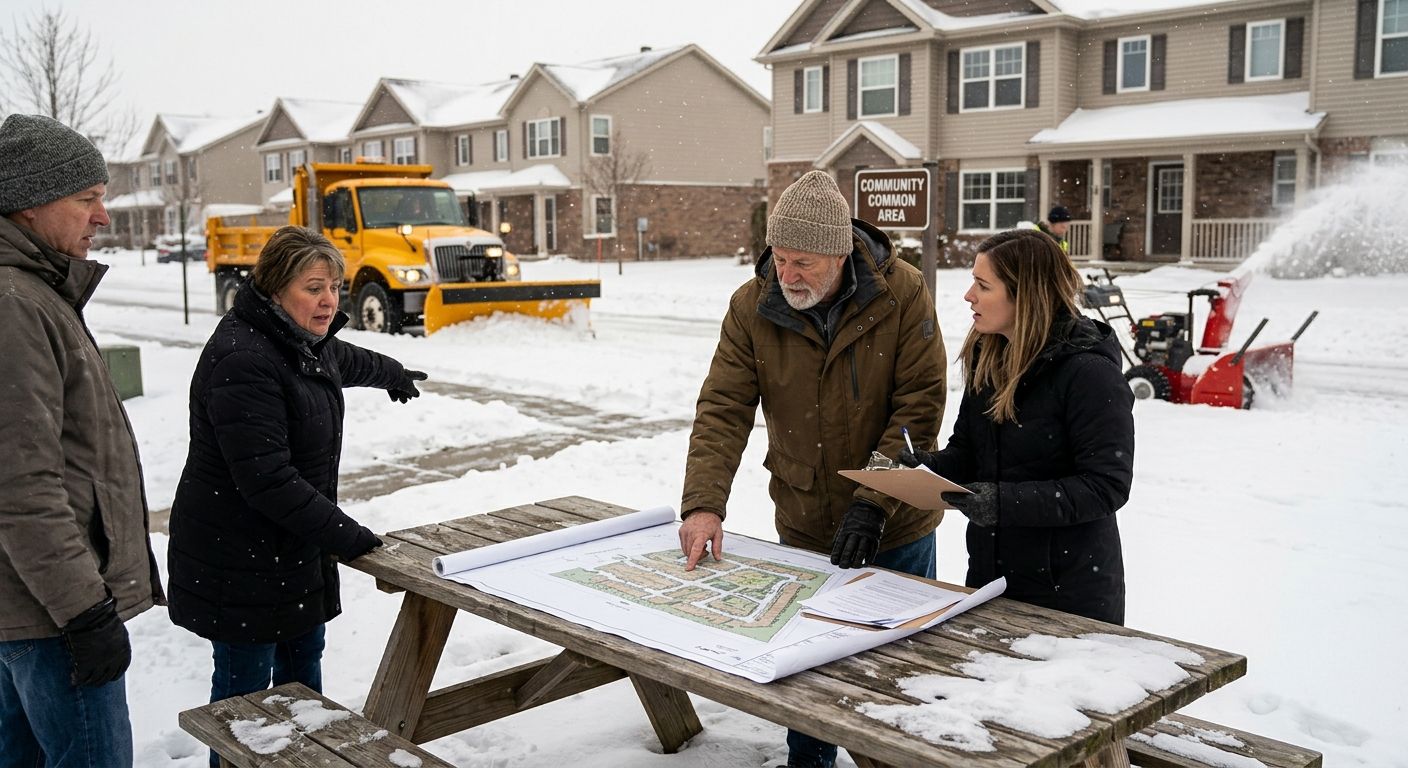
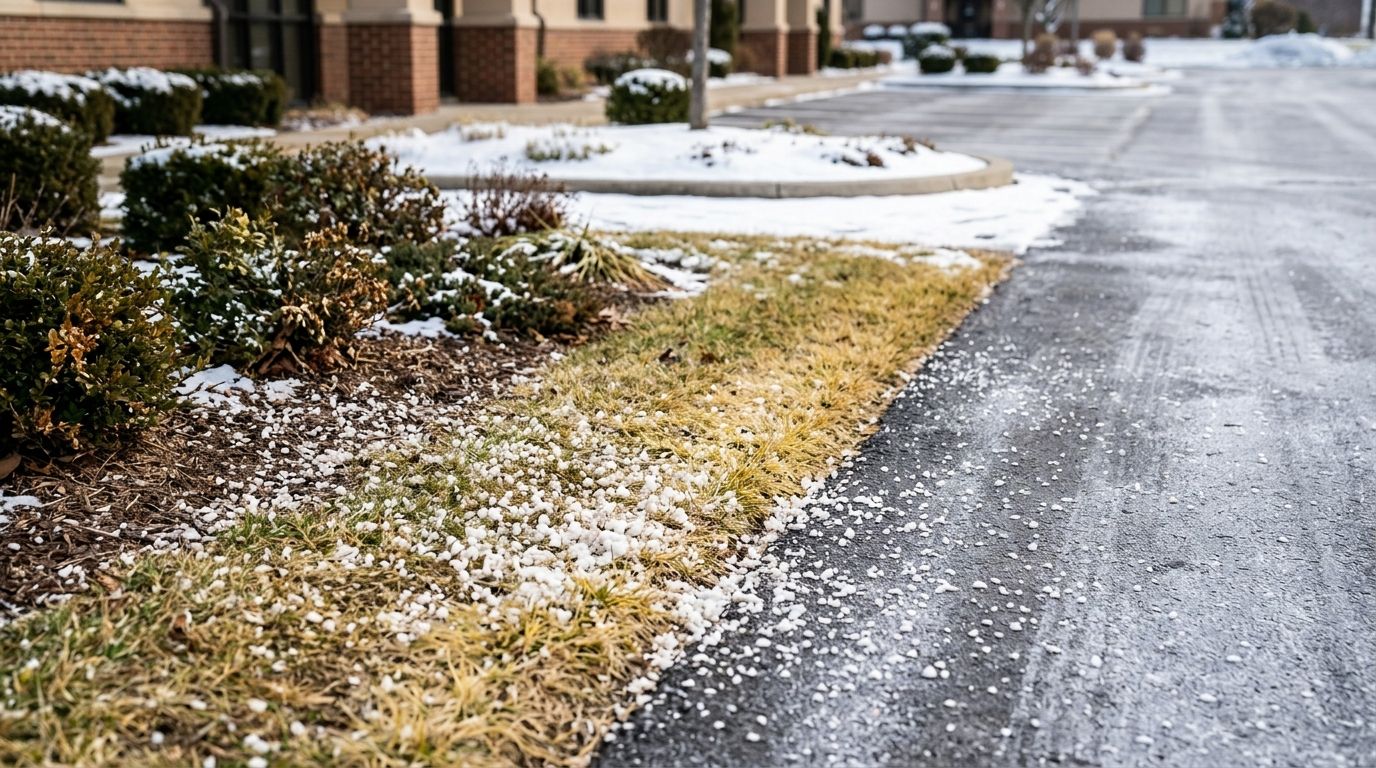
De-icing salt damages grass and landscaping near a parking lot, and the injury shows up as brown, dead turf bands within a few feet of treated pavement, usually visible by late winter or early spring 2026. The bigger hidden cost isn't the dead grass itself — it's chloride that lingers in the soil for one or more seasons after the snow melts, which is why the same strip of turf can look worse the second winter than the first.
- De-icing salt damage to grass and landscaping concentrates within 3 to 6 feet of treated pavement in most cases.
- Sodium chloride (rock salt) carries the highest plant-damage risk of common de-icers; CMA and potassium-based products carry the lowest.
- Over-application, not de-icer choice alone, drives most salt damage on commercial lots.
- Chloride does not break down in soil — poor drainage lets it linger and stunt spring green-up.
- St. Louis Snow Removal applies documented, rate-based salting rather than guessing volume by eye.
Why this matters
Property managers who over-salt a lot to avoid a slip-and-fall claim often trade one liability for another: dead turf, stressed shrubs, and a landscaping bill that shows up months after the storm. Chloride ions from de-icing salt interfere with a plant's ability to take up water through its roots, which is the same mechanism that makes salt effective against ice in the first place. The damage is preventable, but only if the application rate is measured rather than eyeballed — see the salt application rate benchmarks for what a correctly dosed 1,000 sq ft section actually looks like.
Most salt damage complaints in 2026 trace back to one of two causes: a crew salting the full width of a lot when only drive lanes needed it, or plowed snow piled directly on top of planting beds all winter. Both are operational choices, not inevitable outcomes of using salt at all.
Can de-icing salt damage grass and landscaping near a lot?
Yes. Sodium chloride, the cheapest and most common de-icer, pulls water out of root cells and disrupts nutrient uptake in turfgrass, shrubs, and trees planted near treated surfaces. The damage pattern is predictable: a band of browned or thinned turf running parallel to curbs, sidewalks, and drive lanes, worst where snowmelt or plow spray concentrates.
| De-icer | Effective to (approx.) | Landscape damage risk | Best for | |---|---|---| | Sodium chloride (rock salt) | 15-20°F | High — chloride burn on turf and shallow roots | Wide-buffer lots on a tight budget | | Calcium chloride | -20 to -25°F | Moderate-high — still chloride-based | Deep-cold events when rock salt stops working | | Magnesium chloride | around 0°F | Moderate — lower chloride load per cycle | Properties with sensitive plantings near pavement | | Calcium magnesium acetate (CMA) | around 20°F | Low — no chloride, minimal plant toxicity | HOAs and properties with heavy landscaping investment |
Verdict: sodium chloride is the highest-risk, lowest-cost option for landscaping — CMA is the lowest-risk, highest-cost option. Most commercial lots land somewhere between the two depending on the value of what's planted near the pavement.
Why salt damage to grass varies from one site to the next
- Application rate — over-salting is the single biggest preventable cause of landscape damage; correct rates cut the chloride load reaching root zones
- Drainage and slope — poor drainage lets chloride sit in the root zone instead of flushing out with spring rain
- Plant species tolerance — turf varieties like tall fescue handle salt better than Kentucky bluegrass, and shrubs like yews and boxwood are especially chloride-sensitive
- Distance from treated pavement — splash and runoff concentrate damage within the first few feet of curbs and sidewalks
- Snow-pile placement — plowed snow loaded with salt, pushed onto beds or turf all winter, delivers a concentrated dose in one spot
- Freeze-thaw cycling — repeated freezing and thawing pushes chloride deeper into soil layers over the course of a season
A documented salting program addresses most of these factors directly. St. Louis Snow Removal logs application rates per visit rather than salting by feel, which is the difference between a lot that gets the salt application rate benchmarks treatment and one that gets whatever fits in the spreader that trip. For office campuses with landscaped courtyards and entry plantings, the same logic applies at a larger scale — see the de-icing and salting guide for office campuses for how application zones get mapped around plant beds.
Does over-salting also damage the parking lot pavement itself?
Yes, and the mechanism is different from plant damage but related in cause — repeated freeze-thaw cycling driven by chloride penetration can accelerate surface scaling on concrete specifically, more so than on asphalt. The full breakdown of which surfaces are at risk and why is covered in can de-icing salt damage concrete or asphalt surfaces.
Can salt-damaged grass recover on its own?
Yes, mildly salt-stressed turf usually recovers once spring rain flushes chloride out of the root zone, typically greening back up within 4 to 8 weeks of consistent rainfall. Severely burned turf — where the grass crown itself has died, not just the blades — will not recover and needs reseeding or sod replacement rather than time.
Are eco or pet-safe de-icers actually less damaging to landscaping?
Calcium magnesium acetate (CMA) and potassium-based products carry a genuinely lower plant-damage risk than sodium chloride because they don't deliver the same chloride load per application. They cost more per pound and work at a narrower temperature range, which is why most commercial contracts use them selectively near sensitive plantings rather than across an entire lot.
Get a documented salting plan
Rate-based application logs, not guesswork by the spreader.
FAQ
What does de-icing salt damage look like on grass?
Salt-damaged grass shows up as brown or tan, scorched-looking turf running in a band along curbs, sidewalks, and drive lanes. Healthy green turf is often visible just a few feet further from the pavement edge, which is the giveaway that salt, not disease or drought, caused it.
How far from a parking lot does salt damage spread?
Salt damage concentrates within roughly 3 to 6 feet of treated pavement in most cases, driven by splash, plow spray, and runoff. Wind-blown salt spray can extend the damage zone further along heavily trafficked drive lanes.
Which de-icer is safest for landscaping?
Calcium magnesium acetate (CMA) carries the lowest plant-damage risk of common de-icers because it contains no chloride. Rock salt (sodium chloride) carries the highest risk and is also the cheapest, which is why most sites use it broadly and switch to CMA only near sensitive beds.
Can salt-damaged turf grow back in spring?
Mildly stressed turf typically recovers within 4 to 8 weeks once spring rain flushes chloride from the root zone. Turf where the crown has died outright will not recover and needs reseeding.
Does the amount of salt applied matter more than the type used?
Application rate is the bigger factor in most damage cases — a lot over-salted with a low-risk de-icer can still burn turf, while a correctly dosed application of rock salt does less damage than an over-applied one. Rate control matters more than brand or chemistry alone.
Is calcium chloride better for landscaping than rock salt?
Calcium chloride still contains chloride and carries a moderate-to-high plant-damage risk, only somewhat lower than sodium chloride. Its main advantage is working at much colder temperatures, not lower landscape risk.
How can property managers reduce salt damage near planting beds?
Reducing application rate near beds, directing plowed snow away from landscaping, and using a lower-chloride de-icer selectively in sensitive zones cuts most of the damage. Documented, rate-based salting logs make it possible to verify this actually happened after the fact.
Does snow pile placement affect salt damage to grass?
Yes — plowed snow loaded with salt, pushed onto turf or beds and left there all winter, delivers a concentrated chloride dose to that one spot. Directing snow piles toward pavement or low-value turf areas instead of landscaped beds limits the damage.
One last thing
Chloride doesn't break down in soil the way organic matter does — it just sits there until rain or irrigation flushes it out, which means a poorly drained bed can carry elevated salt levels well into a second or third winter even if application rates improve. The fix isn't switching de-icers entirely; it's pairing a measured application rate with attention to where plowed snow actually lands.