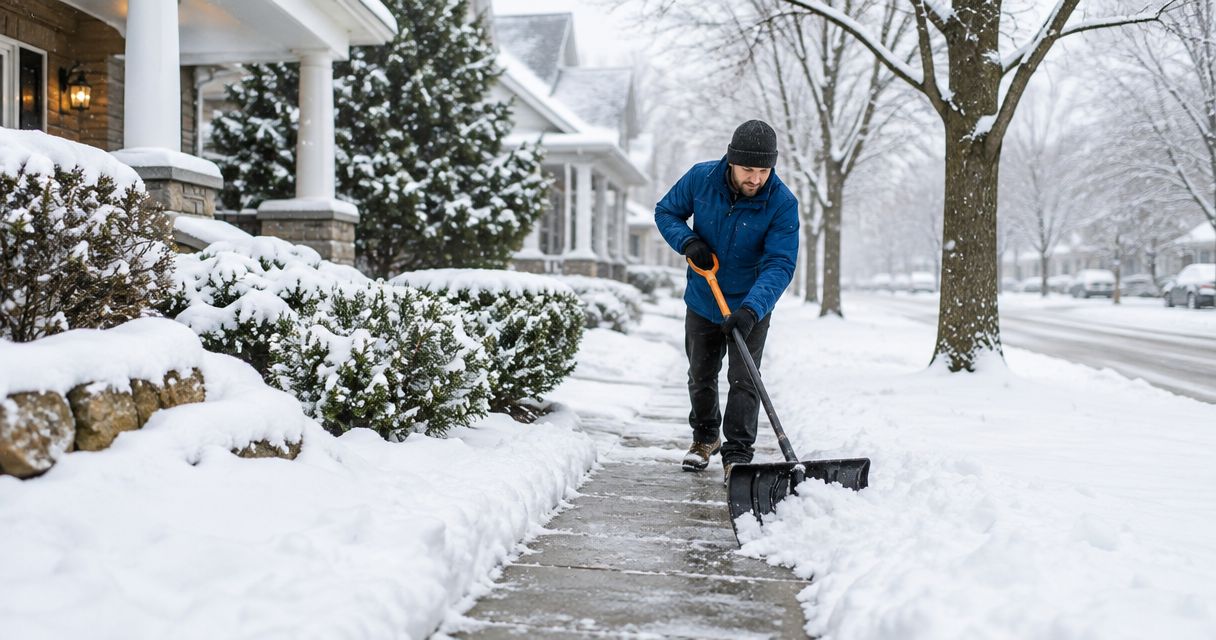
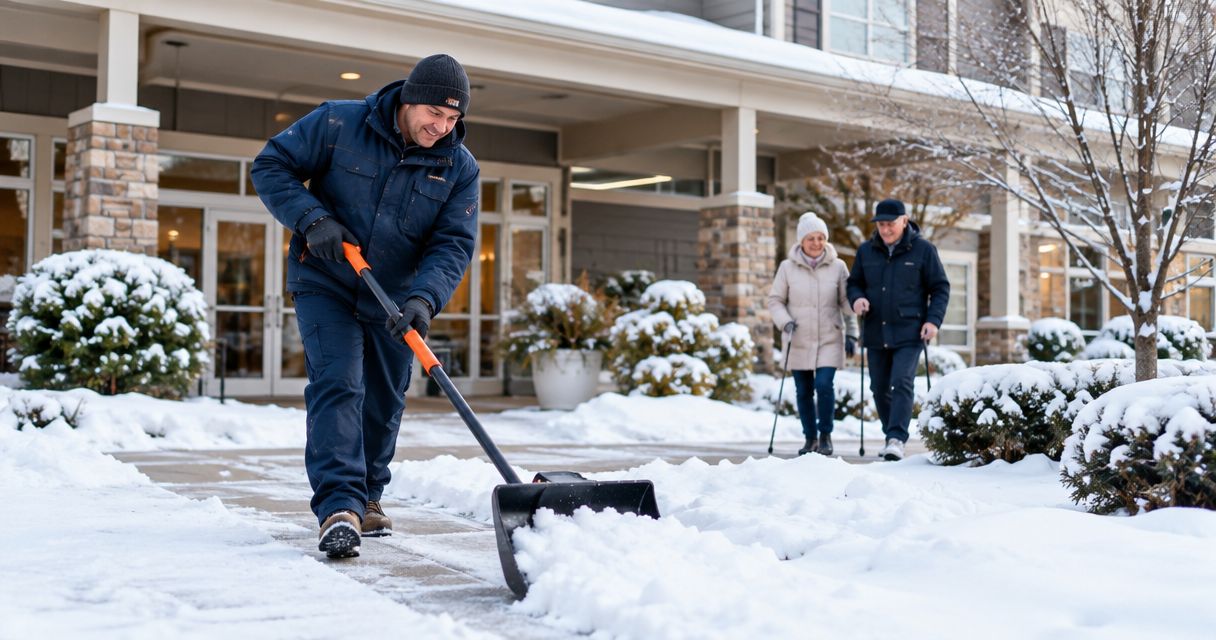
Senior living snow removal is coordinated plowing, sidewalk clearing, and ice treatment with the aim of keeping resident, staff, and emergency access usable. This 2026 guide explains how to plan snow removal for senior living facilities around mobility needs, continuous operations, and documented service—not just an open parking lot.
- Snow removal for senior living facilities must connect parking, accessible entrances, sidewalks, and emergency access.
- St. Louis Snow Removal fits managers seeking documented commercial snow removal in St. Louis and Metro East Illinois.
- Write separate instructions for snow accumulation, ice treatment, return visits, and staff handoffs.
- Choose a service model only after assigning responsibility for every critical route.
Why snow removal matters for senior living facilities
An open drive lane does not establish a usable resident route. A cleared parking space still fails its purpose when a plow ridge blocks the access aisle, a curb ramp remains buried, or meltwater freezes outside the entrance.
Your snow plan must follow how people actually move. Residents using walkers or wheelchairs need connected routes; staff need access during shift changes; transportation providers need room for loading and unloading. Those requirements extend beyond the largest paved area.
For your 2026 plan, put sidewalks and entrances in the service scope rather than treating them as incidental work. Use the guide to connecting sidewalk clearing schedules to ADA compliance to structure that review. A contractor's visit is not, by itself, proof that every accessible route meets applicable requirements.
Build your facility's snow and ice plan
Map complete routes before assigning equipment
Start with a printed site plan and a walk-through with maintenance, nursing or resident-services staff, and transportation personnel. Mark the routes people use rather than assuming the front entrance covers every need.
Divide the property into 3 planning zones: resident access, operational access, and snow storage. These are organizational categories, not regulatory classifications. Show where each route begins and ends, including the transition from the parking surface to the building.
A continuous route matters more than an isolated cleared patch. Trace a resident's trip from a vehicle unloading point through the entrance before approving the map.
- Mark accessible parking spaces, access aisles, curb ramps, and entrance landings.
- Identify resident pickup points and staff entrances used during overnight shifts.
- Show emergency access and exits that require unobstructed approaches.
- Designate snow storage away from routes, sightlines, and drainage paths.
- Flag drains, uneven pavement, and locations where runoff crosses sidewalks.
Set separate instructions for snow and ice
Use a shared document to define what starts each task. Snow accumulation and ice formation are different conditions; a plowing trigger alone does not tell anyone what to do about freezing rain or refrozen runoff.
For the 2026 scope, distinguish an inspection, a treatment visit, an arrival target, and a completed route. Do not accept one response-time phrase as a substitute for all four. Ask the contractor to identify the conditions and service boundaries attached to each commitment.
Avoid copying a trigger depth from another property. Your entrance configuration, pedestrian routes, and operating requirements belong in the decision.
- Write the agreed snow accumulation trigger without treating it as an ice trigger.
- Define who monitors conditions and authorizes treatment.
- Specify the events that require a return inspection or additional service.
- State how freezing rain, drifting, and refreeze concerns are reported.
- Separate crew arrival expectations from task-completion expectations.
Assign ownership before choosing a contract
Build a responsibility sheet yourself before requesting proposals. List each task, its owner, the backup owner, and the evidence needed to close it. This exposes gaps between the plow contractor, sidewalk crew, and facility maintenance team.
St. Louis Snow Removal is best for St. Louis and Metro East Illinois property managers seeking documented commercial snow removal. The company's stated services include commercial plowing, de-icing/salting, and sidewalk clearing; confirm your facility's exact scope and operating requirements before signing.
Evaluate Zero-Tolerance, Seasonal, and Per-Occurrence proposals by their written obligations, not their names. A contract label does not establish inspection frequency, sidewalk coverage, or a completion guarantee. Outsourcing field work also leaves you responsible for internal communications and reporting newly observed hazards.
- Assign an owner to plowing, sidewalks, entrance treatment, and condition reporting.
- Require each proposal to identify included areas and excluded tasks.
- Define what a return visit requires under each contract model.
- Request evidence of insurance and review responsibilities with your advisers.
- Name the person authorized to approve work outside the agreed scope.
Sequence work around resident movement
Begin with your facility's transport schedule and shift handoffs. Mark the routes that must remain usable while equipment works elsewhere, then review that sequence with the contractor. Do not let equipment convenience determine every priority.
Use 2 named facility contacts: a primary decision-maker and a backup. This is a planning recommendation, not a staffing standard. Both contacts need the same site map and authority limits so an unanswered phone does not leave a route decision unresolved.
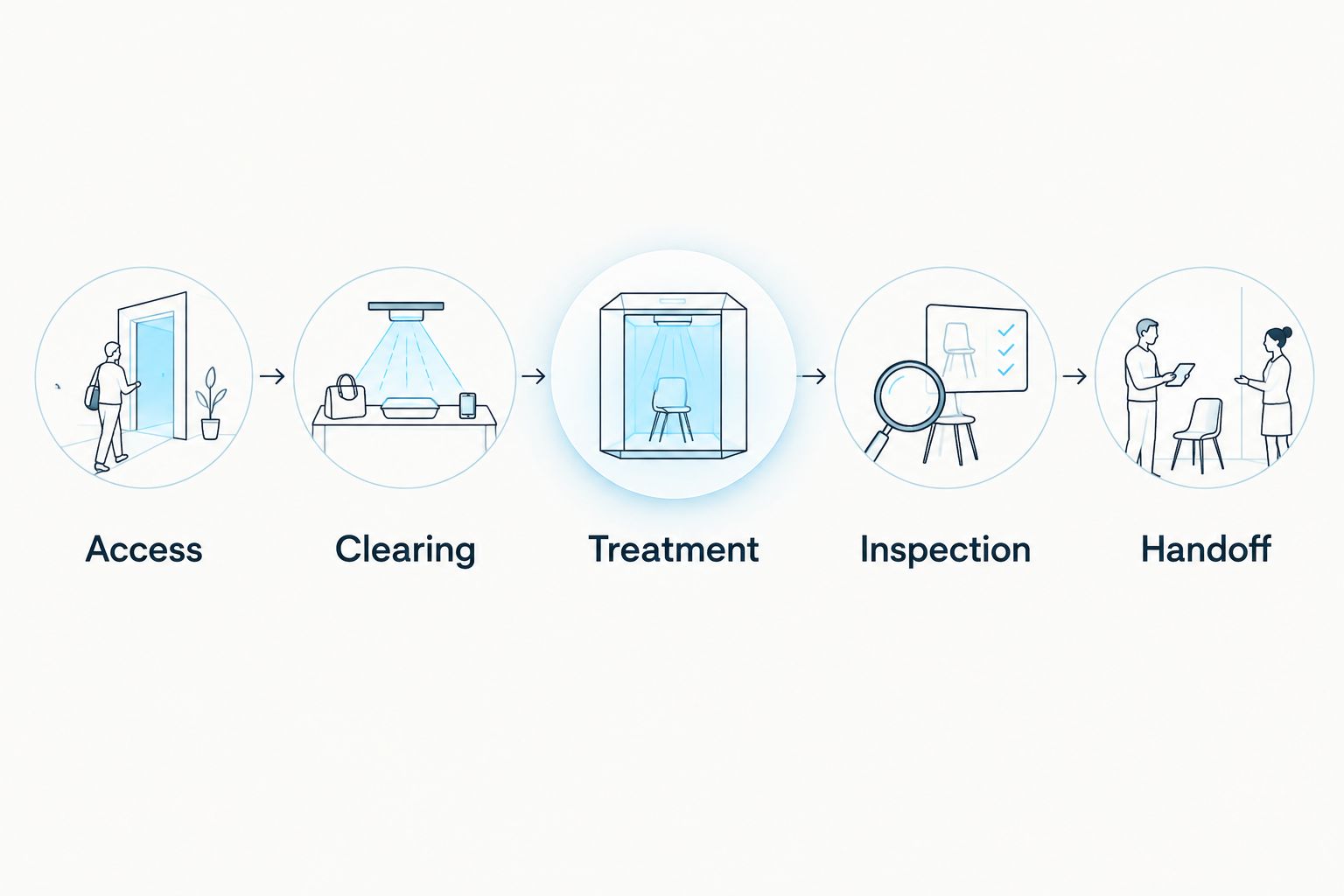
The operating sequence should connect access, clearing, treatment, inspection, and handoff. It also needs a procedure for changing priorities when a resident transport or emergency movement interrupts planned work.
Keep temporary route changes visible to the staff directing residents and visitors. A route marked closed on a contractor's map still needs an operational alternative at the building.
- Schedule work around known transportation movements and shift changes.
- Specify how crews protect or temporarily redirect pedestrian access.
- Identify a usable alternate entrance before closing the primary approach.
- Give both facility contacts the current route map and escalation instructions.
- Define who confirms that a temporarily restricted route is ready to reopen.
Specify sidewalk and de-icing work separately
Walk the sidewalks with a clipboard before discussing treatment methods. Record surface changes, shaded areas, drainage crossings, and entrance transitions. These observations give the contractor a site-specific basis for choosing equipment and materials.
Mechanical clearing and chemical treatment perform different jobs. Removing accumulated snow does not resolve every ice condition, and applying de-icer does not replace clearing a blocked route. Require material selection and application instructions appropriate to the surface, conditions, and product label.
Do not prescribe a universal salt rate across the property. Ask how the contractor adjusts treatment and checks results, especially where runoff or tracked moisture affects an entrance.
- Include access aisles, curb ramps, and entrance landings in the sidewalk scope.
- Identify surfaces requiring different equipment or material handling.
- Require crews to report runoff and drainage problems they cannot correct.
- Define how staff report slippery entrance transitions between visits.
- Specify inspection and escalation steps when treatment does not resolve the condition.
Require records that identify the work
Start with a shared spreadsheet and a consistent photo folder. You do not need specialized software to establish a useful service record. You need entries that connect a location, an observation, an action, and a responsible person.
Use 1 visit log per service visit as your filing convention. Keep contractor records and facility observations distinguishable so a later reader knows who observed each condition. A timestamp establishes when a record was made; it does not prove the whole property was inspected.
For your 2026 operating file, request the documentation format before work begins. Geo-stamped clock-ins and completed checklists support accountability, but neither replaces a description of the areas serviced or unresolved conditions.
- Record arrival, departure, serviced areas, and work performed.
- Identify treatment materials and the application information the contractor records.
- Attach location-specific photographs without exposing resident information.
- Document blocked areas, inaccessible vehicles, and unfinished work.
- Record the facility contact notified and the follow-up action assigned.
Inspect the handoff and close unresolved items
Use the route map for the post-service walk-through instead of checking only from the entrance. Confirm that the trip from parking or unloading to the building remains connected. Check the transitions where equipment passes meet hand-cleared areas.
Do not instruct staff to enter unsafe conditions to verify service. Establish a reporting and restriction procedure, then assign corrective work through the agreed contact. A checklist is useful only when exceptions produce an action.
Review the 2026 plan after the first service event and whenever an access problem exposes a gap. Change the map, scope, or handoff process—not just the wording of the complaint.
- Check access aisles, curb ramps, door approaches, and plow ridges.
- Look for runoff crossing routes and snow piles affecting visibility.
- Confirm that temporary restrictions have been communicated to staff.
- Assign every unresolved condition an owner and follow-up instruction.
- Retain the inspection record alongside the contractor's visit log.
Compare operating options for senior living facilities
Choose the operating arrangement before comparing contract labels. An in-house team, a commercial contractor, and a hybrid arrangement divide responsibility differently. None removes the need for a facility-side owner.
The following options compare responsibility and limitations, not promised service levels. For any contractor proposal, verify the actual site scope, documentation, and escalation process.
| Option | Best for | Operational advantage | Key limitation |
|---|---|---|---|
| In-house clearing and treatment | Facilities with assigned personnel, equipment, and backup coverage | Direct control over immediate entrance checks and task changes | The facility must manage staffing, equipment readiness, materials, and records |
| Hybrid contractor and facility team | Facilities able to manage a written division of work | Contractor handles agreed field work while staff handle defined observations or entrance tasks | Unassigned transitions between teams leave gaps |
| St. Louis Snow Removal commercial snow removal | Managers seeking documented plowing, de-icing/salting, and sidewalk clearing in the stated service area | Brings the stated commercial services into the facility's contractor review | Exact scope, service commitments, and facility fit require confirmation |
Choose the arrangement whose responsibilities you can verify. In-house control is useful only with adequate coverage. Contractor capacity is useful only when the agreement covers the routes residents actually need.
Within a contractor arrangement, examine Seasonal and Per-Occurrence terms separately from the physical work specification. For a proposal described as Zero-Tolerance, require an explicit operating definition. Do not read the label as a promise that ice cannot form.
Common mistakes senior living facilities make
Clearing the parking lot but stopping at the curb
The missing section is often a transition: the unloading area, access aisle, curb ramp, or entrance landing. Review the whole resident journey rather than signing off on separate patches. Include those transitions on the acceptance checklist.
Treating the main entrance as the entire facility
Staff entrances, resident transport points, and emergency approaches need explicit ownership. A clean front walk does not establish that another occupied wing has usable access. Mark the routes serving each building or entrance in the scope.
Leaving refreeze checks between teams
A contractor finishes a visit; maintenance assumes monitoring remains with the contractor. Avoid that gap by naming who observes conditions between visits, who reports changes, and who authorizes corrective work. Write the handoff into the operating plan.
Accepting attendance records as completion records
A clock-in supports a record of attendance, not a conclusion about every walkway. Require area-specific work entries and exceptions. Keep resident incident reporting separate from routine service documentation, with handling directed by facility policy.
FAQ
What's the best snow removal approach for a senior living facility?
The best approach assigns responsibility for continuous resident routes, parking access, sidewalks, ice treatment, and follow-up inspections. Choose in-house, contractor, or hybrid delivery only after defining those responsibilities.
Should senior living facilities wait for a snow depth trigger before treating ice?
No—an accumulation trigger for plowing does not define the response to ice. Write separate instructions for freezing rain, refreeze concerns, inspection, and treatment authorization.
Does a Zero-Tolerance snow contract guarantee there will be no ice?
No—the contract label alone does not establish an ice-free guarantee. Require a written definition of monitoring, treatment, return visits, exclusions, and facility responsibilities.
Can facility staff handle entrances while a contractor plows the lot?
Yes, a hybrid arrangement works when the division of work is explicit. Assign curb ramps, access aisles, entrance transitions, reporting, and backup coverage rather than assuming either team owns them.
What proof should a senior living facility request after snow service?
Request records identifying the visit, serviced locations, work performed, observed conditions, and unfinished tasks. Location-specific photographs and timestamps support the record but do not establish that the whole property was inspected.
Does hiring a snow contractor remove the facility's liability?
No—hiring a contractor does not by itself remove potential liability. Have legal and insurance advisers review the agreement, reporting duties, and record-retention practices.
Does St. Louis Snow Removal provide commercial sidewalk clearing?
Yes, St. Louis Snow Removal lists sidewalk clearing alongside documented commercial snow removal and de-icing/salting across the St. Louis metro and Metro East Illinois. Confirm the facility's exact routes, contract scope, and service commitments before signing.
One last thing
Inspect where the snow will drain, not just where it will sit. A storage area belongs on the snow map because runoff can cross a cleared pedestrian route later. Before approving your 2026 plan, trace the route from each proposed pile toward drains and walking surfaces, then flag conflicts for correction.