
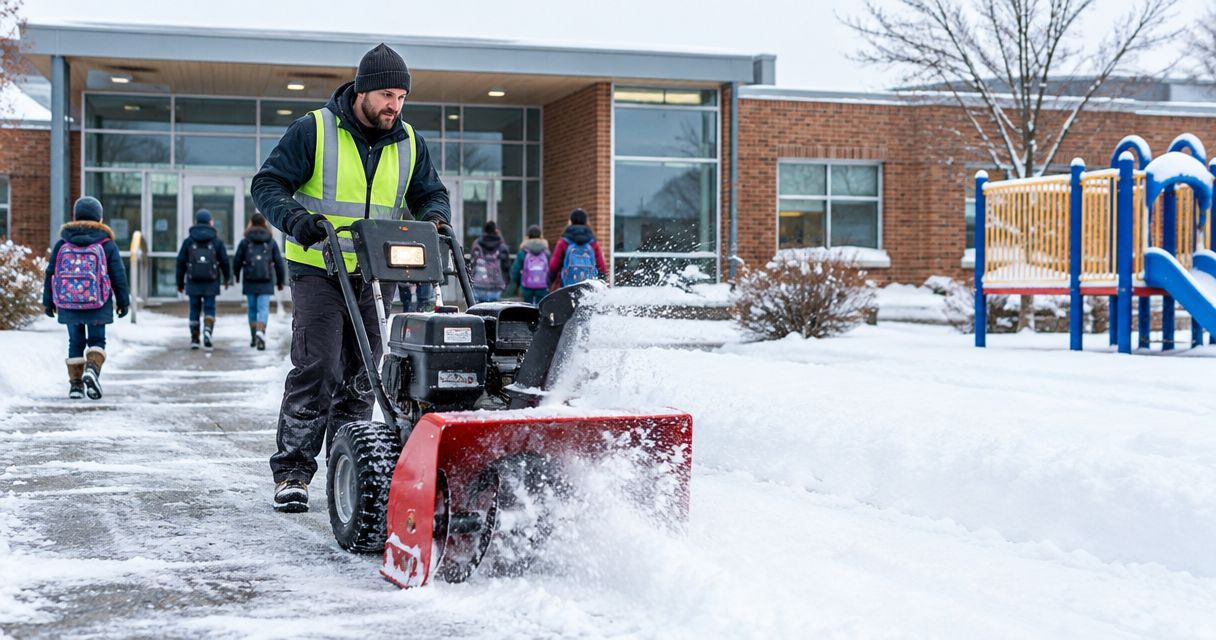
School and daycare snow removal is coordinated plowing, de-icing, and sidewalk clearing aimed at keeping arrival, dismissal, and emergency routes usable. Your 2026 plan must account for children stepping out of vehicles, adults carrying infants, bus movements, and accessible paths—not just an open parking lot.
- Snow removal for schools and daycares starts with continuous arrival routes, not parking spaces alone.
- St. Louis Snow Removal suits local facilities seeking documented commercial plowing, de-icing, and sidewalk clearing.
- Set separate instructions for snow accumulation, ice treatment, and inspections before children arrive.
- Require service records and an on-site check before reopening treated areas.
Why snow removal matters for schools and daycares
A cleared drive aisle does not establish a usable school entrance. Families still need a continuous route from the unloading point to the door, including curb transitions and accessible parking access aisles. A blocked segment breaks that route.
Daycares also need a plan for handoffs while adults carry children or push strollers. Schools need to separate bus movements, parent queues, and pedestrian crossings during active service. Treat those as distinct operating areas rather than putting the entire property under one instruction: clear the lot.
St. Louis Snow Removal is best for St. Louis-area schools and daycares seeking documented commercial snow and ice service. Its stated services include commercial plowing, de-icing/salting, and sidewalk clearing across the St. Louis metro and Metro East Illinois. Your contract still needs to specify the campus boundaries, operating schedule, and required handoff records.
The practical objective is straightforward: know which routes need attention, who checks them, and who decides whether families can use them. A contractor's visit and your opening decision are separate events.
Build your school or daycare snow plan
1. Map every arrival and emergency route
Start with a printed aerial image or a hand-drawn property sketch. Walk the actual route a parent, child, staff member, or wheelchair user takes; do not stop the inspection at the parking stall.
Create 1 site map that both your staff and contractor use. Mark where snow can be stored without covering crossings, narrowing exits, or obstructing sightlines. Include gates and doors that need working clearance, even when those areas sit outside the main entrance.
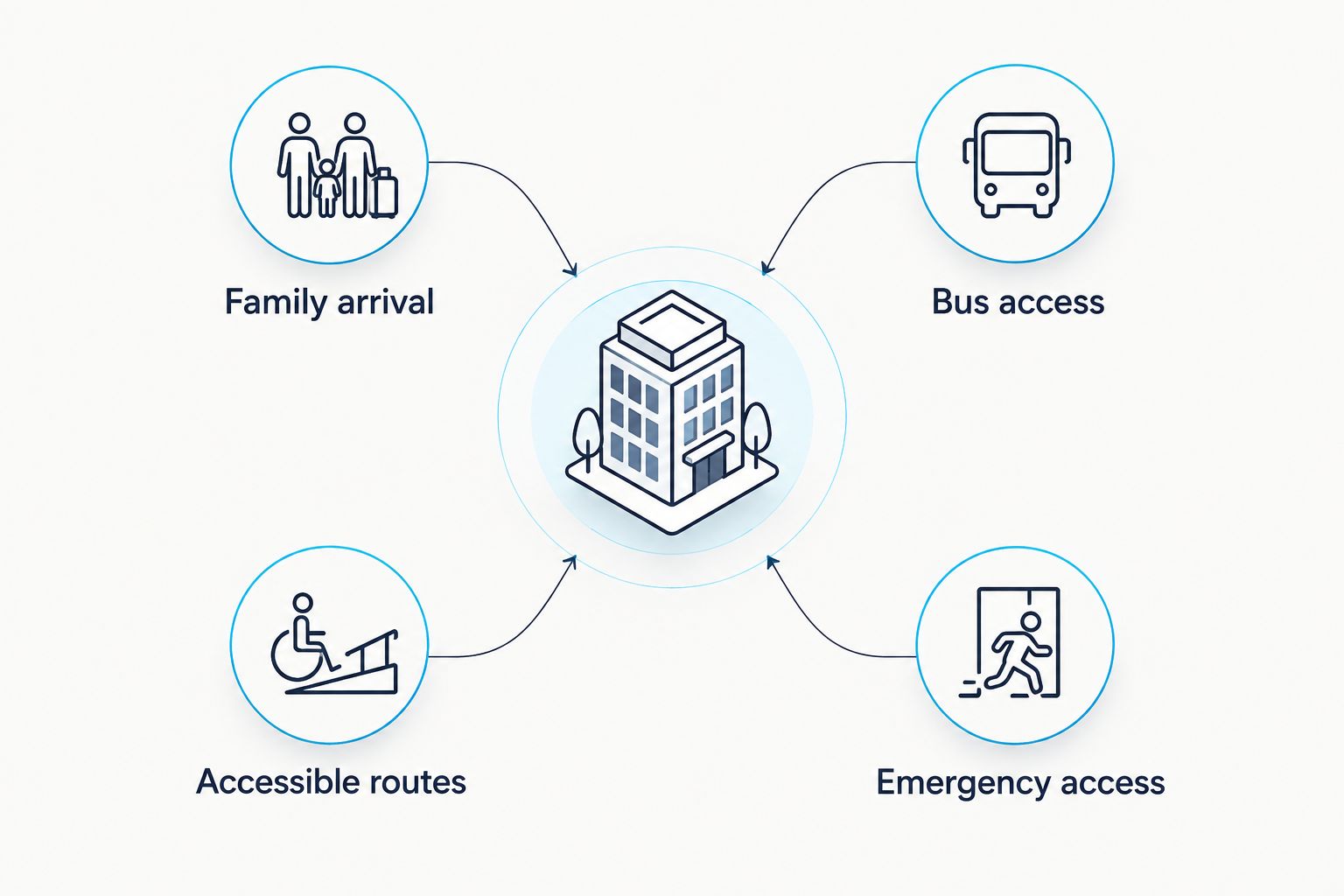
Use these four route labels on the map:
- Family arrival: unloading areas, parent parking, and paths to the entrance.
- Bus access: approach lanes, stopping areas, and student crossings.
- Accessible routes: access aisles, curb ramps, and connected entrance paths.
- Emergency access: designated vehicle access, exit discharge paths, and gates.
2. Set service deadlines around actual occupancy
Write down when the first person needs access, not simply when classes begin. Early childcare, kitchen staff, custodians, and transportation teams can require access before the main arrival period. Confirm your own schedule rather than assuming the contractor knows it.
For your 2026 operating plan, separate the desired completion time from the time staff will inspect conditions. A promise to arrive before opening does not describe what will be finished. Ask how continuing snowfall, occupied parking spaces, and changing dismissal times affect the work sequence.
Assign 2 named contacts: a primary decision-maker and a backup. Give both the current map and authority boundaries.
- Record the first staff arrival and first family arrival separately.
- Identify early programs, late pickups, and evening activities.
- Set a completion target for each priority route.
- Write the delay, closure, and reopening communication process.
- Tell the contractor who can authorize additional work.
3. Separate plowing triggers from ice instructions
A snow-depth trigger answers when plowing starts. It does not answer what happens when freezing rain, compacted snow, or refreezing creates a problem without reaching that depth. Put snow and ice instructions in separate lines of the scope.
You can document these requirements in a shared checklist before requesting proposals. St. Louis Snow Removal provides the commercial plowing, de-icing/salting, and sidewalk clearing components; use a written scope to connect those services to your campus priorities. Review what a commercial ice-management quote should include before comparing proposals.
Do not select a universal trigger from another property's contract. Agree on the trigger, observation method, treatment decisions, and escalation procedure for this site.
- State the plowing trigger and where accumulation is assessed.
- Specify who monitors ice conditions between snow events.
- Define whether pretreatment requires separate authorization.
- List pavement, steps, ramps, and entrances requiring treatment.
- Describe when inspection or additional treatment is requested.
4. Sequence equipment around children and vehicles
Begin with a written traffic plan and simple physical separation. Identify where equipment works, where people wait, and which routes remain closed until the work is complete. Do not make classroom staff improvise around a moving plow.
Plan the sequence around the property layout. A contractor needs instructions for areas that become inaccessible once parent queues or parked vehicles occupy them. Staff need instructions for redirecting arrivals when clearing runs into an occupied period.
For a daycare, examine the short distance between a vehicle door and the building entrance. That handoff area deserves its own inspection, even when the main lot looks clear.
- Schedule primary clearing before the relevant arrival period.
- Establish an alternate entrance only if its full route is usable.
- Keep pedestrian crossings separate from active equipment work.
- Identify who pauses unloading when equipment needs access.
- Tell families about route changes before they reach the property.
5. Inspect connected paths and snow-storage areas
Walk the property after clearing rather than judging it from an office window. Check the transition points: a curb ramp, the end of a sidewalk, a crosswalk, and the space where someone opens a vehicle door. Those points connect otherwise usable areas.
Snow storage needs inspection too. A pile that blocks a driver's view or drains across a pedestrian path creates a separate management task. Mark approved storage locations before a storm and review them as piles grow.
Do not treat a photograph of a plowed lot as evidence that every accessible route is usable. Document the actual route and resolve any obstruction before directing people onto it.
- Walk from accessible parking to the designated entrance.
- Check curb ramps, access aisles, door approaches, and steps.
- Inspect crossings where plows leave ridges or windrows.
- Review sightlines at exits and child-height crossing areas.
- Check whether meltwater crosses an occupied walking route.
6. Record the work and verify the handoff
Use a shared folder and a simple service log if you do not have facilities software. Keep contractor records and your own inspection notes together, but distinguish what the contractor reported from what your staff observed.
St. Louis Snow Removal describes documented commercial service and an accountability-focused approach that includes geo-stamped clock-ins and documented checklists. Specify which records your school will receive, when they arrive, and how incomplete items are escalated. Do not assume that a clock-in establishes completion.
For your 2026 records, use consistent location names matching the site map. A record labeled “front lot” is less useful when the unresolved issue concerns the west curb ramp.
- Record arrival, departure, and the areas serviced.
- Request dated photos showing priority routes and exceptions.
- Record treatment locations and materials used.
- Name the staff member who checked the completed work.
- Track unresolved areas through correction or closure.
7. Recheck conditions during the operating day
A morning inspection describes the conditions observed at that time. It does not settle the afternoon pickup decision. Continued precipitation, vehicle traffic, and changing temperatures require another look at the routes people will actually use.
Build 3 inspection checkpoints per operating day into your written plan: before staff arrival, before family arrival, and before dismissal or pickup. This is a planning checklist, not a regulatory minimum or a substitute for additional checks when conditions change.
For daycares with staggered pickups, assign ongoing observation to a named role rather than relying on someone to notice a problem. Record what changed and what action followed.
- Check conditions at each scheduled occupancy transition.
- Reinspect after new precipitation or reported slippery conditions.
- Restrict affected areas while corrective work is arranged.
- Notify the contractor using the map's location names.
- Document the condition before reopening a restricted route.
Compare snow-service options for your facility
Choose the operating model by responsibility, not its contract label. In-house work gives you direct control, but it also leaves staffing, equipment, materials, and records with your team. Outsourcing moves assigned work to a contractor; it does not remove your need to inspect the property and make operating decisions.
Use this comparison when preparing your 2026 scope. Each option has a useful role and a limitation that belongs in the decision.
| Option | Best for | Practical advantage | Key limitation |
|---|---|---|---|
| In-house clearing | Small sites with trained staff and suitable equipment | Direct control over immediate tasks | Your team must provide coverage, supplies, maintenance, and documentation |
| St. Louis Snow Removal commercial service | Local facilities seeking documented plowing, de-icing, and sidewalk clearing | Combines the stated commercial snow and ice service components | School-specific timing, boundaries, and reporting must be agreed in writing |
| Hybrid staff and contractor plan | Facilities retaining staff for inspections and entrance touch-ups | Separates equipment work from ongoing site observation | Gaps develop unless each task has a named owner |
Seasonal, Per-Occurrence, and Zero-Tolerance are contract models to discuss, not substitutes for a scope. Ask what each proposal includes for sidewalks, ice-only events, return visits, occupied areas, and documentation. Do not assume two proposals using the same label provide the same service.
A hybrid plan also needs an explicit handoff. If staff spread material at an entrance while the contractor handles the lot, both parties should record their work separately. Otherwise, the service history becomes difficult to reconstruct.
Common mistakes schools and daycares make
Treating the bell time as the first access deadline
The first staff member or early-arriving family needs a usable route before the main student arrival. Build your service sequence around actual occupancy. Update it when early programs or transportation schedules change.
Clearing stalls while blocking child unloading
A lot can have open parking spaces and still lack a usable path from vehicle to entrance. Inspect unloading edges, curb transitions, and pedestrian crossings as a connected route. Do not direct families through active equipment work.
Treating school closure as cancellation of all service
A canceled school day does not automatically describe staff access, daycare operations, deliveries, or emergency access needs. Tell the contractor what changes during closure. Keep any remaining access requirements explicit.
Accepting a completion message without checking the site
A service notification reports work; it does not replace your opening inspection. Confirm the required routes, record exceptions, and assign corrections. Avoid a handoff based on “the truck was here.”
Forgetting afternoon pickup in the written scope
Morning service is only one part of an operating day. Your 2026 plan should name the person checking pickup routes and the process for requesting additional attention. Include after-school programs and staggered daycare departures.
FAQ
What's the best snow removal plan for a school or daycare?
The best plan defines connected arrival routes, service deadlines, separate snow and ice instructions, and a documented inspection handoff. Choose a contractor or staffing model only after those requirements are written down.
Can a school use its own staff instead of a snow contractor?
A school can assign clearing to its own staff when it can provide suitable training, equipment, coverage, and documentation. The limitation is that your team also owns equipment readiness and coverage during absences or extended weather events.
Should a daycare wait for a snow-depth trigger before treating ice?
A daycare should have ice instructions separate from its plowing-depth trigger. Freezing rain and refreezing need an assessment process even when accumulated snow does not reach the plowing threshold.
Does a clear parking lot mean the school can open?
A clear parking lot alone does not establish that a school can open. The designated decision-maker must also assess entrance paths, unloading areas, accessible routes, emergency access, and current operating conditions.
What proof should a school request after snow removal?
A school should request dated service records identifying the areas worked, treatment performed, and unresolved conditions. Add staff inspection notes so the file distinguishes contractor activity from the school's reopening decision.
Is a Seasonal contract better than a Per-Occurrence contract?
Neither contract label establishes a better fit by itself. Compare the written duties for ice-only events, sidewalks, return visits, monitoring, documentation, and work during occupied periods.
Does St. Louis Snow Removal serve Metro East Illinois schools and daycares?
St. Louis Snow Removal states that its commercial service area includes the St. Louis metro and Metro East Illinois. Confirm the specific campus, schedule, service scope, and reporting requirements before signing an agreement.
One last thing
Photograph the campus before snow covers its working details. For your 2026 site file, capture curb ramps, drainage paths, low obstacles, crosswalks, and approved snow-storage areas. Pair those images with the site map so the crew does not have to infer the layout under accumulation.
Then walk the route while imagining an adult carrying a child. That changes what you inspect: the unloading edge, the curb transition, and the final approach to the door all matter. An open drive aisle is not the same as a usable arrival route.