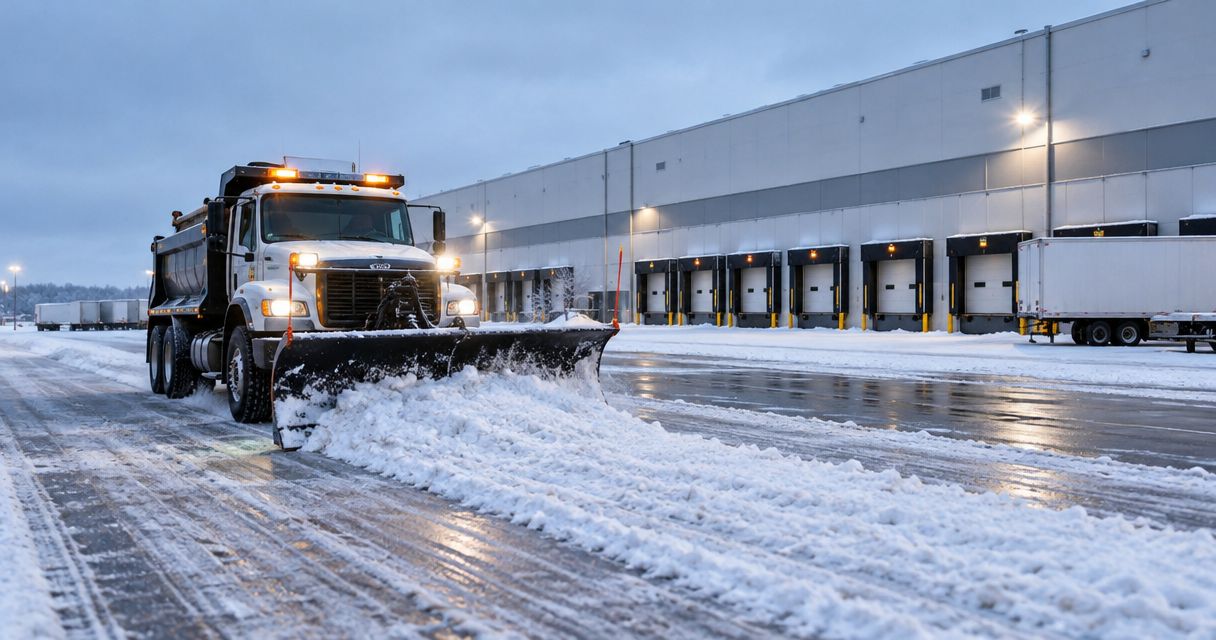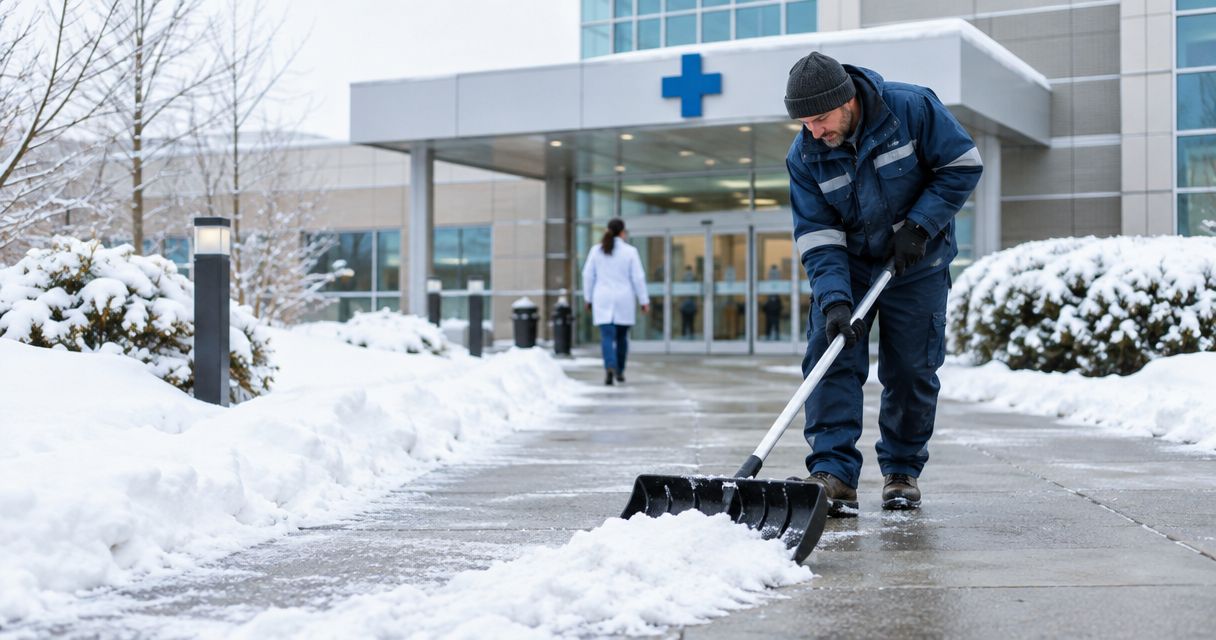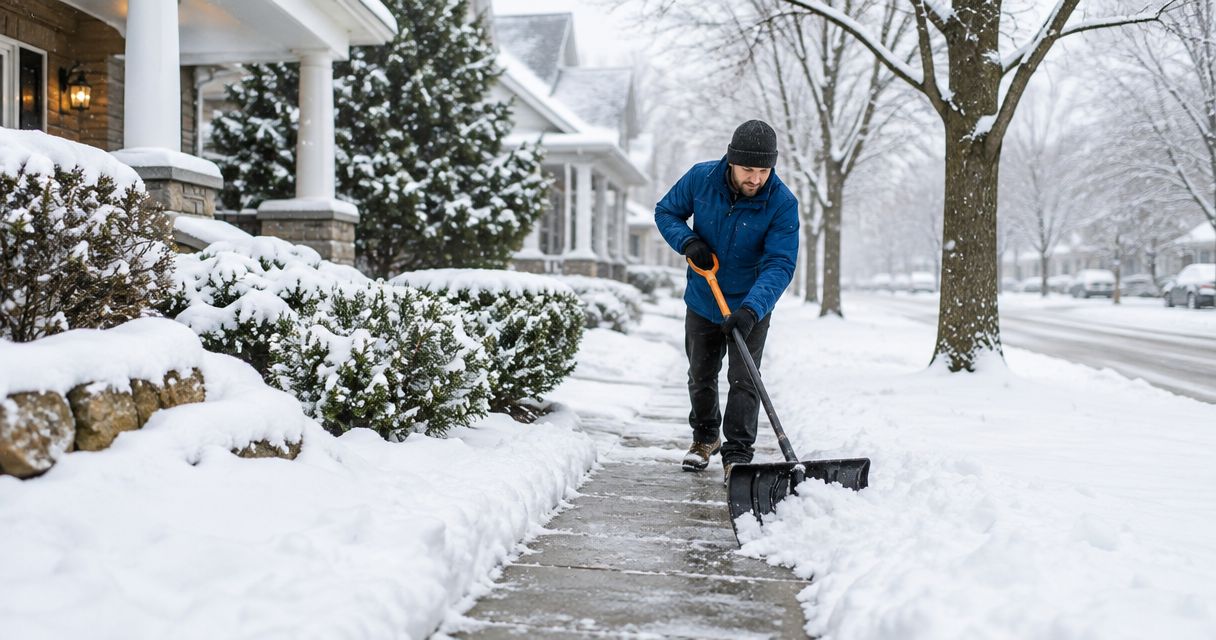
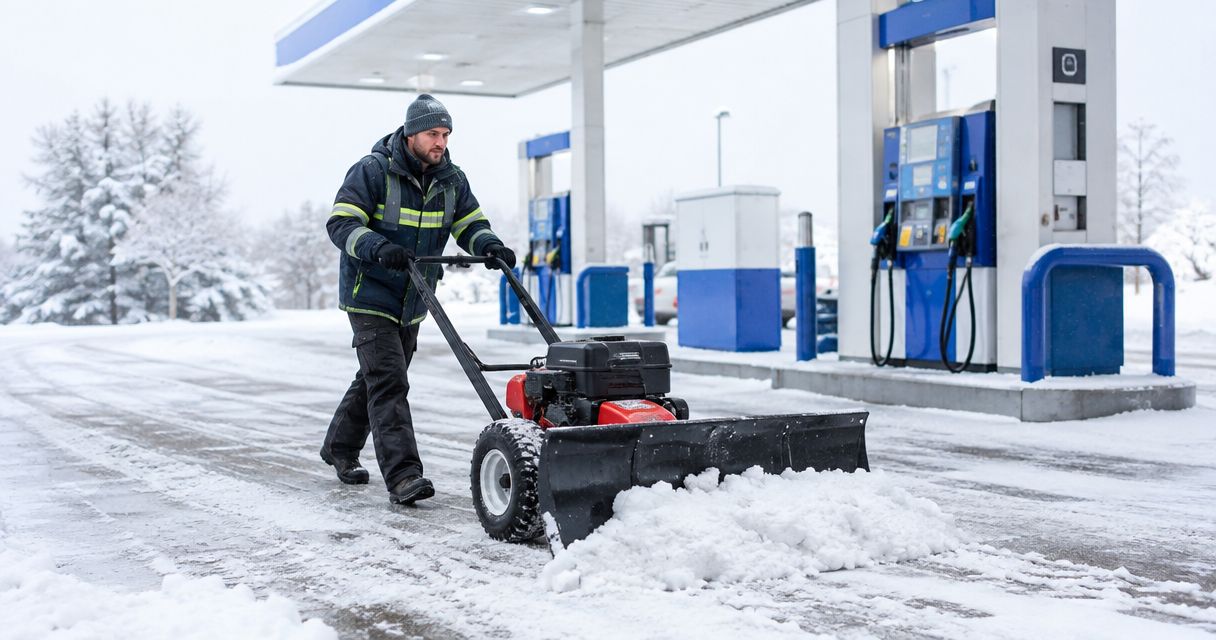
Gas station snow removal is coordinated plowing, de-icing, and pedestrian clearing with the aim of keeping fueling, store access, and deliveries moving during winter weather. Unlike an ordinary parking lot, your forecourt combines moving vehicles, customers walking between pumps, fuel-system infrastructure, and delivery movements that crews must protect rather than simply plow around.
- Snow removal for gas stations requires separate plans for pump lanes, pedestrian access, fuel deliveries, and snow storage.
- St. Louis Snow Removal fits managers seeking documented commercial plowing, de-icing, and sidewalk clearing across its stated service area.
- Use separate instructions for snowfall accumulation and ice; a plow trigger does not define an ice response.
- Compare contract scope, return visits, and service records—not contract labels alone.
Why snow removal matters for gas stations
Your station does not function as one open rectangle. Customers stop beside dispensers, cross vehicle lanes, and walk toward the store while other drivers enter and exit. Clearing the perimeter without addressing those movements leaves the job unfinished.
For your 2026 plan, start with preparing a parking lot for the first snowstorm, then add the operating constraints specific to fuel sales. A contractor needs to know where equipment can travel, where snow can remain, and which areas require handwork.
The operating standard is usable access, not a photograph of a plowed lot. A clean driving lane does not resolve ice beside a dispenser, a buried curb ramp, or a snow pile blocking a delivery approach.
Documentation matters for the same reason. Your service record should distinguish what crews completed from what remained blocked, inaccessible, or scheduled for another visit. An arrival timestamp alone cannot answer those questions.
How to build your gas station snow plan
1. Map the forecourt before assigning equipment
Start with a printed aerial image or a hand-drawn sketch. Walk the property with the station manager and mark the features that disappear under snow, including island edges, raised covers, drainage points, and changes in pavement elevation.
Create 1 site map that both station staff and the contractor use. Treat it as an operating document, not a file attached to a contract that nobody opens. Update it whenever construction, equipment placement, or traffic routing changes.
Include any car wash, air station, outdoor merchandise, or refuse enclosure that exists at your location. Do not assume a crew visiting in darkness can identify every obstacle from the truck.
- Mark dispenser islands, bollards, curbs, and overhead clearance restrictions.
- Identify fuel-fill points and delivery access with the fuel supplier.
- Outline approved snow-storage areas and prohibited stacking locations.
- Mark entrances, exits, drains, and pedestrian crossings.
2. Separate vehicle access from pedestrian clearing
Divide the property into 3 service zones: vehicle circulation, pedestrian access, and fuel-delivery access. These are planning categories, not a rule that every station needs the same equipment or clearing sequence.
You can manage the first version with a checklist and staff observations. Write down where customers leave vehicles, where they walk, and where drivers queue. Then give each zone a completion condition that a supervisor can inspect.
Pedestrian work needs its own assignment. Plowing around the store does not clear the entrance threshold, the curb ramp, or the walking connection from an accessible parking space.
- Vehicle circulation: preserve usable entrances, exits, and pump approaches.
- Pedestrian access: connect parking, dispenser areas, and store entrances.
- Fuel-delivery access: protect the supplier-approved approach and working area.
- Assign responsibility for areas that require shovels or smaller equipment.
3. Write separate snow and ice instructions
A manual plan starts with someone inspecting conditions and recording what needs attention. Assign that responsibility explicitly, including who acts when the usual manager is absent. A weather forecast informs the plan; it does not confirm pavement conditions.
For 2026, specify the accumulation trigger, who measures it, and what starts an ice inspection. Do not copy a trigger depth from another property without checking the station's operating needs. Ice can require attention without enough snowfall to initiate plowing.
St. Louis Snow Removal provides documented commercial plowing, de-icing/salting, and sidewalk clearing across the St. Louis metro and Metro East Illinois. That service combination gives managers an alternative to coordinating those tasks separately; confirm the station-specific scope before assigning responsibility.
- Define the snow trigger and the person responsible for observing it.
- Specify how freezing rain, refreeze, and tracked moisture are reported.
- State who authorizes treatment and additional visits.
- Separate dispatch expectations from completion expectations.
4. Set a clearing sequence around station operations
Begin with a short written sequence that staff can follow without specialized software. Identify the first access route to protect, the areas that need temporary traffic control, and the conditions that require an area to remain closed.
Keep vehicle movement, pedestrian movement, and equipment movement from competing in the same space. Coordinate work near occupied pump lanes with station management. Do not leave a driver to improvise around customers or a fuel delivery.
Use these planning checkpoints to organize the work. They are a sequence for coordination, not a promise that every storm can be handled identically.
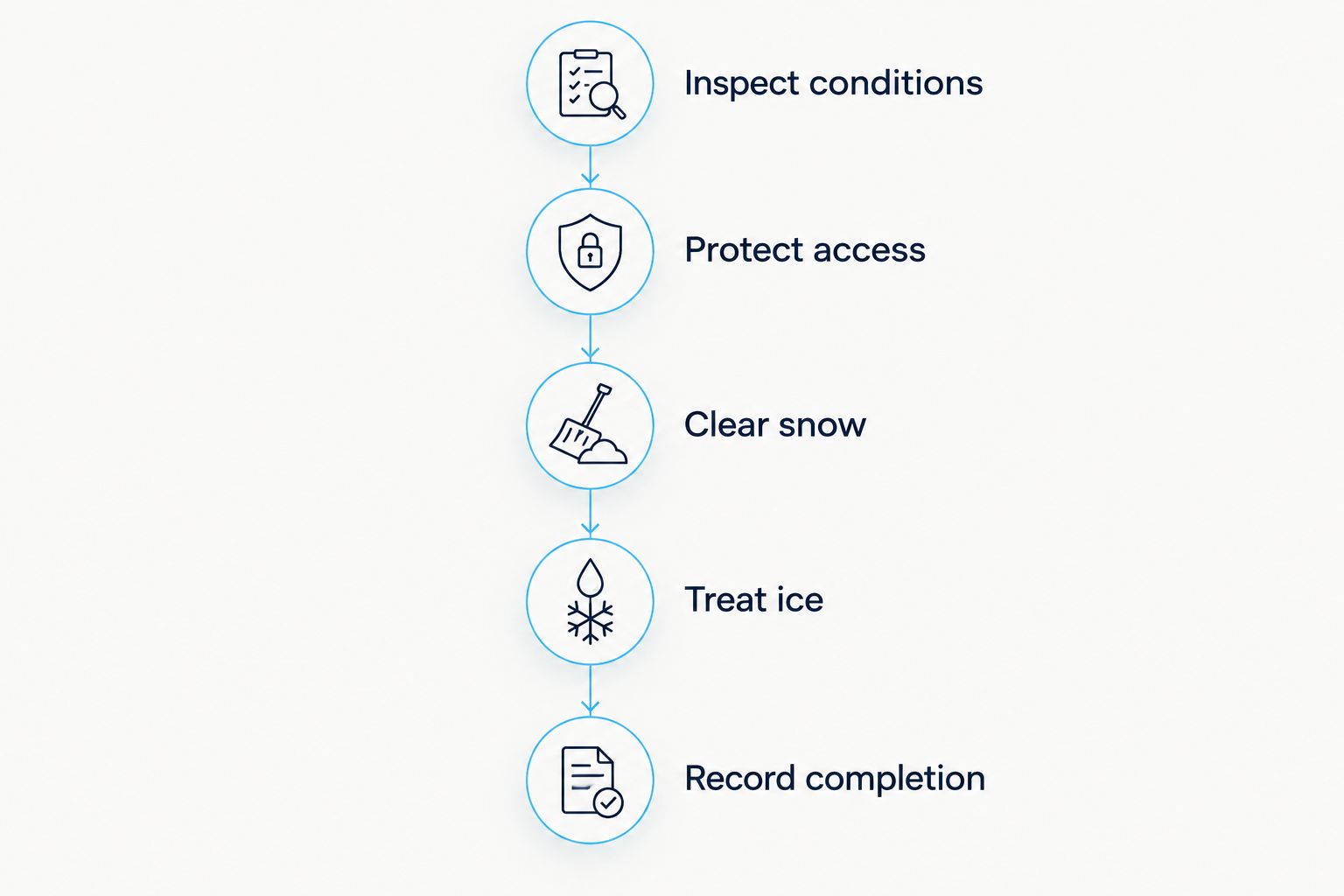
A delivery, blocked lane, or changing surface condition can interrupt the sequence. Give the crew a named contact who can resolve the conflict rather than leaving the operator to choose between access and an unfinished task.
- Inspect conditions: check surfaces, traffic, and reported hazards.
- Protect access: establish the working area and necessary restrictions.
- Clear snow: follow the mapped route and storage instructions.
- Treat ice: use products according to label directions and site requirements.
- Record completion: note finished work and unresolved conditions.
5. Control snow storage and meltwater
Walk the approved storage areas before winter and again after plowing. A pile that fits inside the property boundary can still interfere with visibility, pedestrian movement, equipment access, or drainage. Storage is part of the clearing plan, not leftover space.
Choose locations with the site's drainage pattern in mind. Meltwater flowing from a pile across a walking route creates a condition that deserves inspection when temperatures fall. Moving snow away from a pump island is not enough if it creates another obstruction.
For the 2026 site review, agree on what happens when approved storage reaches its practical limit. Relocation or hauling requires a separate scope discussion; do not assume either is included in routine plowing.
- Keep piles outside designated accessible routes and access aisles.
- Preserve driver sightlines at entrances and exits.
- Keep snow away from fuel-system access and emergency equipment.
- Inspect drainage paths and locations where meltwater crosses traffic.
- Define who approves relocation or hauling when necessary.
6. Assign escalation and service verification
Use a shared log, an email thread, or a paper form to start. The essential task is connecting an observation to a responsible person and a documented response. Buying another system does not fix an unassigned inspection.
Name 2 contacts: the primary station contact and a backup. Give the contractor an escalation path for blocked work areas, suspected equipment damage, ice reports, and incomplete work. Station staff also need to know when a reported condition requires restricting access.
St. Louis Snow Removal's documented commercial snow service fits managers who need plowing, de-icing, and sidewalk work recorded. Confirm the required record fields and delivery method during scope review; documentation should not depend on a manager remembering to ask after every visit.
- Record arrival, departure, work areas, and completed tasks.
- Request photographs that identify the relevant location and condition.
- Note blocked areas, restrictions, and unfinished work explicitly.
- Assign follow-up responsibility and retain the completion record.
7. Review the contract against the site plan
Compare proposals manually against the same marked map and task list. A shorter proposal is not necessarily a simpler service; it can leave more decisions unresolved. Ask each provider to identify exclusions in writing.
Your 2026 agreement should explain plowing, pedestrian work, de-icing, inspections, return visits, and snow storage separately. A contract label cannot tell you whether the dispenser approaches or delivery area are included.
St. Louis Snow Removal is best for managers seeking documented commercial snow removal across the St. Louis metro and Metro East Illinois. Its stated services match the core work categories; gas-station-specific methods, scheduling, and responsibilities still belong in the agreed scope.
- Match every mapped area to a task or an explicit exclusion.
- Clarify what initiates service and who authorizes additional work.
- Identify responsibility during active snowfall and after refreeze reports.
- Confirm insurance documentation and subcontractor responsibilities.
- Require a process for reporting damage and unresolved conditions.
Compare service options for your station
Choose the arrangement that matches your staffing and oversight capacity. The options below describe ways to organize service, not confirmed packages from a particular provider. Seasonal and Per-Occurrence terms describe contract structures; neither automatically defines the operating standard.
| Option | Best for | Main advantage | Key limitation |
|---|---|---|---|
| Staff-managed clearing | Limited handwork with trained staff and suitable equipment | Direct control over observed conditions and immediate task assignment | Pulls staff from station duties and requires equipment, training, and records |
| Per-Occurrence service | Managers who want work authorized and recorded by event | Makes individual service events easier to review | Needs clear definitions for repeat passes, ice treatment, and additional visits |
| Seasonal service | Managers who want a defined seasonal scope | Establishes responsibilities across the agreed season | The label does not establish visit frequency or included ice work |
| Zero-Tolerance scope | Operators seeking an explicitly defined snow-and-ice response standard | Focuses the discussion on conditions and response duties | Does not promise permanently bare pavement or eliminate changing-weather risk |
A provider handling several work categories can reduce coordination handoffs. The trade-off is dependence on one provider's agreed scope and execution. Separate providers divide responsibility, but you must resolve boundaries between plowing, sidewalks, treatment, and inspection.
For either arrangement, judge the written operating plan before the label. Ask who notices a problem, who acts, and what record proves the task was completed.
Common mistakes gas station managers make
Treating the canopy as weather protection
A canopy does not settle the condition of pavement beneath it. Vehicles and pedestrians carry moisture through fueling areas, and exposed edges still need inspection. Include the dispenser approaches in the inspection route rather than excluding the entire covered area.
Using fuel-delivery space for snow storage
An apparently empty corner can be part of a supplier's working area or turning path. Confirm the delivery arrangement before approving a snow pile. Keep the approved plan available to replacement crews as well as the regular operator.
Accepting a plow visit as proof of complete service
A truck can clear vehicle lanes while leaving pedestrian connections unfinished. Require separate completion entries for plowing, sidewalk work, and treatment. An exception should name the location and next action, not disappear inside a general completion note.
Setting a snow trigger without an ice response
Accumulation and surface ice are different conditions. Your staff need instructions for reporting slippery areas even when no plow trigger has been reached. Include treatment authorization and follow-up inspection in the plan.
Assuming a record guarantees a legal outcome
Service records document observations and actions; they do not establish immunity from a claim. Preserve original records and incident details, and ask your insurer or legal adviser what your retention process should include.
FAQ
What's the best snow removal plan for a gas station?
The best gas station snow removal plan assigns separate responsibilities for vehicle circulation, pedestrian access, fuel deliveries, ice treatment, and documentation. Put those responsibilities on a marked site map and in the service scope.
Should crews plow underneath the gas station canopy?
Include canopy-covered pavement in the site assessment rather than automatically assigning it to truck plowing. Equipment access depends on clearance, dispenser layout, obstacles, and occupied lanes; identify where smaller equipment or handwork is required.
What snow depth should trigger service at a gas station?
Set the trigger in the site-specific agreement rather than adopting a universal depth. Define how accumulation is measured, who initiates service, and how ice is handled independently of snowfall.
Is a Seasonal contract better than Per-Occurrence service?
A Seasonal contract suits managers seeking an agreed seasonal scope, while Per-Occurrence service organizes work around individual events. Compare included tasks, repeat visits, treatment, and reporting before choosing either structure.
Can station staff handle snow removal themselves?
Station staff can handle assigned tasks when they have suitable training, equipment, and operating procedures. Do not make clearing duties compete with customer supervision or leave inspection and follow-up unassigned.
Does spreading salt replace plowing at a gas station?
De-icing does not replace mechanical clearing when accumulated snow needs removal. Match treatment to observed conditions, product directions, and the surface, then inspect the result rather than assuming application completed the job.
What should a gas station request as proof of service?
Request a record identifying when crews attended, where they worked, what they completed, and what remained unresolved. Photographs should identify relevant locations and conditions rather than merely showing a vehicle on site.
One last thing
Inspect where the snow will melt, not just where it lands. During your 2026 walkthrough, trace the drainage path from each approved pile toward the pump lanes, store entrance, and accessible route. A storage location belongs in the plan only after you understand what happens downstream.