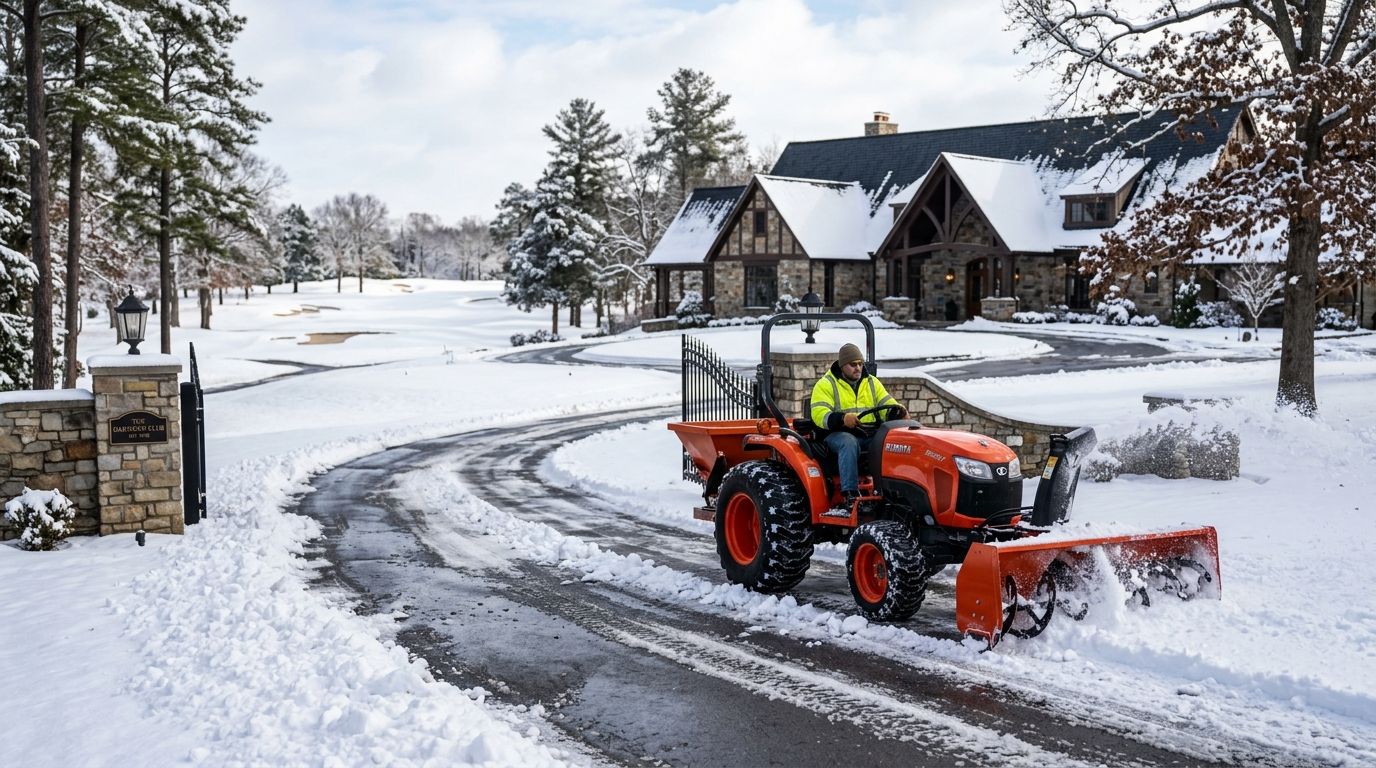
Snow removal for country clubs means keeping cart paths, clubhouse entrances, banquet walkways, and member parking clear on a schedule that matches tee times and event calendars, not a generic commercial route. A club's exposure is different from a retail lot: members expect pristine conditions before an 8 a.m. shotgun start, and a single fall on a clubhouse step turns into a liability claim with a membership roster of witnesses.
- Snow removal for country clubs in 2026 needs member-hour response windows, not standard commercial dispatch triggers.
- Zero-Tolerance contracts fit clubs with early tee times; Seasonal fits clubs with predictable member schedules.
- Cart paths and clubhouse steps carry the highest liability exposure and should be first-pass priority zones.
- Documented, geo-stamped service logs protect the club when a member or guest claims an unsafe condition.
- St. Louis Snow Removal treats clubhouse entrances and banquet walkways as separate priority zones from general lot clearing.
Why snow removal matters for country clubs
A country club isn't a warehouse with a loading dock schedule. It's a membership business where the parking lot, cart paths, and clubhouse entrance are part of the product members are paying dues for. When those surfaces are icy or half-cleared, the complaint doesn't go to a facilities inbox — it goes to the board.
Clubs also run on a compressed set of high-traffic windows: early tee times, lunch service, banquet load-in, and evening events. A snow contractor built for retail centers or apartment complexes, where the trigger is clear it sometime before people show up, doesn't match a club calendar where that phrase might mean 6:30 a.m. on a Saturday in January 2026.
The other difference is surface variety. A single property might have asphalt cart paths, brick clubhouse walkways, wood or composite decking near the pool or patio, and stone steps at the entrance — each with different melt behavior and different slip risk. Treating all of it with one blanket salt application is how clubs end up with a beautifully cleared parking lot and a sheet of ice on the steps nobody walks on until the first member does.
Set your trigger depth and response window for member hours
The trigger depth is the snow accumulation that dispatches a plow or shovel crew — most commercial contracts use somewhere around a 2-inch trigger, but a club with a 7 a.m. tee sheet can't wait for 2 inches to accumulate if the first group tees off before the storm even lets up.
- Map member-hour windows against typical storm timing for the season
- Set a tighter trigger, or a scheduled pre-dawn pass, for early tee time months
- Separate the cart path trigger from the parking lot trigger — they don't need the same threshold
- Confirm who makes the call to open or delay tee times based on conditions
Map cart path and walkway priority zones
Cart paths are long, narrow, and often shaded by trees — they hold ice longer than open asphalt and they're the first thing a member sees after parking.
- Rank zones: clubhouse entrance and steps, then cart paths and pro shop walkway, then general parking
- Flag any bridge or elevated cart path section separately — these freeze first
- Identify drainage low points on paths where meltwater refreezes overnight
- Note any ADA-designated accessible routes that require a dedicated clearing pass
Once the priority map exists, most clubs realize their current contractor is running one flat route regardless of surface type. This is usually the point where a club looks at a documented, zone-based service model instead of a single generalized plow pass — St. Louis Snow Removal builds routes around a club's actual priority zones rather than a default lot-then-sidewalk sequence.
Choose a contract model that matches your risk tolerance
Three contract structures cover most clubs, and picking the wrong one is either an overpay problem or a liability problem.
- Zero-Tolerance — dispatch triggers automatically at the agreed depth, no call needed; best for clubs with early tee times and low tolerance for delayed response
- Seasonal — flat coverage for the season regardless of storm count; best for clubs with predictable budgets and a board that wants no per-storm surprises
- Per-Occurrence — billed per storm event; best for clubs in lighter-snow years or with in-house crews handling routine clearing and needing overflow support only
Document every clearing pass for liability protection
A member slipping on a cart path isn't just an incident report — it's a claim, and the club's insurer will ask what time the area was last cleared and by whom.
- Require geo-stamped clock-ins and clock-outs for every crew visit
- Keep photo or timestamp records of salt application on high-risk zones
- Log which surfaces were treated and which were skipped, and why
- Retain records for the full season, not just the storm in question
This is where the difference between an on-demand plow guy and a documented contractor shows up. A vague assurance that the crew was there doesn't hold up when a club's legal counsel asks for a service log — a geo-stamped, timestamped record does.
Address entrances, steps, and ADA-compliant clubhouse access first
The clubhouse entrance is the single highest-traffic, highest-visibility surface on the property, and it's usually stone, brick, or a mixed material that ices differently than the parking lot.
- Clear and treat entrance steps and landings before the general lot pass
- Confirm the accessible entrance route meets clearance width requirements
- Use a de-icing product suited to the entrance material — rock salt pits some stone
- Check for ice re-formation from gutter runoff above the entrance
Plan for banquet and event day exceptions
A wedding or member event on a snow day is a different service call than a Tuesday morning tee time — guests in dress shoes, valet parking, and a fixed start time that won't move for weather.
- Flag banquet dates in advance so crews know to prioritize event-day zones
- Confirm valet and drop-off zones get a dedicated clearing pass
- Set an escalation contact for day-of weather calls during events
- Coordinate timing with catering and event staff, not just grounds staff
Line up striping and lot maintenance for shoulder season
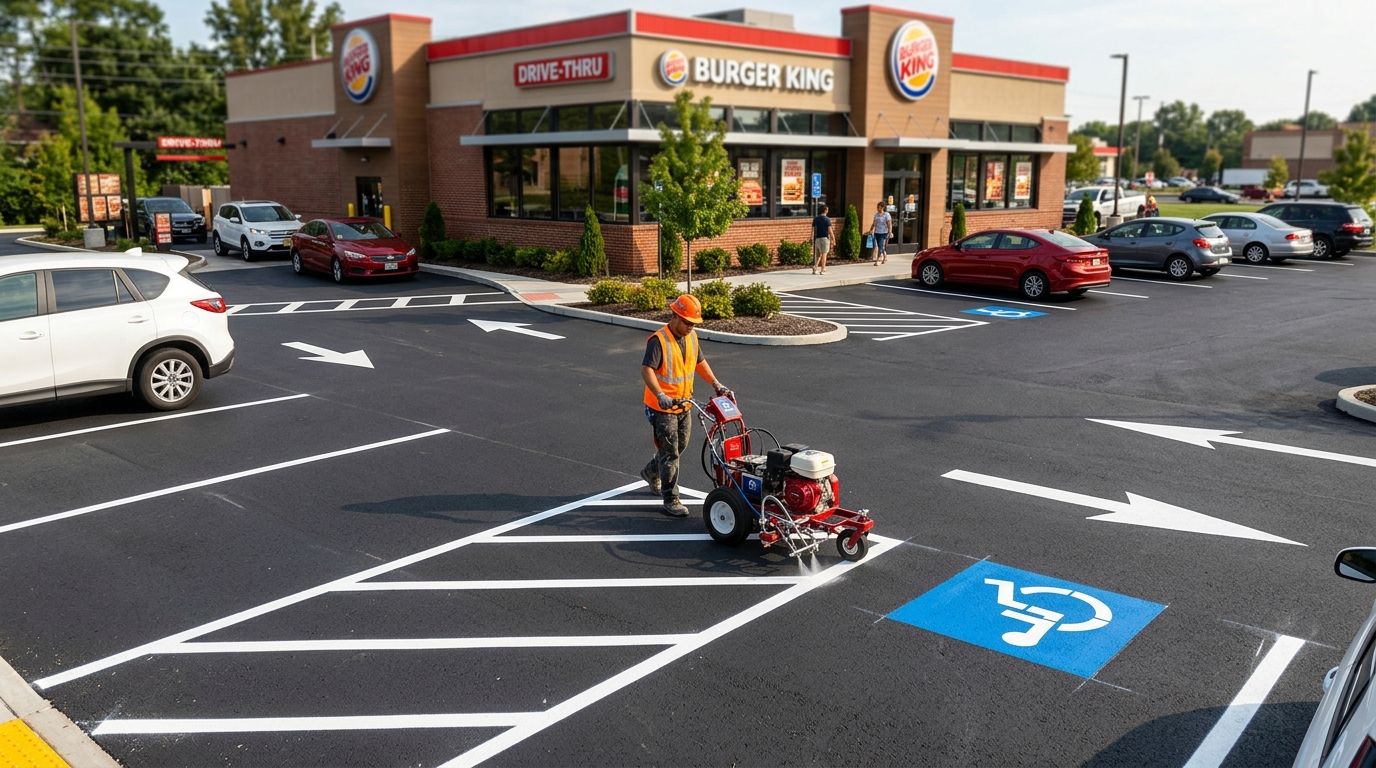
March and April in St. Louis mean thawed lots with faded lines from a season of plow blades and salt exposure — member parking, cart storage areas, and handicap spaces need repainting before the 2026 event season restarts.
- Inspect lot markings for wear as soon as snow clears
- Prioritize ADA-compliant spaces and access aisles for repainting first
- Schedule striping before peak spring event season, not after
- Coordinate lot closures for striping around tournament and event dates
Comparison: snow removal contract options for country clubs
| Option | Best for | Key limitation |
|---|---|---|
| Zero-Tolerance contract | Clubs with early tee times and zero tolerance for delayed dispatch | Requires trust in automatic trigger accuracy — no call-in step |
| Seasonal contract | Clubs wanting flat, predictable budgeting across a full winter | Less cost-efficient in a light-snow year |
| Per-Occurrence contract | Clubs with in-house crews needing overflow support only | Per-storm billing can spike in a heavy-snow winter |
| In-house crew, no contractor | Clubs with year-round grounds staff and equipment already on-site | No backup for multi-day storms or equipment failure |
Verdict: a Zero-Tolerance contract with documented, geo-stamped service logs is the safest match for a country club's liability exposure and member-hour schedule in 2026 — Seasonal works if the board prioritizes flat budgeting over response speed.
“If a cart path isn't cleared before the first tee time, the club's morning is already a liability conversation, not a weather story.”
Common mistakes country clubs make with snow removal
- Treating cart paths like sidewalks. They're longer, shadier, and freeze differently — a generic sidewalk crew pass leaves ice in the low spots.
- Skipping documentation until after an incident. Clubs that only ask for service logs after a claim usually find the records don't exist for the storm in question.
- Letting the contract trigger match a retail standard. A club with 7 a.m. tee times needs a tighter response window than a strip mall that opens at 10.
- Ignoring banquet-day exceptions in the contract. Event dates need to be flagged in advance, not handled as a same-day emergency call.
- Deferring striping until it's visibly bad. Faded ADA spaces and access aisles are a compliance issue the board doesn't want to discover during a spring tournament.
Get a documented snow plan for 2026
Zone-based routes, geo-stamped logs, and a trigger schedule built around your tee sheet.
FAQ
What's the best snow removal contract for a country club?
A Zero-Tolerance contract fits most country clubs because it dispatches automatically at the agreed trigger depth, matching early tee-time schedules without requiring a phone call. Seasonal contracts work better for clubs prioritizing flat budgeting over fast response.
How is snow removal for country clubs different from retail lot plowing?
Country clubs have member-hour windows tied to tee times and events, plus mixed surfaces like cart paths, stone entrances, and decking that ice differently than open asphalt. Retail contracts are typically built around store-open times and a single lot surface.
Should cart paths be cleared before the parking lot?
Cart paths and clubhouse entrances should be treated as separate, higher-priority zones since they hold ice longer and carry more liability exposure than open parking areas. The general lot pass follows once entrances and paths are cleared.
Do country clubs need documented service logs for snow removal?
Yes. A member or guest slip on a cart path or clubhouse step can turn into a liability claim, and geo-stamped, timestamped service records are what protect the club when an insurer or attorney asks what was cleared and when.
How do banquet or event days change a club's snow removal plan?
Event dates need to be flagged in advance so crews prioritize valet zones, drop-off areas, and event-day walkways ahead of the general route. Waiting to handle it as a same-day emergency risks a late clearing pass before guests arrive.
When should a country club schedule parking lot striping?
Striping should happen as soon as the lot thaws in spring, before peak tournament and event season starts, since a full winter of plow blades and salt fades lines faster than normal wear.
What trigger depth should a country club use for snow removal?
Most commercial contracts default to around a 2-inch trigger, but clubs with early tee times often need a tighter trigger or a scheduled pre-dawn pass so cart paths are clear before the first group tees off.
Can an in-house grounds crew handle snow removal without a contractor?
An in-house crew can handle routine snow removal if equipped and staffed year-round, but it lacks backup for multi-day storms or equipment failure, which is where a Per-Occurrence contract for overflow support fits.
One last thing
The clubhouse entrance draws more member complaints than the parking lot — it's small, high-traffic, and the last surface a member touches before walking onto polished flooring. Clubs that build their 2026 snow plan around that one zone first, then work outward to cart paths and general lot clearing, cut complaint volume before a single flake falls.