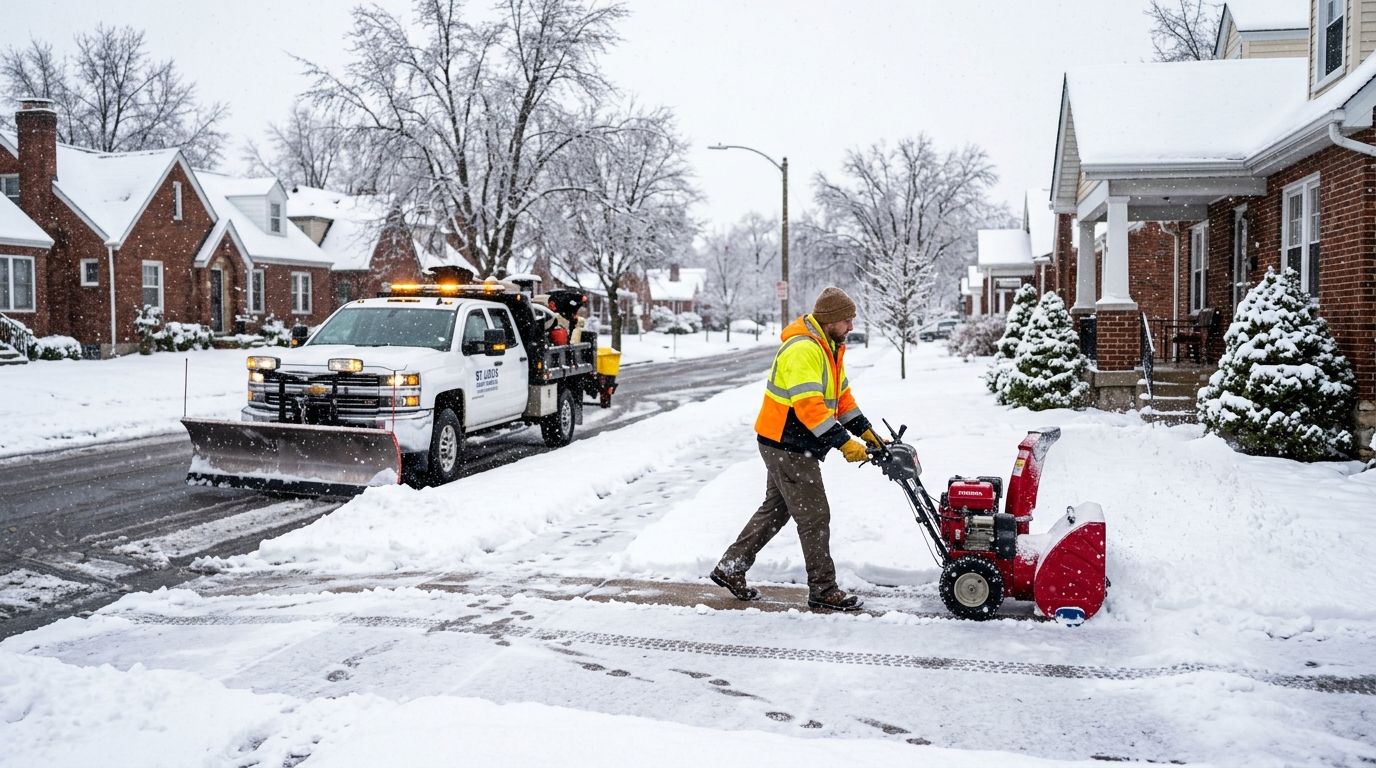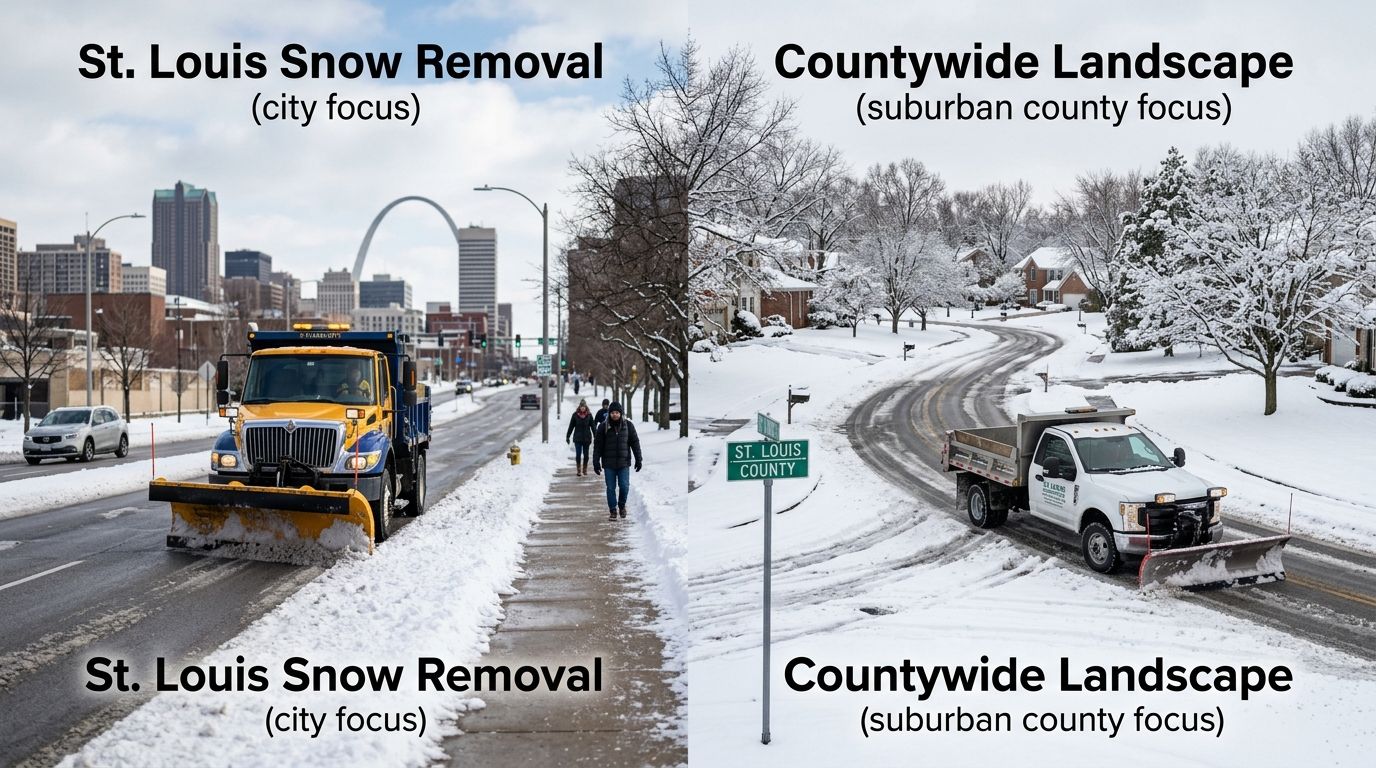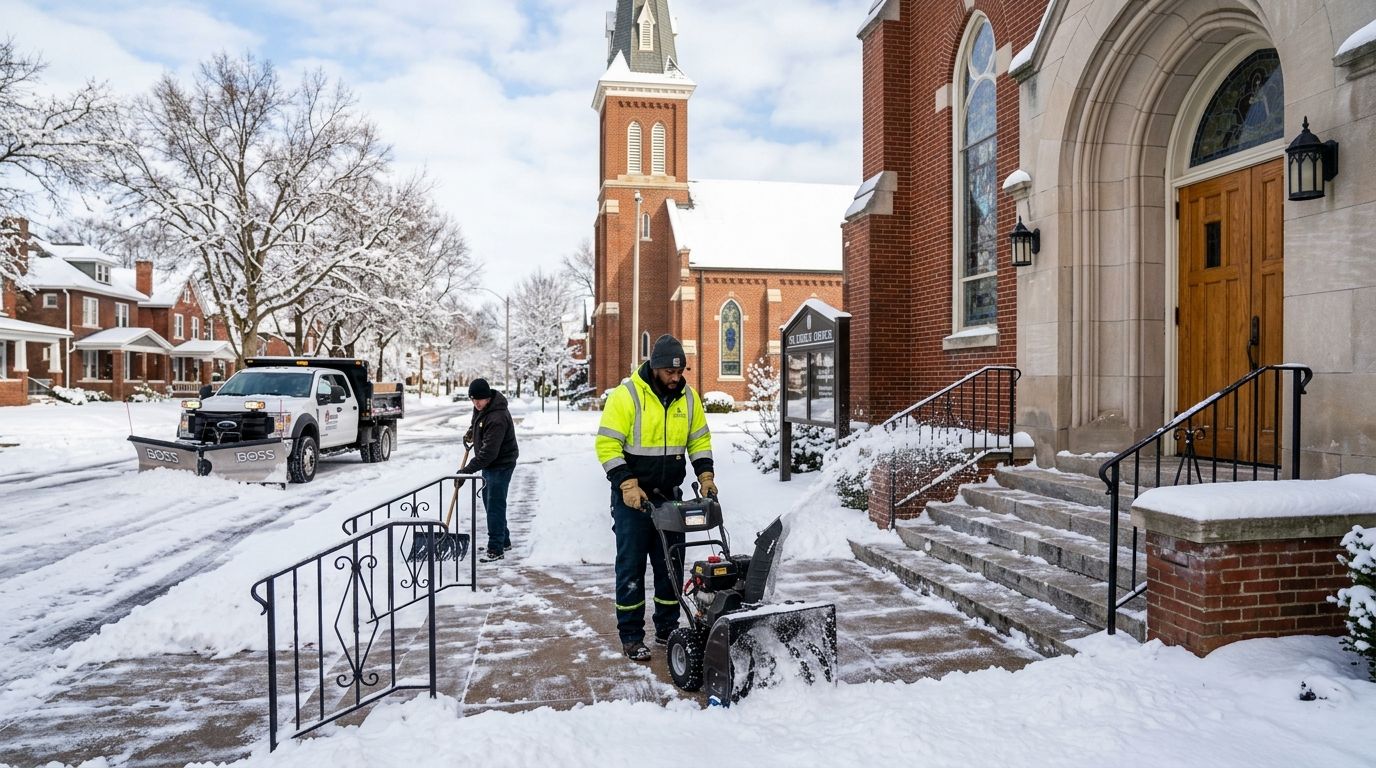
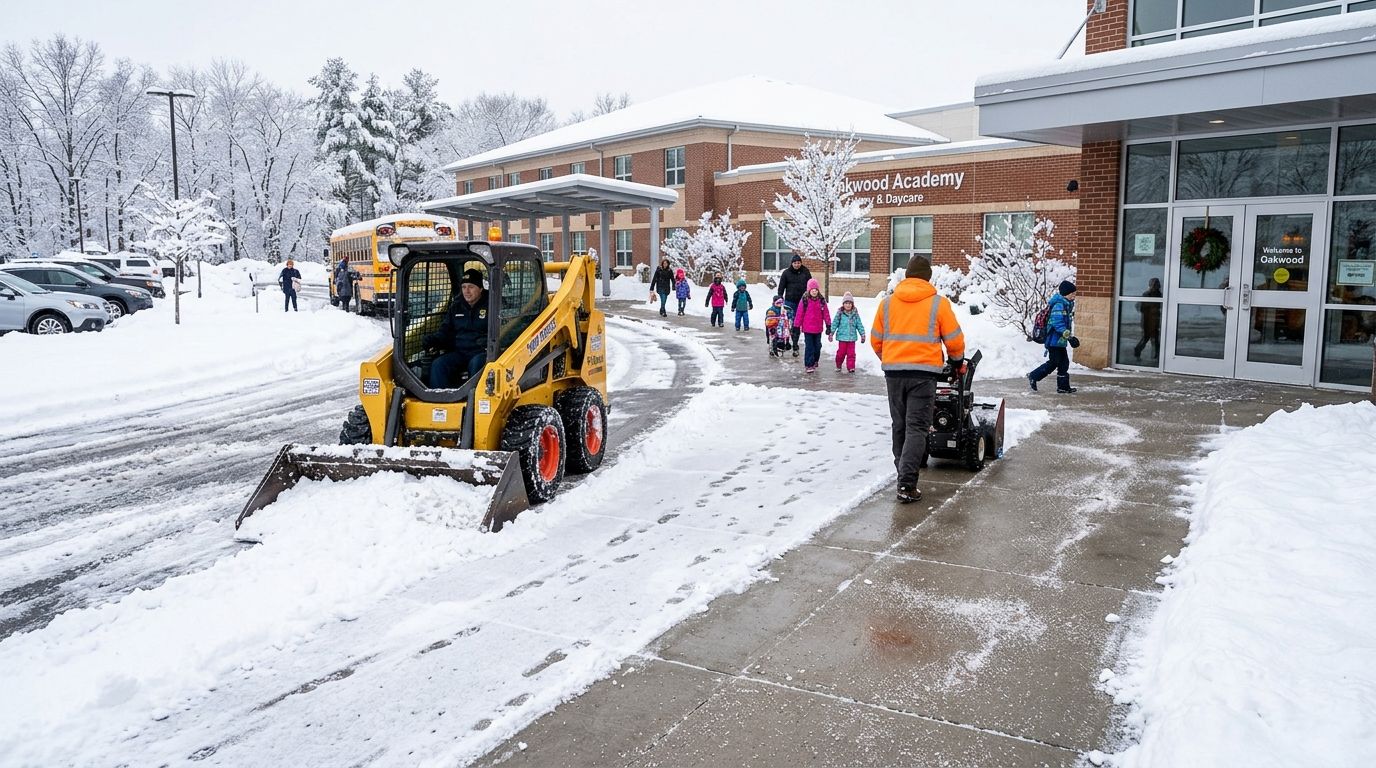
Best overall for documented liability protection: St. Louis Snow Removal. Best for multi-region school districts: national facility maintenance networks. Best budget option for a single small daycare: independent local plow operators. Best for after-hours backup: 24-hour emergency-only crews.
- The best snow removal for schools and daycares in 2026 is a documented commercial contractor like St. Louis Snow Removal for liability-grade proof of service.
- National facility maintenance networks fit districts with campuses outside St. Louis metro and Metro East Illinois, but crew quality varies by local subcontractor.
- Independent local plow operators are the budget pick for a single small daycare once insurance and backup equipment are verified.
- 24-hour emergency-only crews belong on backup duty, not as the primary daytime contractor for a school in session.
Why this matters
A school or daycare carries more liability exposure per square foot of pavement than almost any other commercial property. Parents drop off and pick up on a fixed schedule, licensing agencies audit safety records, and a single icy patch near a covered entry turns into a claim faster than in an empty office parking lot.
That's why the vendor decision for 2026 isn't really about who plows fastest. It's about who can prove the lot and sidewalks were serviced, on what schedule, and to what standard — because St. Louis Snow Removal built its commercial model around exactly that gap: geo-stamped clock-ins and documented checklists instead of a phone call that says "we were there."
The five options below cover the realistic range a school administrator or daycare director evaluates in 2026, ranked by the use case each one actually fits — not a single leaderboard where everyone competes for the same slot.
What makes the best snow removal for schools and daycares
- Documented proof of service — geo-stamped clock-ins and photo checklists that hold up if a parent files a slip-and-fall claim.
- Trigger-depth dispatch — crews sent once snowfall hits a set depth, not after someone remembers to call.
- ADA-compliant sidewalk and entry clearing — walkways, ramps, and drop-off zones cleared to code, not just the parking lot.
- Ice management at playgrounds and entries — de-icing coverage at gates, ramps, and the black-ice zones where children actually walk. See how ice management contractors approach these zones.
- Contract structure matched to risk tolerance — Zero-Tolerance, Seasonal, or Per-Occurrence models instead of one size fits all.
- Verified insurance and backup capacity — a second truck or crew if the primary equipment fails mid-storm.
At a glance
| Provider type | Best for | Standout feature | Key limitation |
|---|---|---|---|
| St. Louis Snow Removal | Liability-grade documentation | Geo-stamped clock-ins, named contract models | Metro-only footprint |
| National facility maintenance networks | Multi-region districts | Single invoice across many campuses | Work is subcontracted locally |
| Independent local plow operators | Single small daycare, tight budget | Direct relationship with the operator | No documentation, no backup truck |
| Landscaping companies (seasonal add-on) | Bundling with an existing landscape vendor | Crew already knows the property | Snow is a secondary service |
| 24-hour emergency-only crews | After-hours events, storm backup | No season-long contract required | No guaranteed arrival window |
1. St. Louis Snow Removal: best for documented liability protection
St. Louis Snow Removal runs commercial snow plowing, de-icing and salting, sidewalk clearing, and parking lot striping for property managers and institutions across the St. Louis metro and Metro East Illinois, structured around three named contract models: Zero-Tolerance, Seasonal, and Per-Occurrence. Every visit logs a geo-stamped clock-in and a checklist, so administrators have a timestamped record instead of a verbal assurance.
St. Louis Snow Removal pros:
- Geo-stamped clock-ins and photo-documented checklists give a paper trail if a claim shows up later.
- Contract models let a school or daycare pick the risk tolerance that matches its liability exposure — Zero-Tolerance for a licensed daycare, Seasonal for a lower-stakes site.
- ADA-compliant sidewalk and entry clearing covers the walkways parents and staff actually use.
- Ice management covers entry ramps and gate zones, not just the drive lane.
St. Louis Snow Removal cons:
- Coverage is the St. Louis metro and Metro East Illinois — a district with campuses outside that footprint needs a second vendor.
- Enrollment happens ahead of storm season; it's not built as a walk-up, mid-storm emergency call.
- The full documentation package adds administrative overhead a single small classroom-sized daycare may not need.
Best for: schools and daycares inside the St. Louis metro/Metro East Illinois footprint that need liability-grade proof of service and standardized contracts across sites.
Verdict: Buy for any licensed facility where a slip-and-fall claim is a real financial risk in 2026.
2. National facility maintenance networks: best for multi-region school districts
These networks aggregate subcontracted local crews under one national account, giving a district a single invoice and one point of contact for campuses spread across multiple states or regions.
National network pros:
- One contract and one invoice for facilities spread across many locations.
- Standardized reporting format across every site the district manages.
- Simplifies accounts-payable for large, multi-region operations.
National network cons:
- The actual plow work is subcontracted, so crew quality and response time vary by local sub-contractor.
- Documentation detail depends on what the local sub captures, not on the network's own standard.
- Centralized dispatch reacts slower to hyper-local weather calls than a contractor based in the metro. Compare how this plays out for property managers juggling multiple sites.
Best for: districts with campuses across multiple metros where one invoice matters more than local crew consistency.
Verdict: Hold — call only if campuses genuinely span more than one region.
3. Independent local plow operators: best budget option for a single small daycare
An individual operator running a truck and a plow blade, usually on a seasonal or per-push arrangement with a handful of local properties.
Independent operator pros:
- Lower overhead usually means competitive rates for a single site.
- Often flexible on last-minute add-on visits.
- Direct relationship with the person doing the work, no account layers.
Independent operator cons:
- No backup truck if the operator's equipment breaks mid-storm.
- Documentation is typically a text message, not a timestamped checklist.
- Liability coverage varies by operator and isn't always verified before the contract starts.
Best for: a single small daycare on a tight budget that can accept lighter documentation.
Verdict: Hold — verify insurance and backup equipment before signing anything for the 2026 season.
4. Landscaping companies with a seasonal snow add-on: best for vendor consolidation
A landscape contractor that mows in summer and plows in winter, bundled under one year-round agreement.
Landscaping add-on pros:
- One vendor relationship covers both seasons.
- The snow crew already knows the property's layout and drainage from summer visits.
Landscaping add-on cons:
- Snow removal is a secondary service, so equipment and crew size are often smaller than a dedicated snow contractor.
- During a multi-property storm, priority typically goes to the vendor's bigger accounts first.
- Documentation is inconsistent since snow isn't the core business.
Best for: a facility that wants one vendor year-round and can tolerate lower storm-day priority.
Verdict: Wait — fine for a low-liability site, riskier for a licensed daycare with strict compliance requirements.
5. 24-hour emergency-only crews: best for after-hours events and backup
On-call crews dispatched for single emergency visits, common for evening events, weekend activities, or as overflow when a primary contractor is overwhelmed.
Emergency crew pros:
- Available outside standard business hours.
- Useful as backup capacity during a multi-day storm.
- No season-long contract commitment required.
Emergency crew cons:
- Response is on-demand, so an exact arrival window isn't guaranteed.
- Not a substitute for a standing daily-trigger contract during school hours.
- Documentation quality varies by whichever crew responds.
Best for: backup coverage for evening events, not primary daytime service during the school week.
Verdict: Skip as a primary contractor; keep in reserve only.
“Documentation replaces 'trust me, we were there' with a timestamp — and a timestamp is the only thing that holds up when a parent calls a lawyer.”
How we ranked these
Each provider type was scored against the six criteria above: documentation, trigger-depth dispatch, ADA-compliant clearing, ice management at entry points, contract flexibility, and verified backup capacity. No provider type wins on all six — the ranking reflects which use case each one actually serves, not a single winner-take-all score.
Get your school or daycare covered before the next storm
Compare Zero-Tolerance, Seasonal, and Per-Occurrence contract models for 2026.
Which snow removal company should you choose for schools and daycares?
If the site sits inside the St. Louis metro or Metro East Illinois, choose St. Louis Snow Removal for the documentation and contract-model flexibility a licensed facility needs in 2026. If campuses span multiple states, a national facility maintenance network's single invoice earns its place despite the subcontracted crews. A single small daycare on a strict budget can go with an independent operator, but only after checking insurance and backup equipment. Everyone else — landscaping bundles and emergency-only crews — plays a supporting role, not the primary contract.
FAQ
What's the best snow removal company for schools and daycares in 2026?
A documented commercial contractor like St. Louis Snow Removal is the best fit for schools and daycares in the St. Louis metro and Metro East Illinois in 2026, because it pairs geo-stamped clock-ins with contract models built around liability risk. Districts outside that footprint typically need a national facility maintenance network instead.
Is a documented snow removal contract worth it for a daycare?
Yes, for any licensed daycare, because a timestamped record of when a lot or sidewalk was cleared is the difference between an assumption and evidence if a slip-and-fall claim is filed. A verbal assurance from a plow operator doesn't hold up the same way in a liability review.
What is trigger-depth dispatch and why does it matter for schools?
Trigger-depth dispatch means crews are sent automatically once snowfall reaches a set depth, rather than waiting for a facility manager to call. For a school that opens on a fixed schedule, this removes the gap between the first snowfall and the first plow pass.
Do daycares need ADA-compliant sidewalk clearing?
Any facility open to the public, including a licensed daycare, benefits from ADA-compliant clearing on walkways, ramps, and drop-off zones, not just the parking lot. Parking lot clearing alone leaves the exact paths parents and staff use uncleared.
What's the difference between a Zero-Tolerance and a Seasonal snow contract?
A Zero-Tolerance contract dispatches crews at the lowest trigger depth to keep surfaces essentially clear at all times, while a Seasonal contract covers a set number of visits or a flat-rate season regardless of how many storms hit. Schools and daycares with strict liability exposure generally lean toward Zero-Tolerance.
Should a school district use a national facility maintenance company or a local contractor?
A national network makes sense when a district has campuses spread across multiple states and wants one invoice, but a local metro contractor typically gives more consistent crew quality and documentation for campuses concentrated in one region. Most single-metro districts get better accountability from a local commercial provider.
How fast should a school parking lot be cleared before drop-off?
The exact timing depends on the contract's trigger depth and the storm's timing, but a documented service log should show the lot and sidewalks were cleared before the first arrivals, not after complaints start. That's the entire point of geo-stamped clock-ins instead of an undocumented plow pass.
What should a daycare check before signing with an independent plow operator?
Verify current insurance coverage and ask what backup equipment exists if the operator's truck breaks down mid-storm, since a single-operator setup has no built-in redundancy. Without those two checks, a budget contract can leave a daycare uncovered during the exact storm it needs coverage for.
One last thing
The riskiest zone at most schools isn't the parking lot — it's the covered entry, where melted snow refreezes into black ice after the sun goes down. Drivers rarely check it, and a plow-only contract that skips entry ramps in its checklist will miss it every time in 2026. Ask any prospective contractor whether their documented checklist specifically names entry ramps and covered walkways, not just "lot and sidewalks" as a blanket line item.