
Documented proof-of-service is worth it in 2026 for any commercial property carrying slip-and-fall liability, and it costs the property owner nothing extra when it's built into the contract instead of billed as an add-on. The catch: documentation only protects you if it exists before a claim gets filed, not after — a crew that shows up but never logs the visit leaves you with the same exposure as a crew that never showed up at all.
- Documented proof of service snow removal is worth it in 2026 for cutting slip-and-fall liability exposure to near zero.
- Geo-stamped clock-ins and timestamped photos replace 'trust me, we were there' with a record anyone can check.
- Undocumented crews leave property managers with no defense file once a claim lands.
- Zero-Tolerance, Seasonal, and Per-Occurrence contracts all benefit, but Per-Occurrence billing needs the paper trail most.
Why this matters
A parking lot slip-and-fall claim doesn't care whether the lot got plowed. It cares whether you can prove it got plowed, when, and to what standard. Insurance carriers, defense attorneys, and property management software all ask the same question after an incident: where's the record? St. Louis Snow Removal builds that record into every visit — geo-stamped clock-ins, trigger-depth notes, timestamped photos — rather than treating it as a premium tier.
The alternative is an undocumented crew that plows, salts, leaves, and moves to the next property. If nothing goes wrong that winter, nobody notices the gap. If something does go wrong, the property manager is the one holding an empty file in front of a judge.
Is documented proof-of-service worth it in 2026?
Yes, for any property where a fall on ice or unshoveled pavement creates legal exposure — retail centers, apartment complexes, medical offices, warehouses, HOAs. The comparison below shows what changes when a visit is documented versus when it isn't.
| Feature | Documented Service | Undocumented Service |
|---|---|---|
| Proof crew was on-site | Geo-stamped clock-in tied to GPS and time | Verbal claim only |
| Trigger depth compliance | Logged snowfall reading at time of dispatch | No record of when plowing started |
| Salt application evidence | Timestamped photo of treated surface | None |
| Slip-and-fall defense file | Ready to hand to an attorney or insurer | Built after the fact, if at all |
| Insurance audit readiness | Logs match audit request format | Manual reconstruction, often incomplete |
| Contract accountability | Ties visit to Zero-Tolerance, Seasonal, or Per-Occurrence terms | Disputed billing, no backup |
The difference isn't cosmetic. When a claim lands 18 months after a storm, memory is gone but a geo-stamped log isn't.
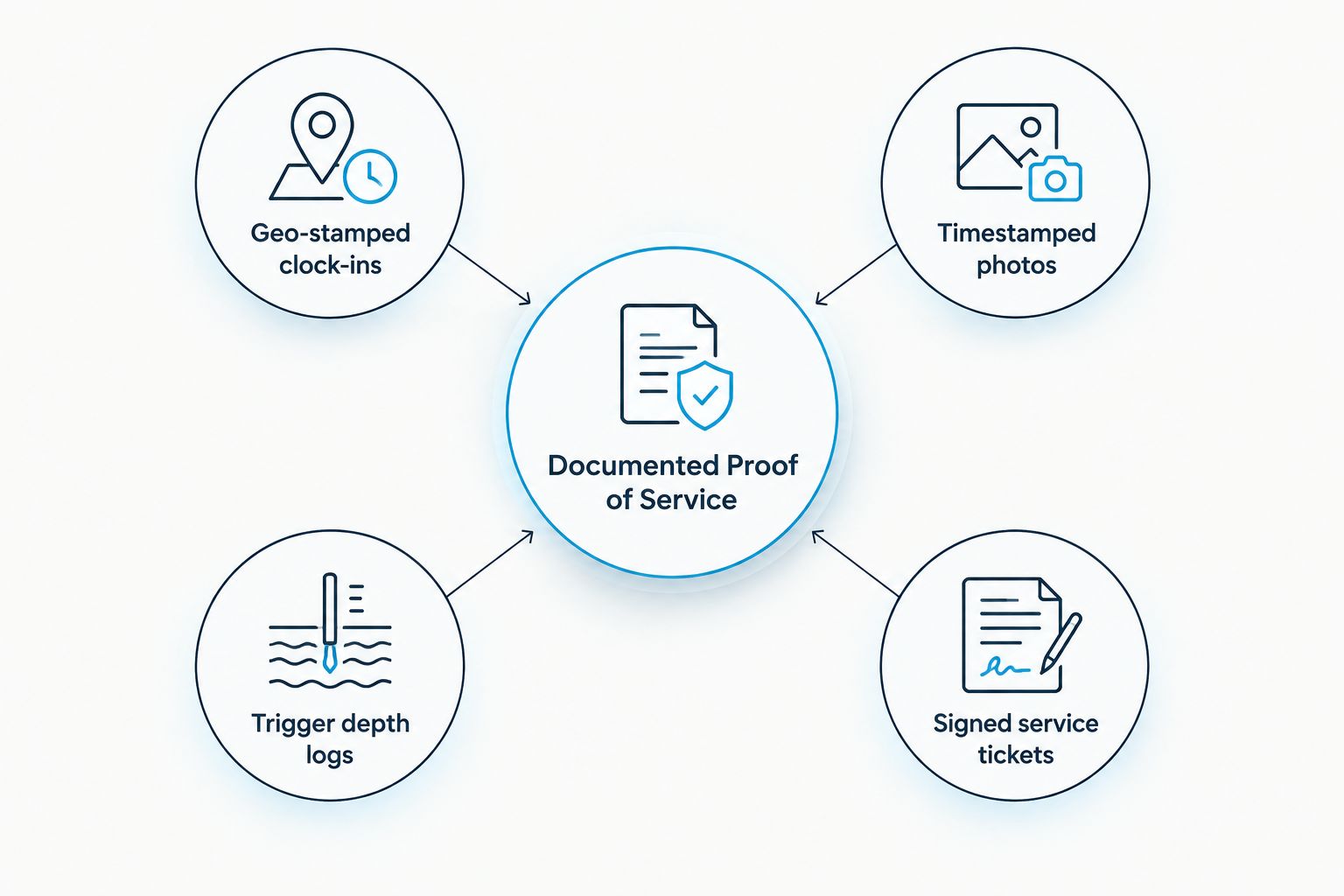
Geo-stamped clock-ins
A clock-in tied to GPS coordinates and a timestamp proves a crew member was physically at the property, not just that an invoice went out. Without it, "we were there" is a claim, not evidence.
Timestamped photos of salted or plowed surfaces
A photo taken at the moment of service shows surface condition at the time of treatment — the single piece of evidence most requested during a slip-and-fall discovery process. Timestamped snow photos connected to a slip-and-fall defense file turn a routine visit into something a defense attorney can actually use.
Trigger-depth logs
Most commercial contracts specify a trigger depth — the snowfall amount that activates dispatch. A log showing when that depth was measured and when the crew responded proves the contract terms were met, not just that a truck eventually showed up.
Signed service tickets
A ticket signed or digitally confirmed at completion closes the loop: service started, service finished, someone accountable signed off. This is the piece property management software and insurance auditors want formatted and ready, not reconstructed from memory in March.
Why documentation quality varies
- Contract type — Zero-Tolerance contracts demand tighter logging than Seasonal contracts because the trigger is more frequent and the liability window is narrower.
- Crew technology — a phone-based clock-in system produces a real record; a paper log filled out at the end of shift does not.
- Property risk profile — a grocery store entrance or a senior living walkway carries more foot traffic and more claim exposure than a fenced industrial yard.
- Insurance requirements — some carriers now request proof-of-service logs as part of the audit file, not as a courtesy.
- Contractor size — a single-truck operator plowing 40 properties in one storm has less time to document than a crew running a dedicated logging system.
- Billing model — Per-Occurrence contracts get disputed more often than Seasonal ones, so the documentation matters more at invoice time too.
Documentation cost is mostly a workflow decision, not a line-item expense. A contractor who builds geo-stamped clock-ins and photo logs into the dispatch process in 2026 isn't charging extra for it — they're running the operation that way by default.
See how your property is documented
Check what proof-of-service looks like for your contract type.
Does documented proof-of-service cost extra in 2026?
Documented proof-of-service does not have to cost extra in 2026 — it's a function of how the contractor runs dispatch, not a premium add-on. The real cost shows up on the other side: an undocumented visit that turns into a disputed claim costs far more in legal exposure than any logging system would have.
Can proof-of-service actually stop a slip-and-fall claim?
Proof-of-service can't stop a fall from happening, but it can stop a weak claim from turning into a costly settlement. A service log connected to an insurance audit file gives the property owner a checkable timeline instead of a memory-based defense.
What happens if a snow contractor has no documentation?
With no documentation, the property manager has nothing to hand an insurer or attorney beyond an invoice, and invoices don't prove trigger-depth compliance or surface condition at time of service. This is the exact gap that turns a routine winter claim into a six-figure liability question.
FAQ
Is documented proof of service snow removal worth it in 2026?
Yes, it's worth it in 2026 for any commercial property with slip-and-fall exposure — it turns a plow visit into checkable evidence instead of a verbal claim.
What counts as proof of service for snow removal?
Proof of service typically means a geo-stamped clock-in, a timestamped photo of the treated surface, and a trigger-depth log tied to the visit. A signed service ticket closes the record.
Do residential snow routes need documented proof of service?
Residential routes carry lower liability exposure than commercial lots, so documentation matters less for the homeowner, but enrolled residential snow route service still benefits from a dispatch record when disputes come up.
Is documented proof of service required for insurance audits?
Some insurance carriers now request service logs directly during audits, and a log formatted for that request saves the property manager from reconstructing a winter's worth of visits by hand.
Does a Zero-Tolerance contract need more documentation than a Seasonal one?
Yes, Zero-Tolerance contracts trigger more frequently and carry tighter liability windows, so the logging needs to be tighter than on a Seasonal contract with fewer trigger events.
Can a property manager request proof-of-service logs mid-season?
A property manager can request logs at any point in the season if the contractor's dispatch system captures them by default rather than reconstructing records after the fact.
How does documented proof of service connect to property management software?
Service logs formatted for property management software let a manager see visit timestamps and photos inside the same system used for maintenance tickets, instead of chasing paper records separately.
One last thing
The gap most property managers miss isn't the plow visit — it's the sidewalk. A parking lot with a clean documented log and an unshoveled entrance sidewalk still loses a slip-and-fall case, because the fall usually happens at the entrance, not in the lot. Check that sidewalk clearing is logged with the same rigor as plowing, not treated as an afterthought to the main contract.