A seasonal snow contract pays off for a small business lot when the property needs a plow crew on nearly every triggering storm and a fixed bill matters more than paying only for the snow that actually falls. This page breaks down when the flat-fee seasonal model beats per-occurrence and Zero-Tolerance pricing for a small commercial lot across the St. Louis metro and Metro East Illinois in 2026.
- A seasonal snow contract wins for small business lots plowed on almost every trigger event, not light-snow years.
- Per-occurrence pricing runs on a documented $90/hr labor floor per push, cheaper only when storms stay rare.
- Zero-Tolerance contracts price in a $180/hr dispatch floor because crews stand by regardless of storm timing.
- St. Louis Snow Removal documents every trigger, push, and clock-in so the contract choice isn't a guess.
Why this matters
A small business lot doesn't carry the plow budget of a hospital campus or a distribution center, and one wrong guess on contract type either overpays for storms that never showed up or leaves a sidewalk uncleared the morning a customer slips. Small business parking lot contracts get written wrong more often than large-portfolio ones because owners assume a small lot means small stakes. It doesn't — a slip-and-fall claim on a 40-space lot carries the same liability exposure as one on a 400-space lot.
2026 winters in the St. Louis metro don't run on a fixed script: some seasons bring six or more plowable events, others bring far fewer. A seasonal contract removes that variance from the budget line. A per-occurrence contract keeps the variance and bets it stays low.
Is a seasonal snow contract worth it for a small business lot?
Yes, when the lot needs service on close to every trigger event and the owner values a predictable line item over the lowest possible bill in a mild winter. No, when the property sits in a low-traffic pocket, sits above street grade, or has a documented history of needing service only a handful of times a season — per-occurrence pricing wins there instead. The three contract structures used across St. Louis commercial properties work like this:
| Contract model | How the bill is set | Best for |
|---|---|---|
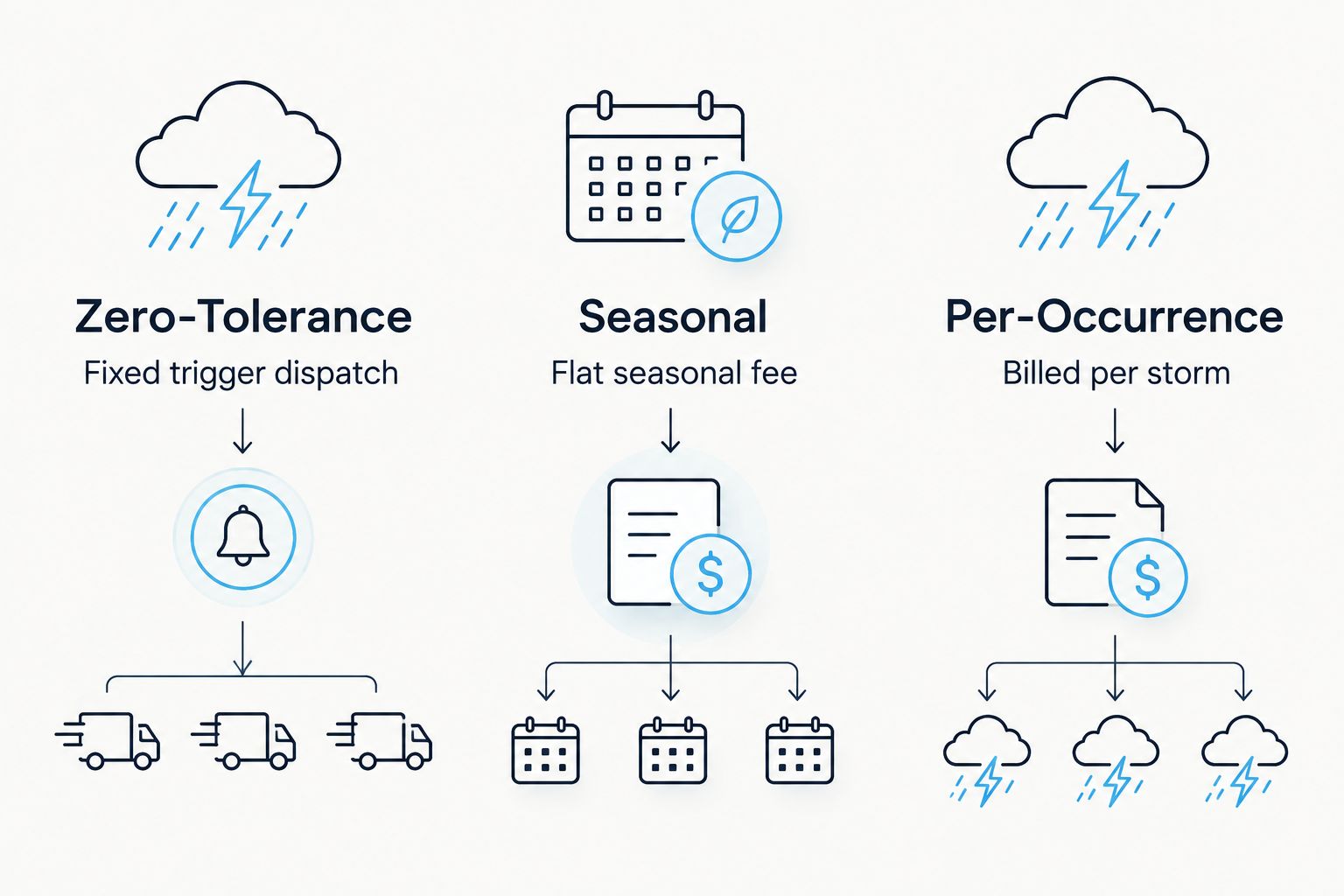
| Zero-Tolerance | Flat seasonal fee, crew dispatches at a fixed trigger depth every time, no exceptions | High-liability lots, medical offices, senior living entries |
| Seasonal (flat-fee) | Flat seasonal fee sized to the property's average trigger count | Budget-certain small businesses that want one number for winter |
| Per-Occurrence | Billed per storm against a documented labor floor | Light-snow-year lots, seasonal or low-traffic businesses |
Zero-Tolerance contracts: $180/hr dispatch floor for high-liability lots
A Zero-Tolerance contract prices in a $180/hr dispatch floor because the crew treats every trigger depth as an automatic dispatch, storm timing and holiday schedules included. That floor covers standby readiness, not just plow time — the contract pays for a crew that shows up at 3 a.m. on New Year's Eve the same way it shows up at 9 a.m. on a Tuesday.
This model fits medical offices, senior living entries, and any small business where a single missed trigger turns into a liability claim instead of a customer complaint. It costs more across a mild 2026 winter than per-occurrence pricing would. Verdict: Buy for high-liability entries, Skip for low-traffic side lots.
Seasonal (flat-fee) contracts: one number for the whole winter
A seasonal flat-fee contract locks the winter's snow line item to a single number, set from the property's square footage and its historical average trigger count. The owner trades the chance of a cheap mild winter for protection against the opposite: a run of six storms in three weeks that would blow past a per-occurrence budget.
Property managers who need one predictable OpEx figure for board reporting lean toward this model over Zero-Tolerance or per-occurrence pricing. It sits in the middle: less rigid than Zero-Tolerance dispatch rules, less exposed than per-occurrence billing. Verdict: Buy for small businesses that want one number for the season, Hold if last winter ran unusually light.
Per-Occurrence contracts: $90/hr per-push floor for light-snow years
Per-occurrence pricing bills each push against a $90/hr labor floor, so a mild 2026 winter with only a handful of plowable storms lands far under what a seasonal flat fee would have charged. The risk sits on the other side of that math: a heavy winter with back-to-back storms can push a per-occurrence total past what the seasonal contract would have cost for the same lot.
This model works for small businesses on a slight grade, in a low-traffic pocket, or with a documented history of light service needs. It's the wrong call for any lot with real liability exposure at the entrance. Verdict: Buy for light-snow-history lots, Skip for high-liability entries.
Laid side by side, the three models trade off the same two variables: how much certainty the owner wants and how much liability the lot carries.
Why the seasonal-contract answer varies by lot
- Storm frequency history. A lot with a documented history of six-plus plowable events per winter leans seasonal; a lot with two or three leans per-occurrence.
- Liability exposure at entrances. Sidewalks, ramps, and main entries carry more slip-and-fall risk than a back-lot overflow area.
- Budget approval cycle. A flat seasonal number is easier to get approved once than a variable per-push bill that needs sign-off after every storm.
- Trigger depth sensitivity. Properties that need service at a shallow trigger depth get dispatched more often, which favors a flat-fee model over per-occurrence.
- Sidewalk and ADA clearing obligations. Businesses that must keep entrances at a documented clearance width face more frequent dispatches than a parking lot alone would need.
- Cost of a missed clearing. A single slip-and-fall claim can cost more than several seasons of the higher-priced contract model combined.
Compare seasonal contract options
See documented trigger depths and labor floors sized to your lot.
Is a seasonal snow contract cheaper than per-push pricing?
A seasonal snow contract is cheaper than per-push pricing only in a heavy-snow winter with more storms than the property's average; in a light 2026 winter, per-occurrence billing against the $90/hr labor floor usually comes in lower. The trade-off is predictability — the seasonal number never moves once it's signed, while the per-occurrence total moves with every storm.
How much does commercial snow removal cost for a small business lot?
Commercial snow removal cost for a small business lot depends on square footage, trigger depth, and which contract model is chosen. Commercial snow removal cost in St. Louis for 2026 breaks down the ranges used to price both seasonal and per-occurrence contracts side by side.
Does a small business need a documented snow removal contract?
Yes — a documented contract with geo-stamped clock-ins and trigger-depth records is the defense that holds up if a slip-and-fall claim reaches a St. Louis courtroom in 2026. Verbal arrangements or on-demand plowing leave no proof the lot was serviced at all.
FAQ
Is a seasonal snow contract worth it for a small business?
A seasonal snow contract is worth it for a small business lot that gets plowed on almost every trigger event and needs a fixed 2026 budget line rather than a variable one. Lots with a light, unpredictable snow history usually do better on per-occurrence pricing.
What's the difference between a seasonal and per-occurrence snow contract?
A seasonal contract charges one flat fee for the whole winter regardless of storm count, while a per-occurrence contract bills each push separately against a documented $90/hr labor floor. The seasonal model trades a possibly higher bill for budget certainty.
How much does a Zero-Tolerance snow contract cost?
Zero-Tolerance contracts price in a $180/hr dispatch floor because crews stand by to hit a fixed trigger depth every time, including nights and holidays. That standby coverage is why Zero-Tolerance runs higher than seasonal or per-occurrence pricing in a mild winter.
Is per-occurrence pricing cheaper than a seasonal contract?
Per-occurrence pricing is cheaper than a seasonal contract in a light-snow winter, since the $90/hr labor floor only bills for storms that actually happen. In a heavy winter with frequent triggers, the same per-occurrence total can end up costing more than the seasonal flat fee would have.
What is a trigger depth in a snow removal contract?
A trigger depth is the snowfall amount that automatically dispatches a plow crew under the contract, regardless of whether anyone calls it in. Zero-Tolerance contracts hold to that trigger depth every time; per-occurrence and seasonal contracts may allow more flexibility around it.
Does a seasonal snow contract cover sidewalk clearing?
Whether a seasonal snow contract covers sidewalk clearing depends on what's written into that specific agreement, not the contract model itself. Confirm sidewalk and ADA clearance obligations are named line items before signing any seasonal or per-occurrence contract.
How many storms make a seasonal contract worth it in St. Louis?
A seasonal contract becomes worth it once a lot's storm history runs close to or above its own historical average trigger count for the winter. Below that average, per-occurrence billing against the $90/hr floor typically produces a lower total.
One last thing
Most small business owners pick a contract model based on last year's bill, not on next year's liability exposure — the two aren't the same question. A lot that only got plowed a handful of times last winter can still generate a six-figure slip-and-fall claim on the next trigger event. St. Louis Snow Removal documents every push, trigger depth, and clock-in regardless of which model gets signed, so switching contract types mid-portfolio in 2026 never means losing the paper trail.