One commercial snow contractor can cover Cass, Clay and Jackson County MO, but only if it runs subcontracted crews assigned by zone instead of dispatching a single fleet across all three during the same storm window. The catch most property managers miss: one contract and one invoice doesn't guarantee one response time — a triggered Jackson County lot and a triggered Clay County lot pull from whichever crew sits closest, not whichever name is on the paperwork.
- One contractor can run commercial snow removal across Cass, Clay and Jackson County MO if it uses a subcontractor-network model, not a single fleet.
- Single-fleet operators fall behind once a storm triggers all three counties at the same hour; networked subs don't.
- Documented contract types — Zero-Tolerance, Seasonal, Per-Occurrence — matter more across county lines than one company name on the paperwork.
- Labor floors run $90/hr for on-demand plowing and $180/hr for 24-hour emergency dispatch, no matter how many counties a contract spans.
Why this matters
Property managers running lots across Cass, Clay and Jackson County usually want one thing: a single phone number to call when snow starts, not three. That's a fair ask, but multi-county coverage runs on subcontractor zones, drive-time radius and municipal trigger depths — not on how many counties fit on one invoice.
St. Louis Snow Removal documents every push, salt application and sidewalk clear with geo-stamped clock-ins on its own metro contracts — the same documentation standard any Cass, Clay or Jackson County contract should be held to, regardless of which company's name sits on the paperwork. Heading into the 2026 season, that standard is what separates a contractor that can genuinely run three counties from one that's just billing for three.
Can one contractor cover Cass, Clay and Jackson County MO?
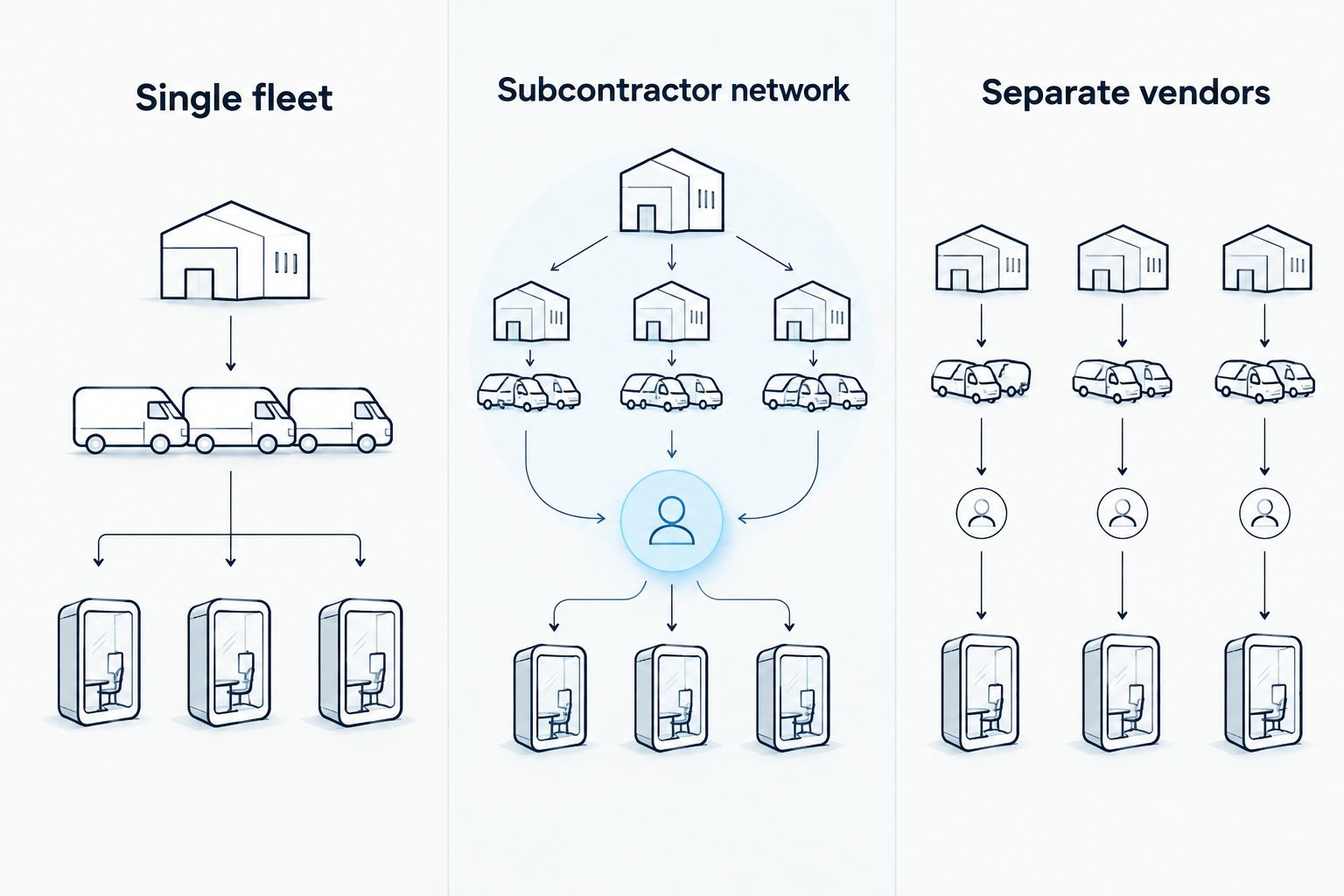
The short answer is yes, structurally. The honest answer is that it depends entirely on which coverage model runs underneath that single contract.
| Coverage model | Response time across all 3 counties | Contract complexity | Best for |
|---|---|---|---|
| Single fleet, one contract | Weakest — one truck queue, longest wait wins | Simplest — one contract, one invoice | Portfolios concentrated in one county |
| Subcontractor network, one contract | Strongest — local sub triggers independently per zone | Moderate — one master agreement, multiple crews | Portfolios spread across Cass, Clay and Jackson |
| Three separate single-county vendors | Strong per site, no shared scheduling | Highest — three contracts, three invoices, three audit trails | Portfolios that want redundancy over consolidation |
Property managers who want to see what's actually operating in each county before signing anything can check the vetted lists for commercial snow removal companies in Cass County, commercial snow removal companies in Clay County and commercial snow removal companies in Jackson County. Cross-referencing which names show up on more than one list is the fastest way to spot an actual subcontractor network versus three unrelated single-county shops sharing a sales pitch.
Why coverage and cost vary across counties
- Drive-time radius between crew depots and trigger sites — a closer depot beats a farther one even under the same contract name.
- Municipal trigger depth differences — some municipalities call at 1 inch, others wait for 2, and a contractor working three counties has to track each one separately.
- Storm timing overlap — a single system hitting Cass, Clay and Jackson in the same hour forces every crew to prioritize, even under one master contract.
- Contract model mismatches — a Zero-Tolerance contract dispatches on any accumulation, a Per-Occurrence contract waits for a set trigger depth, and a Seasonal contract bills flat regardless of storm count; mixing models across counties on one agreement adds administrative overhead.
- Labor floor rates — on-demand plowing runs a $90/hr floor and 24-hour emergency dispatch runs a $180/hr floor for documented commercial work, and that floor doesn't drop just because three counties share a contract.
- Subcontractor certification and equipment allocation — a crew certified and equipped for a Jackson County big-box lot isn't automatically the right crew for a Clay County sidewalk-heavy office park.
Portfolios that already juggle coverage across multiple regions recognize this pattern fast — it's the same tradeoff between consolidation and redundancy that shows up anywhere a single contract spans more than one service zone, and it's worth mapping before the 2026 winter, not during the first storm.
Related questions
Is a subcontractor-network contractor as reliable as a single in-house fleet?
A subcontractor-network contractor is as reliable as a single in-house fleet when every subcontractor is certified, equipped and dispatched off the same trigger-depth rules. The risk isn't the network structure itself — it's an uncertified sub added just to cover a new county without matching the existing documentation standard.
How much does commercial snow removal cost across Cass, Clay and Jackson County MO?
Commercial snow removal across multiple Missouri counties runs on the same labor floor as single-county contracts — $90 an hour for on-demand plowing and $180 an hour for 24-hour emergency dispatch — multiplied by however many zones one storm triggers at once in 2026.
What's the difference between a Zero-Tolerance and a Seasonal snow removal contract?
A Zero-Tolerance contract dispatches a crew for any measurable accumulation, while a Seasonal contract bills one flat rate for the entire winter regardless of how many storms hit. A Per-Occurrence contract sits between the two, billing only once accumulation passes a set trigger depth.
Check your county's coverage model
See how documented contract models hold up before storm season hits in 2026.
FAQ
What's the best way to cover commercial snow removal across Cass, Clay and Jackson County MO?
The best way to cover commercial snow removal across Cass, Clay and Jackson County MO is one master contract built on a subcontractor-network model, not a single fleet. That structure keeps per-zone response times steady when a storm triggers all three counties in the same hour, which is exactly when a single-fleet contract falls behind.
Is 24-hour emergency snow removal worth the extra cost across multiple counties?
24-hour emergency snow removal runs a $180/hr labor floor versus $90/hr for on-demand plowing, and it's worth the premium for properties with liability exposure — grocery stores, medical offices, apartment complexes — where a delayed after-hours response creates a slip-and-fall risk regardless of county.
Can one invoice cover snow removal for properties in three different counties?
One invoice can cover snow removal for properties in three different counties as long as the master agreement itemizes each site separately, because trigger depths and municipal rules differ by jurisdiction even when billing is consolidated.
What documentation should a multi-county snow removal contract include?
A multi-county snow removal contract should include geo-stamped clock-ins, per-site checklists and trigger-depth logs for every property, not just a seasonal summary. That documentation is what holds up in a slip-and-fall dispute or an insurance audit.
How do trigger depths differ between Cass, Clay and Jackson County MO?
Trigger depths differ by municipality, not by county line, so a contract covering Cass, Clay and Jackson County MO has to track each municipality's call-out threshold separately rather than applying one blanket depth across the whole service area.
Is a Zero-Tolerance contract or a Seasonal contract better for a multi-county portfolio?
A Zero-Tolerance contract works better for a multi-county portfolio with high liability exposure since it dispatches on any accumulation, while a Seasonal contract works better for portfolios that want one flat number heading into the 2026 winter regardless of storm frequency.
One last thing
The three-county question almost never comes down to weather — it comes down to billing habits. Most property managers assume separate counties need separate contracts because that's how their last three vendors billed them, not because storm systems respect county lines. A 2026 storm system that drops snow on Blue Springs in Jackson County drops the same system on Liberty in Clay County about the same hour.
“The contract structure is a business decision, not a meteorological one.”