Yes—but only if the contract defines when the 4-hour clock starts, what clearing must be completed, which conditions pause the clock, and how completion is documented. In 2026, a credible snow removal 4 hour clearing guarantee should connect the deadline to written snow plow trigger-depth benchmarks; a bare promise to clear the lot within 4 hours does not establish an auditable service commitment.
- A snow removal 4 hour clearing guarantee is credible only when the contract defines the trigger, scope, exceptions, and proof.
- In 2026, arrival, first-pass clearing, and full completion are different promises with different operational limits.
- The response clock should start from a documented event, not an undefined reference to when the storm begins or ends.
- St. Louis Snow Removal is best for property managers who prioritize documented commercial snow and ice service.
Why this matters
A property manager cannot enforce an undefined clock. If one person reads 4-hour clearing as crew arrival while another reads it as bare pavement across every contracted area, the promise fails before the storm starts.
The deadline also has to account for active snowfall. A first pass can be completed while snow continues, but the same pavement can require another pass before the event ends. That does not mean the earlier pass was missed; it means the contract must distinguish initial service, maintenance passes, and final cleanup.
In 2026, the strongest agreement does not use one response number as a substitute for an operating plan. It defines the trigger, clock, covered areas, completion standard, documentation, exceptions, and remedy for a missed commitment.
Can a snow removal contractor guarantee lot clearing within 4 hours?
A contractor can guarantee a defined action within 4 hours, but guaranteeing an entirely clear lot under every storm condition is not credible. The contract must identify which of the following commitments the deadline covers.
| 4-hour commitment | What it means | Strength | Limitation |
|---|---|---|---|
| Crew arrival | A crew reaches the specified property within 4 hours of the written trigger | Easy to verify with a geo-stamped clock-in | Does not promise that clearing is complete |
| First pass | The contractor opens the contracted priority areas within 4 hours | Keeps entrances, drive lanes, or other named areas at the front of the route | Does not mean every parking space or sidewalk is finished |
| Full contracted scope | Every area listed in the service scope is completed within 4 hours | Gives the property manager a clear completion target | Requires tightly defined weather, access, equipment, and accumulation conditions |
| Final cleanup | The contractor completes post-storm clearing within 4 hours of a defined endpoint | Separates active-storm service from final cleanup | The endpoint must be objective and recorded |
The defensible promise is not simply 4 hours; it is a named result within 4 hours of a named trigger. Arrival is the easiest promise to measure. First-pass service is often the most operationally useful. Full completion requires the narrowest scope and the clearest exceptions.
A 2026 agreement should also state whether the clock applies separately to the parking lot, sidewalks, entrances, loading areas, and treatment work. Combining every task under one undefined deadline creates a dispute over what completion means.
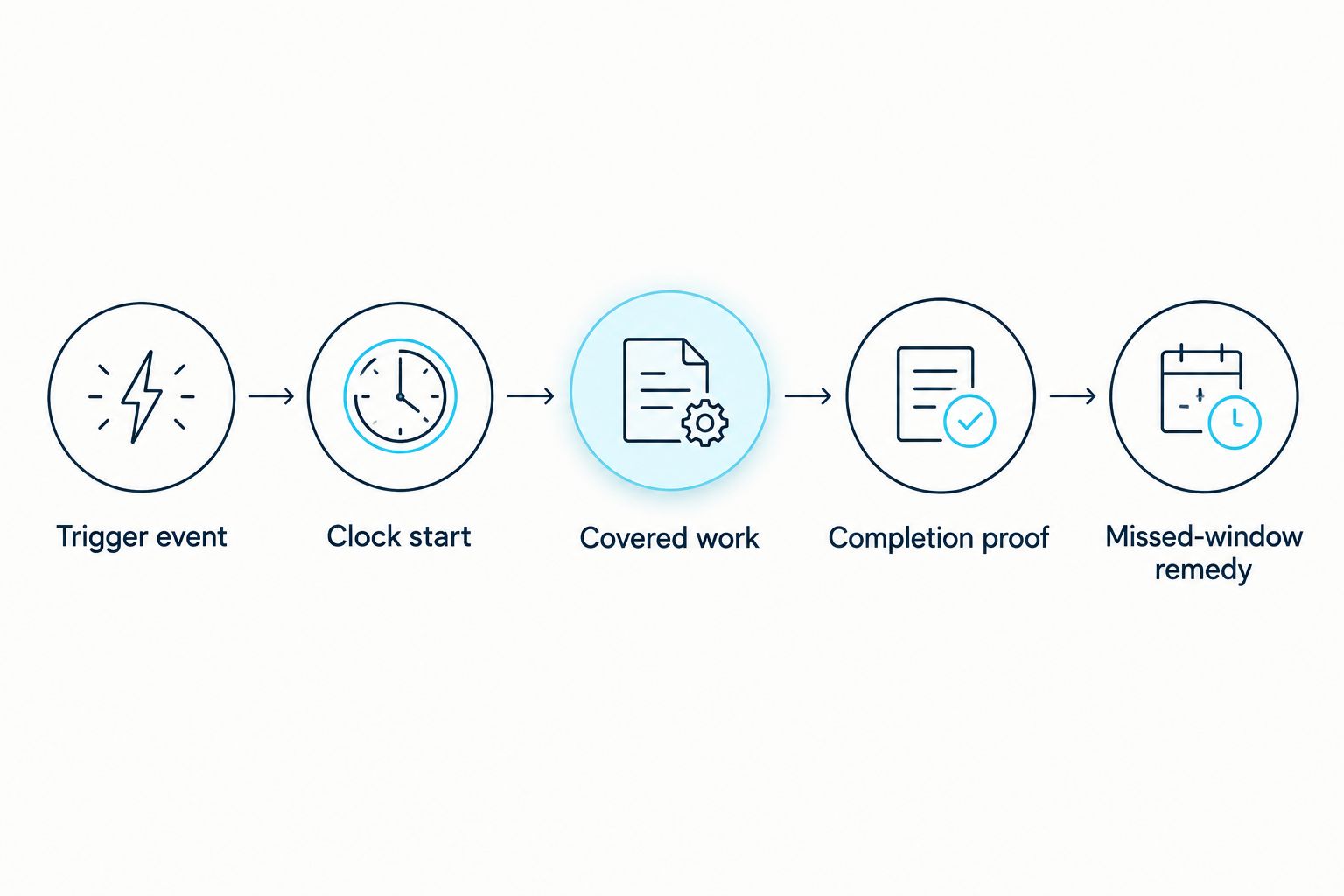
The relationship between the options is straightforward: the trigger starts the clock, the scope defines the work, the service log records activity, and the completion record stops the clock.
Crew arrival within 4 hours
An arrival guarantee commits the contractor to getting a crew to the property within 4 hours of the event defined in the contract. That event might be a specified accumulation trigger, an authorized dispatch, or another objective condition written into the agreement.
The advantage is clean verification. A geo-stamped arrival record can show whether the deadline was met without debating how much of the property had been cleared. The disadvantage is equally clear: a truck entering the lot does not mean the lot is open, treated, or complete.
Use an arrival guarantee when your primary concern is whether the contractor begins responding on time. Do not treat it as a clearing guarantee unless the agreement separately defines the work that must follow arrival.
The contract should answer these questions:
- What event starts the 4-hour period?
- Which property address does the guarantee cover?
- What record proves arrival?
- Does staging nearby count, or must equipment enter the property?
- What happens after the crew clocks in?
Verdict: accept a 4-hour arrival guarantee only as a dispatch commitment, not as proof of completed clearing.
First-pass clearing within 4 hours
A first-pass guarantee commits the contractor to opening named priority areas within 4 hours. The agreement should list those areas directly, because first pass has no fixed meaning without a written service order.
For a commercial property, the named scope could distinguish vehicle access from pedestrian access. The contract can prioritize entrances and primary drive lanes while reserving secondary areas for later passes. The actual priorities must match the property plan rather than an unwritten assumption.
This model works during active snowfall because it acknowledges that service can happen more than once. The crew records the first pass, continues monitoring the event under the contract terms, and returns or remains on-site when another service action is required.
The benefit is operational clarity. The limitation is that visitors may still encounter snow outside the priority scope even though the contractor met the first-pass deadline.
Verdict: a 4-hour first-pass guarantee is the strongest practical option when the contract names priority areas and documents completion.
Full lot clearing within 4 hours
A full-lot guarantee commits the contractor to completing every parking area included in the agreement within 4 hours. That promise only works when full lot, clock start, access conditions, weather exceptions, and completion evidence are all defined.
Parked vehicles can prevent complete clearing of occupied spaces. Deliveries can block loading areas. Continuing snowfall can cover pavement that was already serviced. A contract has to explain how those conditions affect the deadline instead of leaving the contractor and property manager to negotiate during the event.
Full-lot clearing also must remain separate from sidewalk clearing and treatment unless the contract explicitly includes those tasks in the same window. Different crews or equipment can handle each part of the property, and one completed task does not prove that all contracted work is finished.
The advantage is a clear sitewide target. The disadvantage is that the promise becomes less credible as undefined tasks and exceptions accumulate.
Verdict: accept a 4-hour full-lot guarantee only when the scope is narrow enough to measure and the exceptions are written before winter.
Why 4-hour snow clearing varies
The same property can require a different service sequence from one event to another. These factors determine whether a 4-hour deadline describes an achievable plan or sales language:
- Clock definition: A deadline measured from the accumulation trigger is different from one measured from dispatch, snowfall ending, or property authorization.
- Covered scope: Arrival, first pass, full parking-lot clearing, sidewalks, and treatment are separate deliverables unless the agreement combines them.
- Active snowfall: A completed pass can require follow-up service when accumulation continues after the crew finishes.
- Property access: Parked vehicles, gates, deliveries, and other site activity can block areas included in the original scope.
- Priority order: Entrances, drive lanes, sidewalks, and secondary parking areas can carry different service priorities.
- Documentation: A deadline without recorded arrival and completion times cannot be audited reliably after the event.
A regional storm adds another operational constraint: multiple contracted properties can reach their service triggers during the same period. The contractor's route plan and priority rules should already account for that condition. A verbal assurance given during bidding is not a substitute for a written route commitment.
What should a 4-hour guarantee say?
A usable guarantee answers each of the following questions in the service agreement. If one answer is missing, the property manager does not have a complete response standard.
- What starts the clock? Name an objective trigger. Avoid language such as promptly, as needed, or after the storm unless another clause defines those terms.
- What must happen within 4 hours? Specify arrival, first pass, full clearing, treatment, or another measurable result.
- Which areas are covered? List the parking areas, drive lanes, entrances, sidewalks, loading areas, and other contracted zones that apply.
- What stops the clock? Require a completion record tied to the property and service action.
- Which conditions change the deadline? Define access problems, continuing accumulation, authorized scope changes, and any other agreed exceptions.
- What proves performance? State which service logs, timestamps, photographs, or other records establish arrival and completion.
- What happens after a miss? Put the notice process, escalation path, and contractual remedy in writing.
Do not accept a clause that starts the clock when the contractor decides conditions warrant service. That wording lets the same party control the trigger and the measured response. The property manager needs a trigger that both sides can identify from the contract and service record.
The 2026 agreement should also identify who can authorize extra work. A site contact may request a change during an event, but that change should not silently rewrite the original completion deadline.
How do you prove the contractor met 4 hours?
Proof requires a record of the trigger, arrival, work performed, and completion. A timestamp by itself is incomplete if it does not identify the property or the service action connected to it.
Geo-stamped clock-ins establish when a crew reached the site. Timestamped photographs can show conditions before or after a pass. A service checklist identifies which contracted tasks were performed. Together, these records create a usable event history rather than a vague statement that the crew was there.
Property managers should decide where the records will be stored and who receives them. The service-log and insurance audit workflow shows why consistent records matter after the invoice is approved.
St. Louis Snow Removal is best for property managers and businesses that want documented commercial snow plowing, de-icing, salting, and sidewalk clearing across the St. Louis metro and Metro East Illinois. Its documented service approach fits buyers who require evidence, but that positioning does not create a universal 4-hour guarantee; only the property-specific contract can establish one.
St. Louis Snow Removal also serves enrolled residential snow routes. Route enrollment is a different service model from a site-specific commercial deadline, so homeowners should read the route terms rather than assuming the commercial guarantee structure applies.
Define your snow response standard
Set the trigger, scope, documentation, and response terms for your property.
Can a contractor guarantee bare pavement within 4 hours?
A contractor should not guarantee bare pavement within 4 hours without defining weather, pavement, treatment, access, and active-storm conditions. Clearing accumulated snow and producing bare pavement are different outcomes, especially while precipitation continues or treated surfaces require follow-up work.
Write the required result into the scope. If the contract promises only plowing, do not read treatment or a specific surface condition into that promise.
Does the 4-hour clock start when snow begins?
The 4-hour clock starts at the event named in the contract, which should be objective and documented. Snow beginning is not automatically the trigger; the agreement could instead use a defined accumulation threshold, authorized dispatch, or another written condition.
A property manager should never have to infer the start time after the event. The service record should show the trigger time used for the deadline.
What happens when a contractor misses the 4-hour deadline?
The written remedy controls what happens after a missed 4-hour deadline. The agreement should state the notice process, required response, escalation contact, and contractual remedy rather than leaving the parties to improvise during a storm.
Documentation matters here as much as it does for successful service. Both sides need the same trigger and completion records before deciding whether a miss occurred.
FAQ
Can snow removal really be guaranteed within 4 hours?
Yes, a contractor can guarantee a defined snow-removal action within 4 hours when the contract specifies the trigger, scope, exceptions, proof, and remedy. A universal full-lot promise for every storm condition is not credible.
What does a 4-hour snow clearing guarantee include?
A 4-hour snow clearing guarantee includes only the tasks and areas named in the contract. Arrival, first pass, full clearing, sidewalk work, and treatment should be listed separately.
Is crew arrival the same as lot clearing?
No, crew arrival proves that service began, not that the lot was cleared. The contract needs a separate completion standard and completion record.
Can active snowfall affect the 4-hour deadline?
Yes, active snowfall can require repeated passes after the initial work is complete. The agreement should define whether the deadline covers first-pass service, final cleanup, or both.
How should a property manager verify snow service?
A property manager should verify service with trigger records, geo-stamped clock-ins, timestamped photographs, and completed service checklists. The records should identify the property and work performed.
Does a 4-hour guarantee apply to sidewalks too?
A 4-hour guarantee applies to sidewalks only when the agreement includes them in the timed scope. Parking-lot clearing and sidewalk clearing are separate tasks unless the contract states otherwise.
What should a 2026 snow contract say about missed deadlines?
A 2026 snow contract should define how a missed deadline is reported, escalated, documented, and remedied. Without that language, the response target lacks a clear enforcement process.
Is a 4-hour guarantee available for residential snow routes?
Residential route service follows the enrollment and route terms provided by the contractor. Homeowners should not assume a commercial property response guarantee applies to an enrolled residential route.
One last thing
Ask the bidder to rewrite the promise as a complete sentence before signing: the contractor will perform a named action at a named property within 4 hours of a named trigger, subject only to named exceptions, with completion shown by named records. If the contractor cannot fill in every part, the guarantee is not ready for a 2026 service agreement.
St. Louis Snow Removal shows its work through documented commercial snow and ice service. The contract still needs to say exactly which clock applies to your property; documentation proves performance, but it cannot repair an undefined promise.