24-hour emergency snow removal is worth the extra cost in 2026 for properties that carry round-the-clock liability exposure — hospitals, grocery stores, gas stations, apartment complexes — where an uncovered walkway between storms is the risk that costs more than the plow bill. The premium isn't the plow pass itself; it's the overtime labor floor a crew charges to stage trucks and answer a 2 a.m. callout, which runs well above the daytime contract rate.
- 24 hour emergency snow removal is worth it for properties open or occupied around the clock, not daytime-only offices.
- Standard contracted plowing runs on roughly a $90/hr labor floor; overnight emergency dispatch runs closer to $180/hr once overtime and staging are added.
- Zero-Tolerance and Seasonal contracts already price for unlimited pushes, which makes a separate emergency premium redundant for many properties.
- Per-Occurrence contracts without standby coverage are the ones most exposed to a surprise emergency callout invoice.
Why this matters
Property managers get pitched 24-hour emergency snow removal as a blanket upgrade, and most of the pitch skips the part where the premium comes from. It's not a magic surcharge — it's overtime pay, holiday differentials, and a truck sitting fueled and staged instead of parked for the night. St. Louis Snow Removal treats that premium as a line item tied to a specific labor floor, not a flat add-on percentage.
The decision isn't "do I want faster service." It's "does my property's liability profile justify paying overnight overtime rates on top of what I already pay for a seasonal or per-occurrence contract." A daycare that closes at 6 p.m. has a different answer than a 24-hour urgent care clinic.
Is 24 hour emergency snow removal worth it in 2026?
The answer depends on whether the property is already covered by a contract that prices for unlimited pushes, and whether anyone is on-site or arriving between the hours a standard contract doesn't cover.
| Contract model | Trigger for service | Best for | Verdict | |---|---|---| | Zero-Tolerance (seasonal) | Any measurable accumulation, unlimited pushes | Hospitals, grocery stores, gas stations, 24/7 sites | Emergency premium usually redundant | | Per-Occurrence | Documented trigger depth, billed per visit | Daytime-only offices, retail with fixed hours | Skip 24-hour standby, keep documented trigger depth | | Seasonal, no unlimited clause | Set number of pushes per season | Predictable-traffic properties | Read the fine print before assuming coverage | | Add-on 24-hour emergency dispatch | On-call, outside contract window | Any property with round-the-clock occupancy | Worth the $180/hr floor for liability-heavy sites |
Properties running a documented seasonal snow removal contract with an unlimited-push clause are already paying for overnight coverage inside the base rate. Stacking a 24-hour emergency add-on on top of that is paying twice for the same event.
Zero-Tolerance and Seasonal contracts: $90/hr standard labor floor
A Zero-Tolerance contract prices unlimited visits into a flat seasonal or near-flat rate, and that rate is built on the standard $90/hr labor floor because the crew's schedule already assumes storm-hour work. There's no separate invoice line for a 2 a.m. push under this model — it's baked in.
This works for properties where the trigger depth and unlimited-push language cover every hour of the day, not just business hours. Verdict: keep the Zero-Tolerance contract as-is and skip the emergency add-on — you're already paying for it.
The catch is verification. Not every "seasonal" contract is actually Zero-Tolerance; some cap the number of pushes per month. Read the contract before assuming overnight events are covered at the base rate.
Per-Occurrence and emergency dispatch: $180/hr overtime labor floor
Per-Occurrence contracts bill by the visit at the standard rate during contracted hours, and that's the model where a genuine gap exists. If a storm hits at midnight and the contract doesn't specify overnight response, the property either waits until morning or pays an on-call crew at the overtime labor floor — roughly $180/hr once staging, fuel pre-positioning, and holiday differentials stack on top.
For a property with foot traffic before the morning plow arrives — a 24-hour pharmacy, a hospital campus, a hotel — that overnight gap is the exposure a slip-and-fall claim gets built on. Verdict: pay the $180/hr emergency premium if the property has any occupancy between contract hours and sunrise.
Check the emergency snow removal callout cost breakdown before signing an add-on — the invoice should itemize labor, staging, and any holiday differential separately, not roll it into a single flat surcharge.
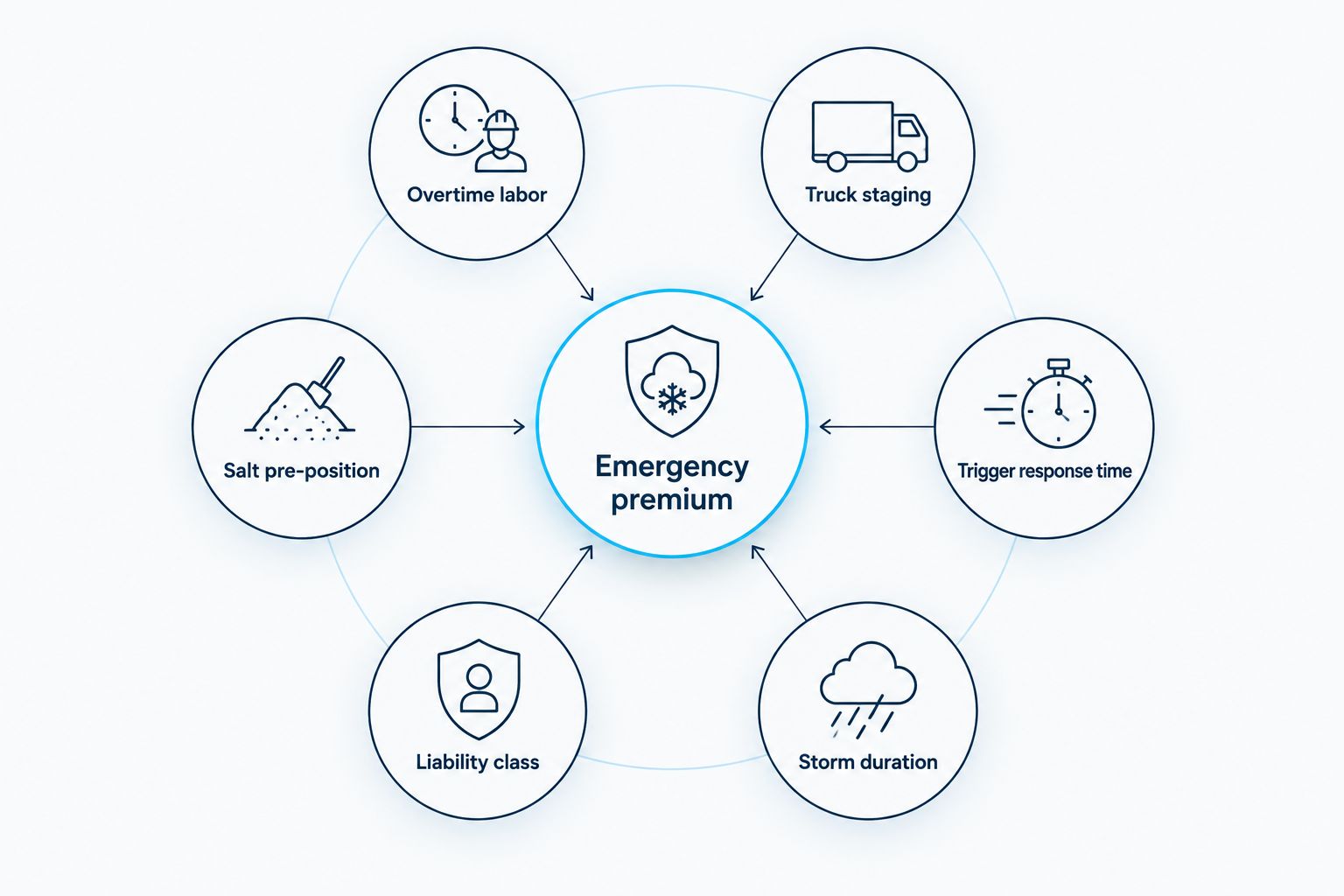
Why the emergency premium varies
- Overtime and holiday differentials — a storm on Christmas Eve at 3 a.m. costs more to staff than a Tuesday afternoon push.
- Truck staging distance — crews held on standby near the property cost more than crews dispatched from a central yard after the call comes in.
- Salt and fuel pre-positioning — pre-treating and pre-loading trucks before a storm arrives adds labor hours the base contract doesn't cover.
- Documented trigger response time — a commitment to start clearing within a set window of hitting the trigger depth costs more than an undefined "as soon as possible."
- Liability class of the property — a hospital or grocery store with continuous foot traffic carries a different response commitment than a closed office park.
- Storm duration and intensity — a multi-day event with repeated pushes runs the overtime meter longer than a single six-inch storm.
“Emergency dispatch without geo-stamped clock-ins is just a bigger invoice with no proof attached.”
Does a seasonal contract already include emergency response?
A Zero-Tolerance seasonal contract usually does, since unlimited pushes at any measurable accumulation are already priced into the base rate, including overnight and weekend storms. A seasonal contract with a capped number of pushes per month does not, and a 3 a.m. storm on that plan can still trigger a separate emergency charge.
How fast should an emergency crew respond after a storm starts?
Response should begin once accumulation crosses the property's documented trigger depth, not on a fixed clock unrelated to the storm itself. Properties with continuous occupancy should have that trigger depth and response commitment written into the contract, not left as a verbal assumption.
Is per-occurrence pricing cheaper than paying for 24-hour standby?
Per-occurrence pricing is cheaper for properties that never need overnight service, since you only pay the standard $90/hr labor floor for contracted-hour visits. It gets more expensive than a seasonal contract fast once a property racks up multiple emergency callouts at the $180/hr overtime floor in a single season.
Get your 2026 snow contract reviewed
Check whether your current contract already covers overnight events before you pay for standby.
FAQ
Is 24 hour emergency snow removal worth it in 2026?
It's worth it for properties with round-the-clock occupancy or liability exposure — hospitals, grocery stores, gas stations, apartment complexes — where an uncovered overnight storm is the real risk. Daytime-only offices already covered by a documented seasonal or per-occurrence contract usually don't need the add-on.
How much more does emergency snow removal cost than standard plowing?
Standard contracted plowing runs on roughly a $90/hr labor floor, while overnight emergency dispatch runs closer to $180/hr once overtime, staging, and holiday differentials are added. The gap comes from labor cost, not a bigger truck or more salt.
Does a Zero-Tolerance contract already cover overnight snow events?
A true Zero-Tolerance contract covers overnight and weekend events because it prices unlimited pushes into the base seasonal rate. Confirm the unlimited-push clause is actually in writing before assuming a 2 a.m. storm won't trigger a separate charge.
What properties need 24-hour emergency snow removal the most?
Hospitals, grocery stores, gas stations, senior living facilities, and apartment complexes need it most because people are on-site or arriving at hours a standard contract may not cover. A closed office park with no overnight traffic has far less need for standby coverage.
Can I switch from per-occurrence pricing to a seasonal contract mid-winter?
Most snow contracts lock in for the season, so switching mid-winter is uncommon and depends on the terms already signed. Review the contract renewal window before the next storm season starts in 2026.
What should an emergency snow removal invoice show?
It should itemize labor hours at the overtime rate, any staging or standby charge, and holiday differentials separately rather than rolling everything into one flat surcharge. A vague single-line invoice is a sign the premium isn't tied to actual work performed.
Does trigger depth affect whether I need emergency dispatch?
Yes — a property with a low trigger depth and a tight response-time commitment needs faster coverage than one with a higher trigger depth and a looser window. Properties with continuous occupancy should pair a low trigger depth with either Zero-Tolerance coverage or a 24-hour emergency add-on.
One last thing
The properties that regret skipping 24-hour emergency coverage almost never regret the plow bill — they regret the slip-and-fall claim with no documentation behind it. Geo-stamped clock-ins and time-stamped photos turn an emergency callout into a defensible record instead of a "trust me, we were there" conversation with an insurance adjuster in 2026.