

An emergency snow removal callout in the St. Louis metro runs on the same labor-floor pricing St. Louis Snow Removal uses for every dispatch, whether a property is already under contract or calling in cold during a storm. This page breaks down what an off-contract call costs in 2026, why enrolled properties pay less per hour, and what actually moves the price during an active storm sequence.
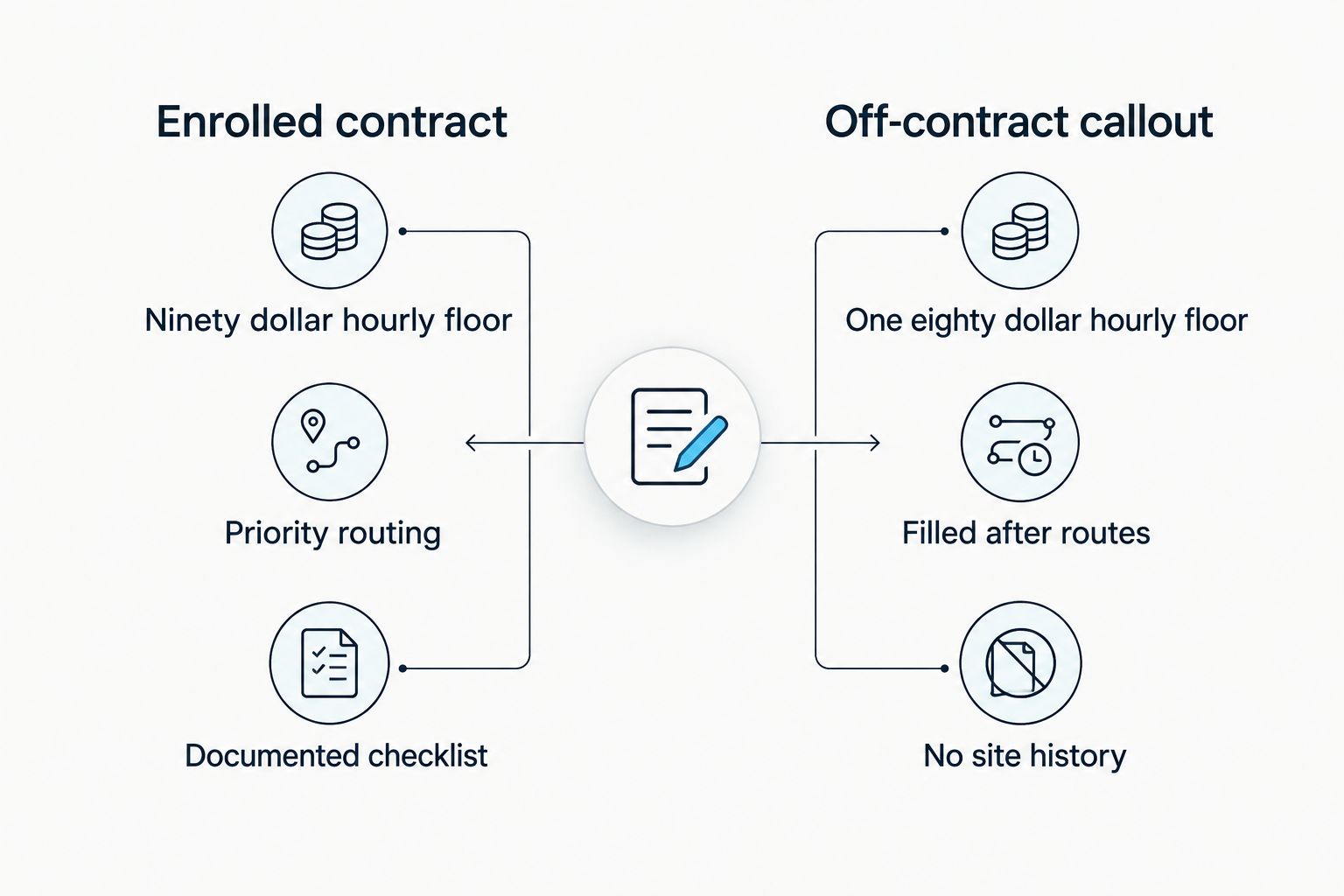
- Off-contract emergency snow removal callouts run $180 an hour in 2026; enrolled accounts pay a $90-an-hour labor floor.
- The $90-an-hour rate only applies once a property is enrolled before the storm — not once you're already calling for help.
- Off-contract calls get filled after enrolled routes, inside the same 24-hour dispatch window.
- Zero-Tolerance, Seasonal, and Per-Occurrence contracts all lock in the lower labor floor; nothing arranged mid-storm does.
Why this matters
A storm doesn't check your contract status before it hits. Property managers who skip enrollment find out mid-storm that St. Louis Snow Removal — like any contractor running a real route sheet — services enrolled properties first and fills off-contract calls only after those routes are done.
Calling during a storm for an emergency snow removal callout means paying for queue position, not just labor. That's the entire gap between $90 an hour and $180 an hour: one rate assumes a crew was already routed to you, the other assumes a crew has to be pulled off a committed schedule.
How much does an emergency snow removal callout cost?
The rate depends entirely on whether a property has a standing agreement in place before the snow starts falling.
| Scenario | Labor rate (2026) | Dispatch priority |
|---|---|---|
| Enrolled — Zero-Tolerance, Seasonal, or Per-Occurrence contract | $90/hour | Routed ahead of unscheduled calls |
| Off-contract emergency callout | $180/hour | Filled after enrolled routes, inside the 24-hour dispatch window |
The off-contract rate is exactly double the enrolled floor. That's not a penalty tacked on for effect — it's what it costs to hold a truck, a driver, and a plow blade in reserve for a call that might not come, instead of running that same crew on a pre-planned route all storm long.
Enrolled per-occurrence dispatch: $90 per hour
Every property signed to a Zero-Tolerance, Seasonal, or Per-Occurrence contract with St. Louis Snow Removal in 2026 bills at the $90-an-hour labor floor once a documented trigger depth is hit. Billing runs against actual hours logged, backed by geo-stamped clock-ins so there's no dispute over when a crew arrived or left.
That documentation matters more than most property managers expect. A slip-and-fall claim doesn't care what the invoice says — it cares whether there's a timestamped record showing the lot was serviced before the incident. Enrolled accounts get that record as a built-in part of the $90 rate, not as an add-on.
Off-contract emergency callout: $180 per hour
A property with no standing agreement pays the $180-an-hour floor for an emergency snow removal callout, and that crew is dispatched only after enrolled routes are covered. Check the list of 24-hour emergency snow removal companies in St. Louis before assuming any contractor can drop everything for a walk-in call — most can't, and the ones that can are the ones already running a 24-hour dispatch operation with spare crew capacity built in.
The $180 rate reflects three things bundled together: the labor itself, the opportunity cost of holding standby capacity, and the risk of servicing a lot with zero site history — no known layout, no prior salt application record, no existing checklist.
Why the emergency callout rate varies
No two off-contract calls cost identically, even at the same $180-an-hour floor. A handful of factors move the total bill:
- Contract status — enrolled properties never see the $180 rate; it only applies to unscheduled, off-contract calls.
- Queue position during an active storm — a call placed at the start of a storm sequence gets serviced sooner than one placed at hour six of an all-day event.
- Lot size and layout — more square footage and more obstacles (islands, curb cuts, fire lanes) mean more billed hours at the same hourly floor.
- Whether de-icing or salting is bundled in — plowing and salting are separate line items, and an off-contract call that needs both takes longer to invoice-close than a plow-only visit.
- Distance from an existing crew route — a callout near a route St. Louis Snow Removal is already running costs less in dead-head time than one that requires pulling a crew off-route entirely.
- Documentation requirements — a property that needs a full proof-of-service file for an insurance audit or a slip-and-fall defense takes more crew time than a bare plow-and-go.
Is a seasonal contract cheaper than paying for emergency callouts?
Yes — a seasonal contract cheaper than per-push pricing comparison holds up here too: locking in the $90-an-hour enrolled floor before the season starts beats paying $180 an hour for even one off-contract emergency callout. One unscheduled storm call at the higher rate can wipe out the savings a seasonal contract would have delivered over several storms.
Does St. Louis Snow Removal charge extra for overnight emergency dispatch?
The $180-an-hour off-contract floor applies any time a crew is pulled in without a standing agreement, including nights and weekends, inside the same 24-hour dispatch window St. Louis Snow Removal runs for every storm in 2026. There isn't a separate overnight surcharge layered on top of that rate — the floor itself already accounts for round-the-clock coverage.
What happens if I don't have a contract when the first snow of the season hits?
You pay the $180-an-hour off-contract rate and wait behind every enrolled property on the route sheet. Enrollment doesn't retroactively apply to a storm that's already in progress — the $90-an-hour floor only kicks in once a Zero-Tolerance, Seasonal, or Per-Occurrence agreement is signed before the next trigger depth is hit.
FAQ
How much does an emergency snow removal callout cost in 2026?
An emergency snow removal callout costs $180 an hour when a property has no standing contract, versus a $90-an-hour floor for enrolled accounts in 2026. The gap covers standby crew capacity and the lack of prior site documentation.
Why is off-contract emergency snow removal double the enrolled rate?
The $180-an-hour off-contract rate is exactly double the $90-an-hour enrolled floor because it covers crew standby time and dead-head travel for a property with no existing route or site history. Enrolled accounts get the lower rate because their route is already planned.
What's the difference between a Zero-Tolerance, Seasonal, and Per-Occurrence contract?
All three contract types lock in the $90-an-hour enrolled labor floor with St. Louis Snow Removal for 2026, but they differ in how service triggers and billing cycles are structured across the season. None of them apply retroactively once a storm has already started.
Do enrolled properties get serviced before emergency callouts during a storm?
Yes — enrolled properties on a Zero-Tolerance, Seasonal, or Per-Occurrence contract are routed ahead of off-contract emergency callouts. Off-contract calls are filled after scheduled routes are cleared, inside the same 24-hour dispatch window.
Is emergency snow removal billed by the hour or by the push?
Emergency snow removal is billed against an hourly labor floor — $90 an hour for enrolled properties, $180 an hour off-contract — with hours logged against geo-stamped clock-ins. Total cost depends on how many hours the site actually takes to clear.
Can I get the $90-an-hour rate mid-storm if I sign up during the snowfall?
No — the $90-an-hour enrolled floor applies to accounts signed before the storm's trigger depth is hit, not to calls made once snow is already falling. Mid-storm sign-ups are dispatched at the $180-an-hour off-contract rate for that event.
What proof of service comes with an emergency snow removal callout?
Both enrolled and off-contract emergency callouts are logged with geo-stamped clock-ins as part of St. Louis Snow Removal's documented checklist process. That record is what backs an insurance audit or a slip-and-fall defense file if a claim comes in later.
One last thing
The $180-an-hour off-contract rate isn't a random markup — it's exactly double the $90-an-hour floor enrolled properties pay, and that ratio is fixed for 2026. The only lever a property manager controls is timing: sign a Zero-Tolerance, Seasonal, or Per-Occurrence contract before the season's first accumulating snow, and the lower floor applies for every trigger event after that. Wait until the parking lot is already covered, and the $180 rate is the only option on the table.
Lock in the enrolled rate before the next storm
Enroll before the season's first trigger depth to avoid the $180/hour off-contract rate.