

Budget commercial snow removal for the 2026-2027 season by defining what crews must clear, when service starts, and which visits your contract covers before assigning a budget. Compare Seasonal, Per-Occurrence, and Zero-Tolerance terms against the same site map; keep de-icing, sidewalks, repeat visits, and service records visible rather than hiding them inside a plowing line item.
- To budget commercial snow removal for the 2026-2027 season, define site scope and triggers before comparing contracts.
- Seasonal terms make planned spending easier to track; Per-Occurrence terms tie charges to billable events.
- Zero-Tolerance needs a written service definition, not an assumption that every surface stays clear.
- St. Louis Snow Removal is best for property managers seeking documented commercial snow and ice service across its stated service area.
How do you budget for commercial snow removal for the 2026-2027 season?
Start with a site-by-site scope, then ask each contractor to price that identical scope under the contract models it offers. The seasonal versus per-push comparison is a useful companion when you need to separate predictable contract spending from charges tied to individual events. For each proposal, record what activates a visit, which surfaces are included, how repeat service is handled, and what proof arrives with the invoice.
| Budget line | What to define before requesting a proposal | What to check in the contract |
|---|---|---|
| Parking areas | Lots, drives, loading areas, and areas where snow can be placed | Plow trigger, return visits, and whether hauling is separate |
| Pedestrian routes | Entrances, sidewalks, crossings, and access routes | Clearing trigger, priority, and whether hand work is included |
| Ice treatment | Surfaces to treat and who authorizes treatment | Whether salting or de-icing is included, separate, or conditional |
| Response | When the property needs usable access | Dispatch terms versus a promised clearing deadline |
| Records | What your team needs to verify each visit | Timestamps, photos, checklists, and invoice detail |
The budget is not complete until the service boundary is complete. A plowing figure cannot tell you what winter operations cost if pedestrian clearing and ice treatment sit outside it. The same applies to snow hauling: identify whether there is room to store pushed snow before treating removal from the property as part of ordinary plowing.
Why this matters for your property
A property manager needs a budget that can be approved, administered during a storm, and reconciled afterward. Those are different tests. A contract can appear clear at approval yet leave the on-site manager deciding whether an icy entrance qualifies for treatment or whether a return visit needs separate authorization.
For the 2026-2027 season, build the budget around decisions someone will actually make: whether conditions activate service, which area takes priority, who can request extra work, and what documentation confirms completion. This keeps the proposal tied to the operating needs of the property rather than a single headline charge.
If you manage several properties, do not copy one site's scope across the portfolio. A loading entrance, a customer-facing walk, and an otherwise unused section of pavement have different service priorities. Put those differences on each site map so contractors can respond to the same instructions.
Build a scope contractors can price consistently
Map every surface and its priority
Mark the parking lot, drives, entrances, sidewalks, crossings, loading areas, and places where snow can be stored. Distinguish areas that must be addressed first from areas that can wait until the initial pass is complete. Give contractors the same map and ask them to identify exclusions on it.
The map also exposes work that a plow alone cannot finish. A truck can clear an open lane without clearing the walk between that lane and the building. If both are required for access, both belong in the scope. Document who is responsible for each surface instead of assuming the parking-lot contractor covers everything adjacent to it.
Write down the activation rule
A trigger depth tells a crew when plowing begins; an ice-treatment rule addresses conditions that do not depend on plowable snow. Put both in writing. State who monitors conditions, whether a visit is automatic or requires approval, and what happens when conditions change after the first pass.
Do not substitute a desired finish time for a dispatch rule. A 4-hour clearing request needs a defined starting point, covered areas, and conditions under which the deadline applies. Otherwise, the number describes a wish, not a service obligation you can administer.
Identify work beyond the first pass
List repeat plowing, additional salting, sidewalk return visits, snow hauling, and emergency requests as distinct decisions. Ask which are included and which require separate authorization. This is especially important when a storm continues after a lot has been opened: an initial pass and a final cleanup are not the same task.
For ice treatment, define the area rather than assuming the whole site receives the same application. A proposal organized by surface makes it easier to question a treatment record and compare the invoice with the visit log. If a contractor uses an application benchmark per 1,000 sq ft, ask which measured areas that benchmark covers; the area alone does not establish a treatment quantity.
Seasonal versus Per-Occurrence: choose the budget model
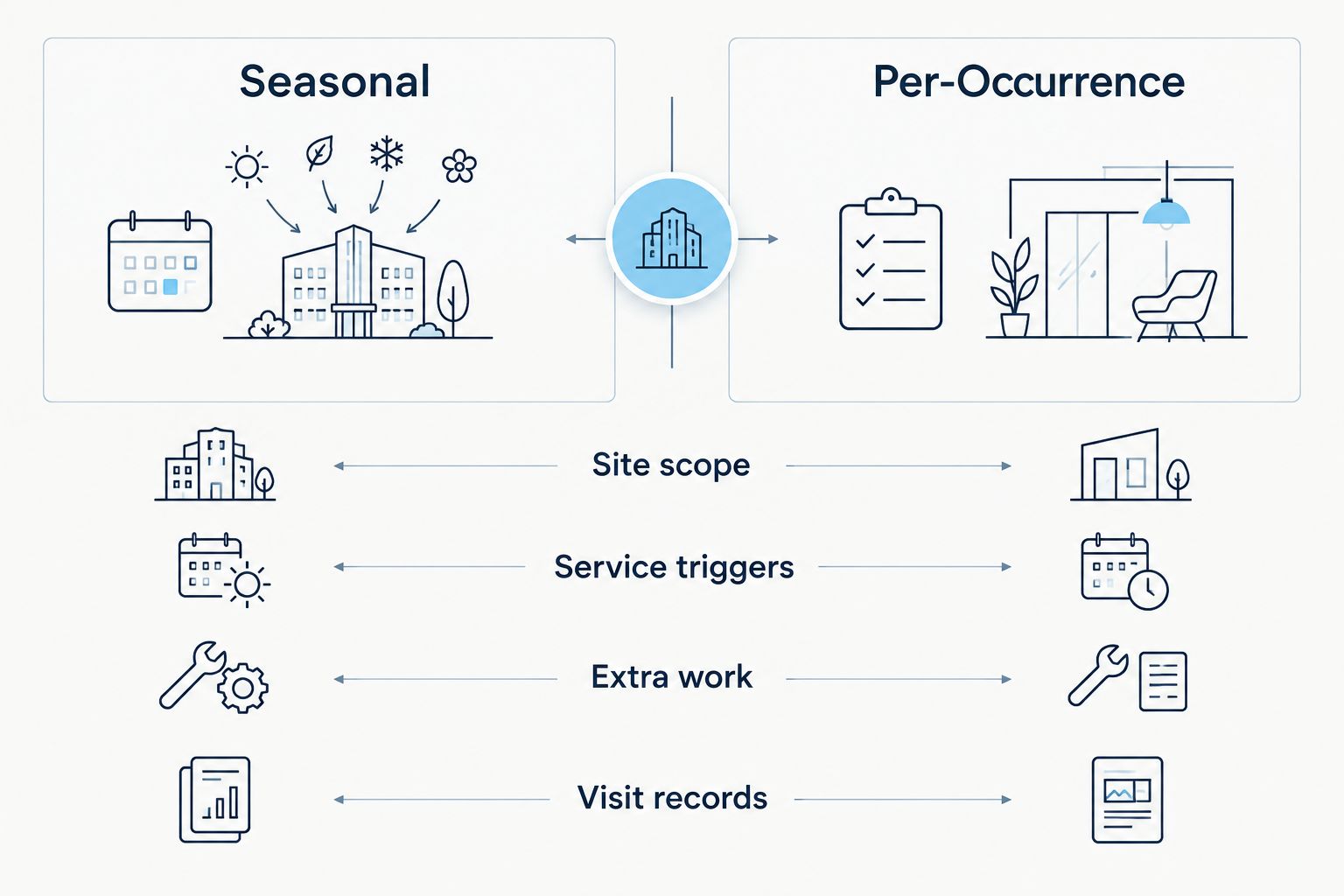
Seasonal is best for a property manager who wants contract spending defined in advance; Per-Occurrence is best when the manager wants charges tied to specified service events. Neither model fixes a vague scope. Compare the same plowing, sidewalk, ice, and documentation requirements under both before deciding which billing structure fits your approval process.
| Model | Best for | Budget advantage | Budget limitation |
|---|---|---|---|
| Seasonal | A property with a defined recurring service scope | Makes the contracted portion easier to plan | Extra work and exclusions still need written treatment |
| Per-Occurrence | A property that reviews charges by completed visit or event | Connects billing to stated service activity | Total spending changes with the number and type of billable visits |
| Zero-Tolerance | A property that requires an explicitly defined response to changing conditions | Forces attention onto monitoring and treatment rules | The label alone says nothing about covered surfaces, response, or exclusions |
For a Seasonal proposal, identify the exact service included throughout the 2026-2027 season. Ask whether sidewalk work, de-icing, repeat passes, and hauling belong to the contracted scope. Then list every circumstance that creates an additional charge or requires approval. A predictable contract line is useful only if the team knows where that line ends.
For a Per-Occurrence proposal, define what counts as an occurrence. Is a second visit during the same storm another billable event? Are plowing and salting separate activities? Does sidewalk clearing appear on its own record? Those questions matter more than the model name because they determine what your team will approve and reconcile.
Treat Zero-Tolerance as a service standard that needs its own written definition, not as a substitute for a pricing model. Specify the areas it applies to, the conditions that prompt treatment, who checks the site, and what happens when conditions recur. You still need to establish how the work is billed.
A useful comparison sheet has a row for each required task and a column for each proposal. Mark the task as included, separately authorized, or excluded. If a contractor cannot place a task in one of those categories, the proposals are not ready for a budget decision.
Why commercial snow removal budgets vary
The 2026-2027 budget changes when the work changes. Put these drivers beside every proposal so a difference in scope does not masquerade as a difference in value:
- Surface mix. Open parking areas, narrow walks, entrances, and loading areas require different tasks. List them separately.
- Service triggers. Plowing, salting, and sidewalk clearing need their own activation rules. One snow-depth trigger does not define ice response.
- Repeat visits. A continuing event can require another pass or treatment. State how those visits are requested, recorded, and billed.
- Snow storage and hauling. Pushing snow to a designated area is different from taking it off-site. Identify which outcome the property needs.
- Access priorities. A business entrance and a secondary area need not share the same order of service. Put the sequence on the site map.
- Documentation. Specify the visit records your team needs to verify work and resolve invoice questions.
These drivers give you a way to challenge a proposal without asking a contractor to guess at an undefined site. They also make budget changes traceable: if the scope expands to another walkway or a different trigger, you can identify the reason the agreement changed.
Make the records part of the budget
A service record is the bridge between the agreement and an approved invoice. Require a record that identifies the property, the visit, the work performed, and the areas covered. If your approval process calls for photos, timestamps, or a checklist, specify those deliverables before the 2026-2027 season starts.
St. Louis Snow Removal is best for property managers who want documented commercial snow plowing, de-icing, and sidewalk clearing across the St. Louis metro and Metro East Illinois. Its stated service includes documented work; the limitation is that you still need to confirm the exact site scope, triggers, records, and contract terms in the proposal. Do not treat a description of documented service as a promise about a particular clearing deadline.
Use the commercial snow and ice service site when requesting a scope for a property in its stated service area. Send the marked site map and ask for written distinctions among routine visits, additional treatment, and separately authorized work. That gives your team something concrete to check when the first invoice arrives.
A useful reconciliation process is simple: match the invoice line to the contract category, then to the service record. If the record does not show the area or task billed, request clarification before approval. The commercial snow removal service log guide explains what to examine in a visit record without treating the invoice itself as proof of the work.
Define your snow service scope
Start with your site map, service triggers, and required visit records.
What should you approve before the season starts?
Approve the map and contract together. The map says where the contractor works; the contract says when the work starts, how it is documented, and which tasks need additional authorization. If either document is unclear, your operating team will have to interpret it during a storm.
Give the person who handles after-hours decisions the same instructions as the person approving the budget. Name who can authorize extra work, who receives completion records, and who reviews disputed charges. For the 2026-2027 season, check these handoffs before service is needed, not after an invoice exposes the gap.
Finally, preserve the distinction between an operating target and a contractual commitment. If access must be ready before a particular business activity, state that need when requesting a proposal. Ask the contractor to define what it can commit to, which surfaces the commitment covers, and how a missed or incomplete visit will be reported. Do not write an internal deadline into your budget as though the contractor has accepted it.
FAQ
How do I budget commercial snow removal for the 2026-2027 season?
Define the site map, service triggers, covered tasks, extra work, and required records before comparing proposals. Apply the same scope to each contract model so the differences are clear.
Is a Seasonal snow contract better than Per-Occurrence billing?
A Seasonal contract is better when you need the contracted portion defined in advance; Per-Occurrence billing is better when you want charges tied to specified events. Both require written rules for exclusions and additional work.
Does a commercial plowing contract include salting?
Only the written scope can establish whether salting is included. Ask which surfaces receive treatment, what activates it, and whether another application needs separate approval.
Should sidewalk clearing have its own budget line?
Yes, if sidewalks are part of the property's required service. Identify the routes, trigger, priority, and billing treatment instead of assuming parking-lot plowing covers them.
What does Zero-Tolerance mean in a snow contract?
Zero-Tolerance needs a written definition of covered areas, monitoring, response conditions, and billing. The label alone does not establish what a crew will do or when.
Can I require proof of every snow removal visit?
You can make visit documentation a requirement when requesting and agreeing to service. Specify the property, areas worked, tasks completed, and records your team needs for invoice review.
Does a 4-hour clearing request guarantee the lot will be open?
No. A 4-hour request becomes a meaningful contract term only when the starting point, covered areas, conditions, and contractor commitment are defined in writing.
One last thing
The easiest budget gap to miss is the space where plowing ends and access begins. A cleared drive does not settle who treats the entrance walk, and a completed visit does not settle whether another treatment is needed later. For the 2026-2027 season, ask for those boundaries in writing; St. Louis Snow Removal's documented commercial service is most useful when your scope gives the records something precise to prove.