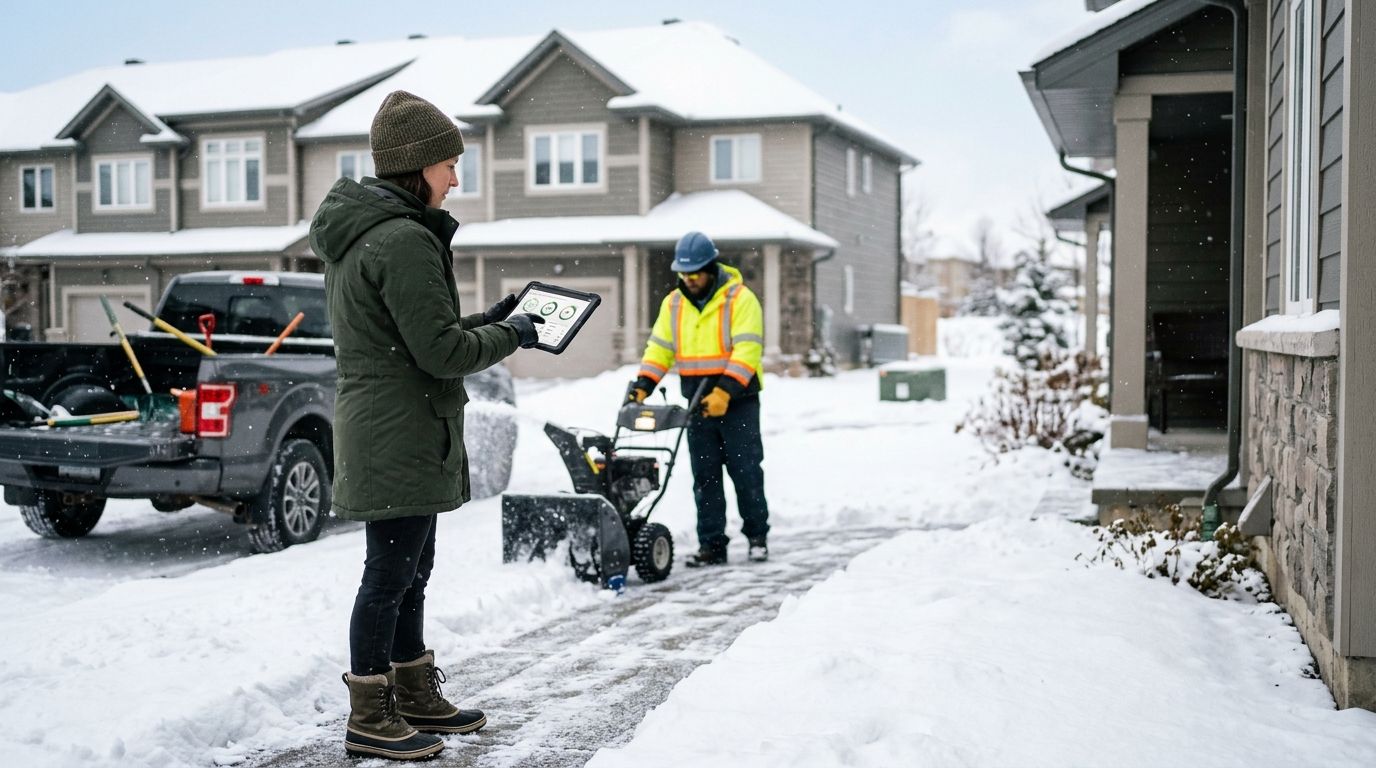

Manually re-keying snow removal invoices into QuickBooks or Sage every storm week wastes hours and produces GL coding errors that surface in March when the auditor asks why "Repairs & Maintenance" jumped $14,000 in one quarter. Build a snow removal invoice accounting integration around documented line items instead — trigger depth, clock-in time, labor rate, and contract type baked into the invoice — so your bookkeeper codes and posts in minutes, not hours.
- A working snow removal invoice accounting integration matches documented per-occurrence line items to GL codes without manual re-entry.
- St. Louis Snow Removal's Zero-Tolerance, Seasonal, and Per-Occurrence contracts each reconcile differently — pick the wrong match method and invoices bounce back to AP.
- Labor floors like $90/hr for sidewalk crews and $180/hr for plow operators belong on the invoice as line items, never as a lump sum.
- Match every invoice against the geo-stamped proof-of-service log before posting — an invoice without a log entry is a dispute waiting to happen.
Why this matters
Property managers running multiple sites lose track of which invoice covers which storm event once paper piles up. A vendor who bills a flat number with no trigger data forces your accounting team to trust the total and move on — that's how duplicate charges and phantom occurrences slip through in a bad winter.
St. Louis Snow Removal structures every invoice around the same documentation it uses for liability defense: geo-stamped clock-ins, trigger-depth readings, and per-occurrence timestamps. That structure is what makes an invoice-to-ledger workflow repeatable instead of a scramble every time it snows in 2026.
Before you start
- Get your GL structure settled first. Decide whether snow removal posts to "Snow Removal," "CAM - Snow & Ice," or a property-specific cost center before the first invoice arrives — retrofitting this mid-season means re-coding every entry.
- Confirm your contract model. Zero-Tolerance, Seasonal, and Per-Occurrence invoices carry different data (some are flat, some itemized by storm) and need different matching logic in your accounting system.
- The gotcha: a single storm can generate two or three separate line items on a Zero-Tolerance contract — plow pass, re-salt, sidewalk clear — each with its own timestamp. If your AP process expects one invoice per storm, these multi-line invoices will look like duplicates and get flagged in error. Set the expectation with your bookkeeper before week one, not after the first rejected batch.
Set up the vendor record correctly
- In your accounting system, create the vendor record for St. Louis Snow Removal with a default expense category matched to your chosen GL code — "Snow Removal Services" or your internal equivalent.
- Attach the property or cost center to the vendor record if you manage more than one site, so invoices route automatically instead of landing in a general bucket.
- Set payment terms to match the contract type: Seasonal contracts typically bill on a fixed schedule, while Per-Occurrence invoices arrive after each qualifying storm.
Expected result: every invoice from this vendor lands pre-coded to the right cost center the moment it's entered, with no manual category selection required.
Standardize invoice line items to match your GL structure
- Request itemized invoices that break out labor, material (salt/de-icer), and equipment separately rather than one bundled total.
- Confirm labor floors appear as rate times hours — commonly $90/hr for walk-behind sidewalk crews and $180/hr for truck-mounted plow operators — not as a flat service fee.
- Match each line item's date and trigger depth (the snowfall threshold, often 1-inch, 2-inch, or 3-inch, that activated the dispatch) against your service agreement's trigger clause.
- Split multi-service invoices (plow plus salt plus sidewalk) into separate GL lines if your chart of accounts tracks them independently.
Expected result: each invoice line drops into a specific, pre-mapped account with no judgment calls left for whoever is closing the books that month.
Match invoices to proof-of-service logs before you post
- Pull the documented service log for the billing period — the geo-stamped clock-in/clock-out record tied to the same contract.
- Line up each invoiced occurrence against a corresponding log entry by date and time.
- Flag any invoice line with no matching log entry and hold it out of the posting batch until it's resolved.
- For properties tracked through property-management software, connect proof-of-service logs directly to your PM platform so the match happens automatically instead of by hand each cycle.
Expected result: every dollar posted to the ledger has a documented service event behind it — no invoice gets paid on trust alone.
Batch and code entries into your accounting system
- Group matched, verified invoices into a single batch for the billing period.
- Import or manually enter bills using your accounting system's standard bill-entry function, applying the GL codes set up in step one.
- Attach the matched proof-of-service log as a supporting document on the bill record — most accounting platforms allow file attachments per transaction.
- Reconcile the batch total against the seasonal or per-occurrence contract cap before approving payment.
Expected result: a clean audit trail from invoice to ledger to source documentation, ready for year-end review without reconstruction.
Seasonal flat-rate vs. per-occurrence invoices: adjust the match
A Seasonal contract bills a fixed amount regardless of storm count, so the reconciliation step shifts from matching individual occurrences to confirming the season-to-date service log supports the flat fee — spot-check trigger events rather than matching line by line. A Per-Occurrence contract requires the full match described above for every single invoice, since the total varies by storm activity. Mixing these two matching methods on the wrong contract type is the single most common reconciliation error property managers make heading into 2026's first storm season.
Troubleshooting
- Invoice date doesn't match the log date. Storms that start late at night sometimes post to the following calendar day on the invoice but the prior day on the dispatch log — check the timestamp, not just the date field, before flagging it as an error.
- Combined plow-and-salt invoice won't split cleanly. Ask for itemized labor and material lines rather than trying to allocate a bundled total after the fact.
- Disputed line item has no log to back it. Hold that line out of the payment batch and request the specific geo-stamped record before releasing payment — don't pay first and investigate later.
- Multiple properties billed on one contract. Request per-property line items or a cost-center breakdown on the invoice itself so the split doesn't have to happen manually in your ledger.
- Seasonal invoice arrives without occurrence detail. Cross-check season-to-date trigger events against the service log rather than expecting a line-item breakdown that a flat-rate contract doesn't produce.
Customize your workflow
Once invoices are posting cleanly, extend the same documentation discipline to tenant communication and liability defense. Notify tenants automatically when crews arrive on site, and keep timestamped snow photos tied to your slip-and-fall defense file so a disputed invoice line and a disputed claim draw from the same documented record.
Get invoices built for your ledger
Documented, itemized snow removal billing for 2026 contracts.
FAQ
What is a snow removal invoice accounting integration?
It's a repeatable process for matching itemized snow removal invoice line items to your accounting system's GL codes using documented service records instead of manual re-entry. It relies on trigger-depth data, timestamps, and labor rates appearing on the invoice itself.
Should snow removal be coded to CAM or Repairs & Maintenance?
Either works as long as you pick one GL code before the season starts and apply it consistently. Property managers running CAM reconciliations for tenants typically use a dedicated Snow & Ice line so charges are easy to allocate back out.
How do I reconcile a Seasonal snow removal contract with variable storm activity?
Check the season-to-date proof-of-service log against the flat fee rather than matching every occurrence line by line. Spot-check a few storm dates against the trigger depth on record to confirm the flat rate is supported.
What's the difference between Zero-Tolerance and Per-Occurrence billing?
Zero-Tolerance contracts dispatch crews at low trigger depths and can bill multiple line items per storm event, while Per-Occurrence contracts bill once per qualifying storm. Set your AP process to expect multiple lines per week on Zero-Tolerance accounts so they don't get flagged as duplicates.
Can I attach proof-of-service logs directly to an accounting entry?
Most accounting systems allow a file attachment on a bill or transaction record, so the geo-stamped log can sit alongside the invoice line it supports. This keeps the audit trail in one place instead of split across email and a separate PM platform.
What labor rates should appear on a commercial snow removal invoice?
Line items should show rate times hours, not a flat total — commonly $90/hr for walk-behind sidewalk crews and $180/hr for truck-mounted plow operators. Invoices without a labor breakdown are harder to audit against the actual storm event.
How do I handle a disputed snow removal invoice line?
Hold that line out of the payment batch and request the specific geo-stamped service record tied to it before releasing payment. Paying first and investigating later removes your leverage to get the documentation corrected.
Does trigger depth matter for accounting purposes?
Yes — trigger depth confirms the service event actually met the contract's dispatch threshold, which is what justifies the charge showing up on the invoice at all. A 2-inch trigger clause with no depth reading logged against a dispatch is a red flag worth holding before you post it.
One last thing
The property managers who avoid year-end snow removal disputes in 2026 aren't the ones with the cheapest contract — they're the ones who never post an invoice without a matching log entry sitting behind it. Build that one habit into your AP process and the rest of the reconciliation takes care of itself.