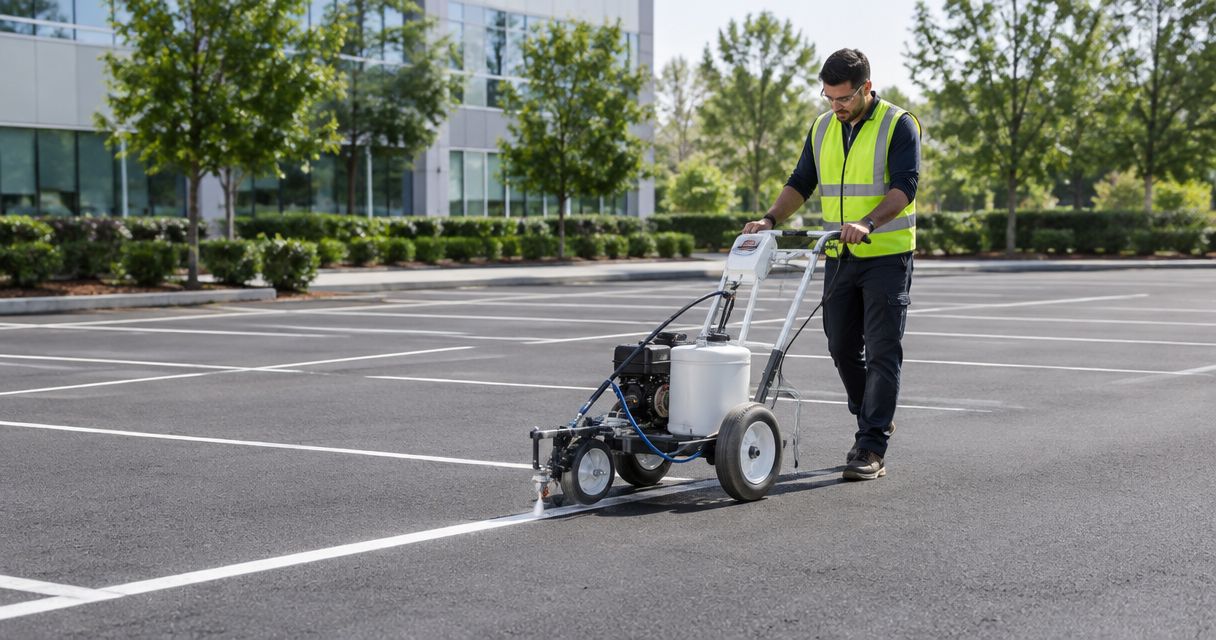
Yes—you can repaint parking lot lines without repaving when the existing pavement is stable and suitable for paint adhesion. Repainting does not fix potholes, loose pavement, drainage problems, or an incorrect parking layout; those issues need separate attention before striping. For your 2026 maintenance plan, decide from pavement condition and layout—not from faded paint alone.
- Repaint parking lot lines without repaving when the pavement is sound; repair unstable areas before restriping.
- St. Louis Snow Removal provides parking lot striping for businesses and property managers across St. Louis and Metro East.
- Parking lot restriping restores markings, not pavement strength, drainage, or accessible parking compliance by itself.
- Approve the layout, surface preparation, and reopening requirements before authorizing paint.
Can striping be repainted without repaving the lot?
Faded lines do not automatically justify new pavement. A sound asphalt or concrete surface can receive replacement markings after appropriate preparation. The decision changes when the surface beneath the markings is deteriorating or the existing layout needs correction.
Separate the work into the following scopes before requesting bids:
| Approach | Best for | Main advantage | Limitation |
|---|---|---|---|
| Repaint existing lines | Sound pavement with a verified layout | Restores visible boundaries without replacing pavement | Preserves layout mistakes if nobody checks them |
| Repair damaged areas, then restripe | Localized pavement defects | Addresses failed areas before painting | Requires coordination between repair and striping work |
| Remove conflicting markings and restripe | Changed stalls, aisles, or traffic patterns | Establishes a revised layout | Old markings need treatment so competing lines do not remain |
| Resurface or reconstruct, then stripe | Pavement requiring broader rehabilitation | Addresses pavement needs beyond markings | Is a separate pavement project, not a paint refresh |
None of these approaches substitutes for a site assessment. Ask the contractor to identify which pavement conditions support the recommendation rather than treating every faded lot as a resurfacing job.
Why this matters
A parking lot has separate maintenance needs: the pavement carries vehicles, while markings organize parking and movement. Combining those needs into an undifferentiated proposal makes it harder to approve only the work your property requires.
For a 2026 striping project, review the striping schedule and accessible-space compliance workflow before approving the old layout. A visible line is not proof that a stall, access aisle, or pedestrian route is correctly arranged.
St. Louis Snow Removal is best for property managers seeking parking lot striping in the St. Louis metro and Metro East. Striping is the relevant service here; pavement rehabilitation requires its own assessment and scope.
Repaint existing lines when the surface and layout pass inspection
A straightforward repaint follows existing markings only after you confirm they belong in the same locations. Walk the lot with the proposed scope in hand. Look beyond whether the old paint remains visible.
Check the pavement along stall boundaries, turning areas, entrances, accessible spaces, and loading zones. Loose material, peeling coatings, oil contamination, and damaged patches require attention because paint depends on the surface beneath it.
Also check how the lot operates. Delivery vehicles blocking an aisle or pedestrians crossing an awkward parking arrangement are reasons to review the layout rather than reproduce it automatically.
- Advantage: You retain serviceable pavement and restore the markings that define its use.
- Limitation: Repainting cannot correct a surface defect or layout error unless that work is included.
- Recommendation: Approve a repaint only after the contractor confirms the preparation requirements and you approve the layout.
Do not judge the project solely by how closely the new paint follows the old paint. Correct placement matters more than reproducing an existing mistake neatly.
Repair damaged areas before repainting their lines
Localized pavement damage does not automatically require repaving the entire lot. It does require a repair decision before paint covers the area.
Ask the pavement contractor to distinguish isolated defects from broader deterioration. A pothole, failed patch, or loose surface at a marking location needs more than a fresh stripe. Painting across it does not restore pavement integrity.
Keep the repair limits visible in the scope. Identify which markings cross those limits, who restores them, and what surface-readiness requirements apply after the repair. Otherwise, a completed patch can leave missing stall boundaries or an interrupted access aisle.
- Advantage: You address the damaged area without treating every serviceable section as failed.
- Limitation: Repair work and marking work need coordinated sequencing.
- Recommendation: Finish and accept the specified repairs before approving striping over those areas.
If damage extends beyond isolated locations, obtain a pavement assessment before treating the job as routine restriping. Paint is not a pavement repair.
Change the layout only after resolving old markings
Repainting and redesigning are different scopes. Moving a stall boundary, widening an aisle, or relocating accessible parking requires more than painting new lines beside old ones.
Require a marked-up plan showing what stays, what moves, and which markings need removal or another approved treatment. Evaluate the proposed removal method against the pavement and coating involved; removal itself can affect the surface.
Do not assume a dark coating makes obsolete lines disappear permanently. The objective is an unambiguous parking arrangement, not merely a darker patch around competing markings.
- Advantage: A revised layout can address a documented circulation or space-allocation problem.
- Limitation: Conflicting old markings add preparation work and require a specific treatment decision.
- Recommendation: Approve the revised plan before the crew lays out replacement lines.
When a layout changes, verify the resulting stall count, accessible parking arrangement, pedestrian connections, and applicable local requirements. Do not accept a new arrangement solely because it fits within the pavement edges.
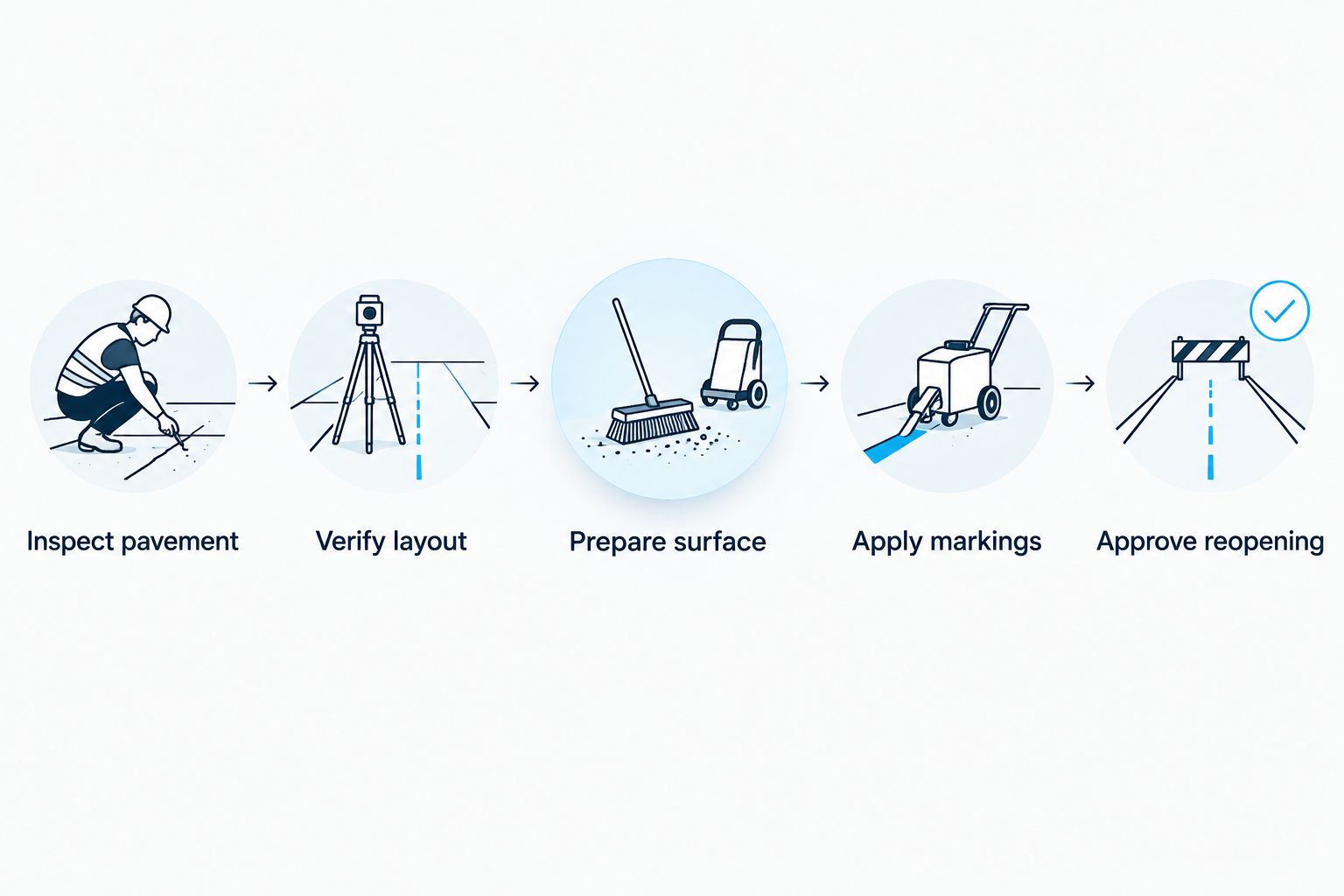
How to repaint parking lot lines without repaving
Use this sequence to keep pavement decisions ahead of painting decisions. Each step should leave a clear instruction for the next person responsible for the work.
- Inspect pavement. Identify unstable areas, contamination, failing coatings, and conditions requiring a pavement specialist. Record repair locations separately from faded markings.
- Verify layout. Confirm stall boundaries, accessible spaces, access aisles, arrows, and other markings against the approved plan and applicable requirements.
- Prepare surface. Complete specified cleaning, repairs, and conflicting-marking treatment. Follow the selected coating manufacturer's surface requirements.
- Apply markings. Confirm placement before painting and protect the work area from vehicles and pedestrians during application.
- Approve reopening. Follow the coating manufacturer's traffic-readiness instructions and document any unfinished items before removing barriers.
The order matters: an approved layout does not make damaged pavement ready for paint, and dry-looking paint does not establish that a lot is ready for traffic.
Assign responsibility for moving vehicles, placing barriers, and communicating closures before the work starts. A striping plan that depends on empty spaces needs an actual vehicle-relocation plan, not an assumption that tenants will move.
Why repainting requirements vary
The relevant question is not simply whether old lines can accept more paint. It is what must happen before the replacement markings are usable.
- Pavement condition: Sound pavement supports a repaint scope; unstable or deteriorated areas require assessment and preparation beyond painting.
- Existing coating condition: Loose or incompatible coatings affect the preparation and coating selection needed for adhesion.
- Surface contamination: Dirt, oil, and residue must be addressed according to the selected coating's requirements.
- Layout changes: Relocated stalls and aisles require measurements and a plan for obsolete markings.
- Application conditions: Surface temperature, moisture, and weather must meet the coating manufacturer's instructions.
- Site access: Occupied stalls, deliveries, and pedestrian routes determine how you phase and protect the work.
For your 2026 scope, ask bidders to describe these conditions consistently. Comparing an application-only proposal against a proposal that includes preparation and marking removal does not compare equivalent work.
Check accessible spaces before tracing existing lines
Accessible parking is a layout requirement, not just a painted symbol. Repainting the existing arrangement does not establish that its dimensions, access aisles, signage, or route to the entrance meet applicable requirements.
The U.S. Access Board's guidance to the ADA Standards for Accessible Design, sections 502.2 and 502.3, identifies these dimensional requirements for covered accessible parking:
- Car parking spaces are at least 96 inches wide.
- Access aisles are at least 60 inches wide and extend the full length of the parking spaces they serve.
- Van parking spaces are at least 132 inches wide with the required access aisle; the standards also permit a 96-inch-wide van space with a 96-inch-wide access aisle.
These measurements address specific parts of the federal standard, not the entire compliance review. Required space counts, location, slopes, signs, routes, and applicable state or local provisions also need attention.
For a 2026 repaint, verify the accessible layout before tracing worn lines. If dimensions or placement need correction, resolve that on the plan rather than asking the painting crew to improvise around existing vehicles or curbs.
Can you paint over old parking lot lines?
Yes, when the existing marking and pavement are suitable for recoating. The contractor must check adhesion, coating compatibility, cleanliness, and whether the existing line is correctly located.
Painting over loose material or an incorrect layout preserves the underlying problem. Require preparation or layout correction where needed instead of specifying blanket overpainting.
Do you need sealcoating before repainting parking lines?
No—sealcoating is not an automatic prerequisite for restriping. Decide whether the pavement needs sealcoating independently, based on its condition and the maintenance plan.
If sealcoating is included, coordinate the sequence and follow the applicable product instructions before applying markings. A faded line alone does not establish a need to sealcoat the lot.
How soon can vehicles use repainted parking spaces?
Reopen parking spaces only when the selected coating meets its traffic-readiness requirements under actual site conditions. Touch-dry appearance alone is not a reopening instruction.
Confirm who authorizes reopening and who removes barriers. Keep tenant notices consistent with that instruction rather than promising a fixed interval before the coating and conditions are known.
What to put in the striping request
Send photographs, a site plan if available, and a list of the markings you want restored or changed. Distinguish a like-for-like repaint from a layout revision so the contractor can assess the right scope.
For a 2026 request, ask for written treatment of the following:
- Areas excluded because pavement repairs remain unresolved.
- Cleaning and surface-preparation responsibilities.
- Existing markings requiring removal or treatment.
- The layout approval process before painting.
- Coating selection and applicable application requirements.
- Closure arrangements, reopening authority, and completion documentation.
For St. Louis Snow Removal parking lot striping, get a quote with the property's location and proposed scope. Request confirmation of included work rather than assuming pavement repair, marking removal, or layout review is part of the repaint.
FAQ
Can I repaint parking lot lines without repaving my lot?
Yes, you can repaint parking lot lines without repaving when the pavement is stable and suitable for the selected coating. Repair damaged areas and verify the layout before painting.
Do faded parking lines mean the asphalt needs replacing?
No, faded parking lines alone do not establish that asphalt needs replacing. Assess pavement condition separately from marking visibility.
Can a striping contractor just follow the old lines?
A striping contractor should follow old lines only after you verify their location and the surface is ready for recoating. Existing markings do not prove that the layout meets applicable requirements.
Will repainting fix cracks or potholes in my parking lot?
No, repainting does not repair cracks, potholes, or unstable pavement. Specify pavement repairs separately and coordinate them before striping.
Do accessible parking spaces need checking during a repaint?
Yes, check accessible parking before reproducing the layout. Federal standards address dimensions, access aisles, signs, routes, and other requirements; a fresh symbol alone does not establish compliance.
Can my business stay open while the parking lot is repainted?
Your business can remain open only where the work plan maintains appropriate access and separates traffic from the striping area. Confirm phasing, pedestrian routes, vehicle relocation, and reopening instructions before work begins.
Does St. Louis Snow Removal provide parking lot striping?
St. Louis Snow Removal provides parking lot striping for property managers and businesses across the St. Louis metro and Metro East Illinois. Request a property-specific scope that distinguishes repainting from repairs and layout changes.
One last thing
The oldest visible line is not necessarily the correct line. Before authorizing your 2026 repaint, photograph the existing arrangement and mark every proposed change on the plan. Your acceptance check should compare the finished work with that approved plan—not simply confirm that the pavement has fresh paint.