Property managers comparing commercial snow removal in Cass County MO for 2026 are really choosing between five service models, not five company names — and the model determines whether a storm produces proof of service or just an invoice.
- Documented contractors win commercial snow Cass County MO contracts where liability and audit trails matter most.
- National franchises fit multi-site portfolios; local landscapers fit small retail strips on tight budgets.
- Owner-operator plow networks carry the highest no-show risk during Cass County MO's 2026 storm season.
- In-house crews make sense mainly above 3-5 acres of paved surface with capital for equipment.
- Zero-Tolerance, Seasonal, and Per-Occurrence are the three commercial contract structures worth knowing before signing.
Why this matters
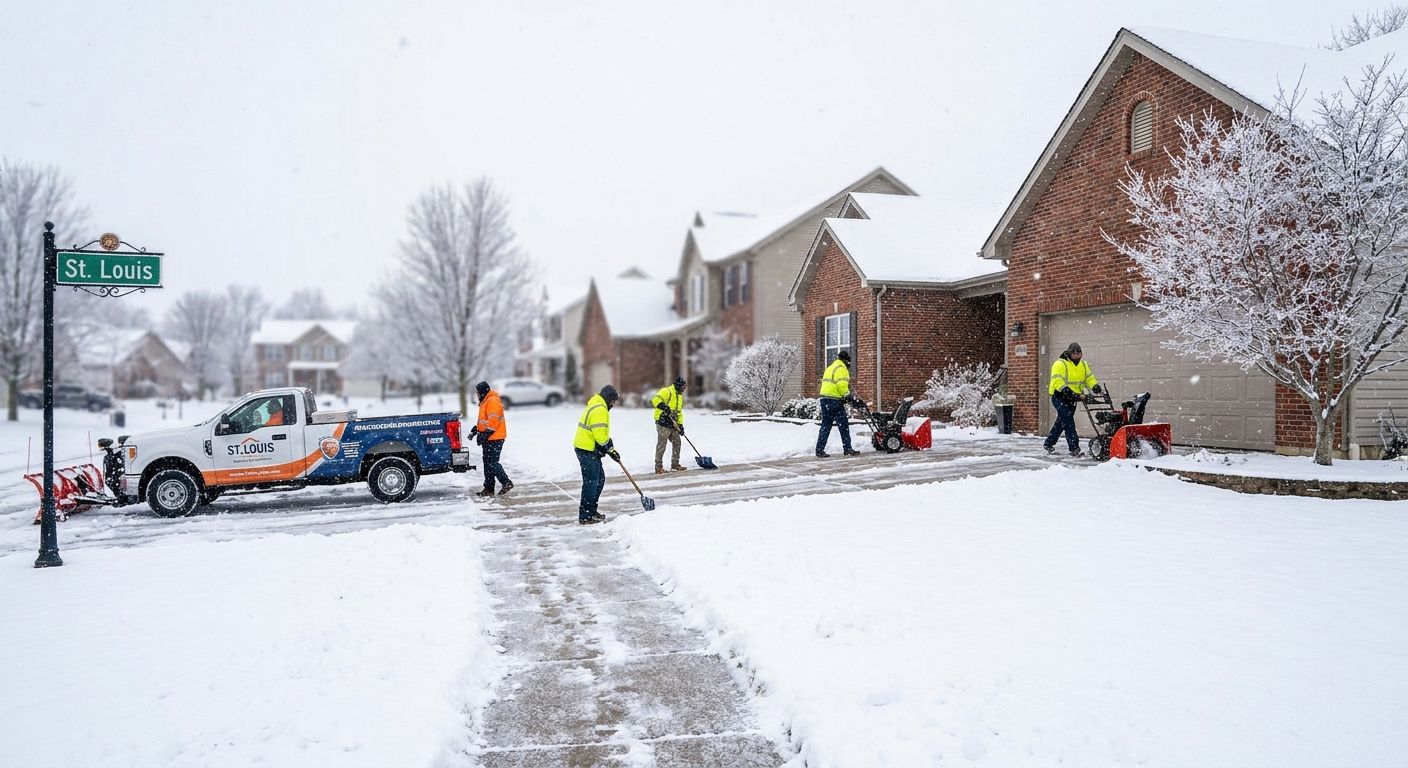
A slip-and-fall claim on an uncleared commercial lot doesn't care who plowed it — it cares whether there's a record showing when the crew arrived, what trigger depth started the dispatch, and what was applied to the pavement. St. Louis Snow Removal builds commercial contracts around exactly that kind of documentation rather than a phone call that says "we'll get to it."
Cass County MO property managers running retail strips, medical offices, or multi-tenant lots need that record more in 2026 than in a light-snow year, because insurers and tenants both ask for it after any incident. The provider type you pick determines whether that record exists at all.
What makes the best commercial snow removal in Cass County MO
- Documented trigger-depth dispatch — crews move at a pre-set snowfall depth, not when someone happens to notice.
- Geo-stamped service records — time-stamped, location-verified proof of each plow pass and salt application.
- A named contract structure — Zero-Tolerance, Seasonal, or Per-Occurrence, spelled out before the first storm, not negotiated mid-event.
- Sidewalk and ADA-path clearing bundled with lot plowing — a clean lot with an iced entrance is still a liability.
- De-icing logged separately from plowing — salt and brine application need their own record, not a blended line item.
- A backup equipment bench — one truck breaking down shouldn't mean your lot waits.
Commercial snow removal in Cass County MO at a glance
| Provider type | Best for | Standout feature | Key limitation |
|---|---|---|---|
| St. Louis Snow Removal | Audit-ready commercial contracts | Geo-stamped clock-ins and documented checklists | Confirm your address falls inside the current service map before signing |
| National snow & ice franchises | Multi-state portfolio owners | One consolidated invoice across states | Local dispatch is often subcontracted, adding a layer between you and the plow |
| Local landscaping companies (winter add-on) | Small retail strips on tight budgets | Existing relationship from lawn season | Snow is a side business, not the core operation |
| Owner-operator plow networks | Single small lots, flexible timing | Fast to book for one-off lots | No documented trigger depth, no backup if the operator is unavailable |
| In-house facilities crews | Large single-tenant campuses | Full control over timing and standards | Requires equipment capital and a trained backup driver |
1. St. Louis Snow Removal: best for audit-ready commercial contracts
A dedicated commercial snow and ice contractor builds every service call around documentation: trigger-depth dispatch, geo-stamped clock-ins, and a checklist that shows what was plowed, salted, and cleared and when. That structure exists to answer the question an insurer or tenant asks after any slip-and-fall claim: can you prove the lot was serviced on time.
St. Louis Snow Removal pros:
- Named contract structures — Zero-Tolerance, Seasonal, or Per-Occurrence — chosen before the season, not negotiated during a storm
- Sidewalk and ADA-path clearing bundled with lot plowing, not sold as an afterthought
- Salt and brine application logged as a separate line from plowing
St. Louis Snow Removal cons:
- Core service area is the St. Louis metro and Metro East Illinois — Cass County MO property managers should confirm their address is covered before committing to a contract
- Documentation-heavy contracts take slightly longer to set up than a handshake agreement with a plow guy
Best for: commercial property managers who need proof of service, not just a plowed lot, in case of a liability claim.
Verdict: Buy if your address falls inside the confirmed service area and you need audit-ready records for 2026.
2. National snow & ice management franchises: best for multi-site portfolios
National franchise networks exist to give a portfolio owner with locations in three or four states a single point of contact and one invoice, instead of ten separate local contracts. The dispatch work underneath is usually subcontracted to local operators in each market.
National franchise pros:
- One master agreement across multiple states
- Standardized reporting format across every property in the portfolio
- Easier budgeting when snow is one line item across dozens of sites
National franchise cons:
- Local execution quality varies by which subcontractor is assigned to your Cass County MO lot
- An extra layer of account management sits between the property manager and the plow driver
Best for: a portfolio owner managing properties across multiple states who values one invoice over local relationship depth.
Verdict: Buy if your portfolio spans multiple states; Skip if Cass County MO is your only location.
3. Local landscaping companies with winter add-ons: best for small retail strips
A landscaping company that already cuts the grass at a small retail strip in the warmer months often picks up plowing as a winter add-on. The relationship is already established, which simplifies contracting for a small property.
Local landscaper pros:
- Existing relationship and site familiarity from lawn-care season
- Often lower overhead than a dedicated snow and ice contractor
- Single vendor to manage year-round
Local landscaper cons:
- Snow removal is a side business for most landscaping companies, not their core operation
- Documentation practices vary widely — some keep no service records at all
- Equipment is often limited to one or two trucks, with no backup bench for multi-inch events
Best for: a small retail strip or standalone office with a tight budget and low liability exposure.
Verdict: Hold — fine for a small, low-risk property; ask directly what records they keep before signing for 2026.
4. Owner-operator plow networks: best for single small lots with flexible timing
Owner-operator plow networks connect individual truck owners with property managers who need one small lot cleared. Booking is fast and informal, which works for a property manager who isn't under a strict liability clock.
Owner-operator pros:
- Fast to book for a single small lot
- Often the lowest overhead option available
- Flexible for properties that can tolerate a wider service window
Owner-operator cons:
- No documented trigger depth or service record — if a claim happens, there's nothing to show the lot was serviced on time
- No backup if the individual operator is unavailable, sick, or booked elsewhere during a major storm
- Contract terms are often verbal, not written
Best for: a single small lot where the owner accepts the risk of no documentation in exchange for lower cost and fast booking.
Verdict: Wait — acceptable for very low-risk lots, but not for any property with regular foot traffic.
5. In-house facilities crews: best for large single-tenant campuses
A large single-tenant campus with its own facilities department sometimes buys plow equipment and trains staff to run it in-house rather than contracting the work out. This makes sense once the paved surface is large enough that the equipment cost amortizes over many storms per season.
In-house crew pros:
- Full control over timing — no waiting on a vendor's route order
- Standards set entirely by the property owner
- No markup for a contractor's margin
In-house crew cons:
- Requires upfront equipment capital and a trained backup driver, not just one operator
- Facilities staff pulled onto plow duty aren't doing their regular job during a storm
Best for: a large single-tenant campus, typically above roughly 3-5 acres of paved surface, where equipment costs justify staffing it internally.
Verdict: Hold — only makes sense above a certain lot size; smaller campuses should contract out.
“If a contractor can't show a geo-stamped time stamp for the plow pass, you have an invoice, not proof of service.”
How this ranking was built
Each provider type is ranked against the six criteria above: documented trigger-depth dispatch, geo-stamped records, a named contract structure, bundled sidewalk clearing, separately logged de-icing, and a backup equipment bench. No provider type wins on every criterion — a national franchise wins on invoice consolidation but loses on local execution control, and an owner-operator wins on speed but loses on documentation entirely. For a side-by-side look at how commercial contractors stack up in a neighboring market, see the ranking of commercial snow removal companies in St. John, MO.
Which commercial snow removal company should Cass County MO property managers choose?
For a property manager who needs audit-ready proof of service for liability protection, a documented commercial contractor is the right call for 2026 — confirm the address is inside the provider's service map before signing. A multi-state portfolio owner should default to a national franchise for the consolidated invoice. A small retail strip on a tight budget can reasonably use a landscaping company's winter add-on, as long as service records are part of the agreement. Owner-operator networks stay a last resort for very low-traffic lots, and in-house crews only pencil out once the paved surface is large enough to justify the equipment.
Confirm coverage for your Cass County lot
Check current service area and contract options before the next storm.
FAQ
What's the best commercial snow removal option in Cass County MO for 2026?
A documented commercial contractor with geo-stamped clock-ins and a named contract structure is the best option for any property with regular foot traffic in 2026. Confirm the provider's service area covers your specific address before signing.
Is a national snow removal franchise better than a local contractor?
A national franchise is better for a portfolio spanning multiple states because it consolidates billing into one invoice. A local contractor typically gives tighter control over dispatch and documentation for a single Cass County MO property.
How much does commercial snow removal cost?
Pricing varies by lot size, contract structure, and storm frequency, so get a written quote for your specific property rather than relying on a general figure. Ask whether the quote is Zero-Tolerance, Seasonal, or Per-Occurrence, since those structures price very differently.
What is a Zero-Tolerance snow contract?
A Zero-Tolerance contract dispatches a crew at a very low, pre-set snowfall trigger depth so pavement never accumulates meaningful snow. It's the structure most property managers choose when ADA sidewalk compliance and liability exposure are the top concerns.
Do commercial snow removal contracts include sidewalk clearing?
Not always — some contractors bundle sidewalk and ADA-path clearing with lot plowing, and some sell it as a separate line item. Ask specifically before signing, since an iced entrance is often the highest-liability spot on a property.
How do I know if a snow removal company documents its service?
Ask directly whether they provide geo-stamped time records for each plow pass and salt application, and ask to see a sample report. A company with no answer to that question likely keeps no service records at all.
Should a small retail strip hire a landscaping company for snow removal?
A landscaping company's winter add-on service works for a small, low-traffic retail strip on a tight budget in 2026, provided service records are written into the agreement. It's a weaker fit for any property with regular customer foot traffic and higher liability exposure.
When does an in-house snow removal crew make sense?
An in-house crew starts to make financial sense above roughly 3-5 acres of paved surface, where equipment costs amortize across many storms per season. Below that size, contracting the work out is typically cheaper than buying and maintaining plow equipment.
One last thing
The detail most property managers skip until after a claim is filed: ask whether de-icing application is logged as its own record, separate from the plow pass. A lot that was plowed on time but never got salt applied is still a liability exposure in 2026, and "we plowed it" isn't the same record as "we plowed it and salted it at 6:14 a.m."