Clay County, Missouri commercial properties need documented snow and ice coverage before the first flake falls in 2026, not a scramble once a lot ices over. This guide ranks the provider models that actually protect property managers from liability, sorted by the situation each one fits best.
- Zero-Tolerance contracts with geo-stamped clock-ins set the documentation bar for commercial snow removal in Clay County, MO in 2026.
- Seasonal flat-rate operators suit small lots with fixed budgets, not high-liability retail entrances.
- 24-hour dispatch crews matter most for healthcare and retail sites with round-the-clock foot traffic.
- Multi-site brokers add coordination but subcontract the actual plow work, so confirm who shows up on the truck.
Why this matters
A slip-and-fall on an unsalted sidewalk doesn't get resolved with a handshake. It gets resolved with a lawsuit, and the property manager who wins that lawsuit is the one with a time-stamped log showing when the lot was plowed, when it was salted, and at what snowfall depth the contract triggered service. St. Louis Snow Removal built its commercial model around exactly that kind of paper trail, and it's the standard every Clay County bidder should be measured against, whether they're based in the metro or working out of a truck twenty minutes from your lot.
The providers below aren't ranked by brand name. They're ranked by contract structure, because in commercial snow removal the structure determines whether you have proof of service or just a memory of a guy in a pickup.
What makes the best commercial snow removal provider in Clay County MO
- Trigger-depth clarity — the contract states the exact snowfall depth (commonly 1 to 2 inches for commercial lots) that starts service, not a vague "when needed"
- Time-stamped documentation — geo-stamped clock-ins and photos for every visit, not a verbal assurance after the fact
- De-icing coverage — salting and ice management written into the same contract, not billed as a surprise add-on
- ADA-compliant sidewalk clearance — ramps, curb cuts, and accessible entrances cleared to a walkable surface, not just the parking stalls
- Response time commitments — a stated window for when plows arrive after a trigger event, especially for 24-hour retail or healthcare sites
- Labor floor transparency — a contract that spells out minimum billed hours or callout minimums instead of open-ended time-and-materials billing
At a glance
| Provider model | Best for | Standout feature | Key limitation |
|---|---|---|---|
| Zero-Tolerance documented contracts | Liability-conscious property managers | Geo-stamped clock-ins, trigger-depth logs | Costs more than reactive per-visit billing |
| Seasonal flat-rate independents | Small lots on a fixed budget | Predictable seasonal cost | Rarely documents individual visits |
| Per-occurrence regional contractors | Low-traffic industrial yards | Pay only when it snows | No guaranteed response window |
| Multi-site national brokers | Portfolio owners across several counties | One point of contact for many properties | Subcontracts actual plow crews |
| 24-hour emergency dispatch crews | Retail and healthcare with round-the-clock traffic | Rapid response after hours | Premium pricing structure for off-hours calls |
1. Zero-Tolerance documented contracts: best for liability-conscious property managers
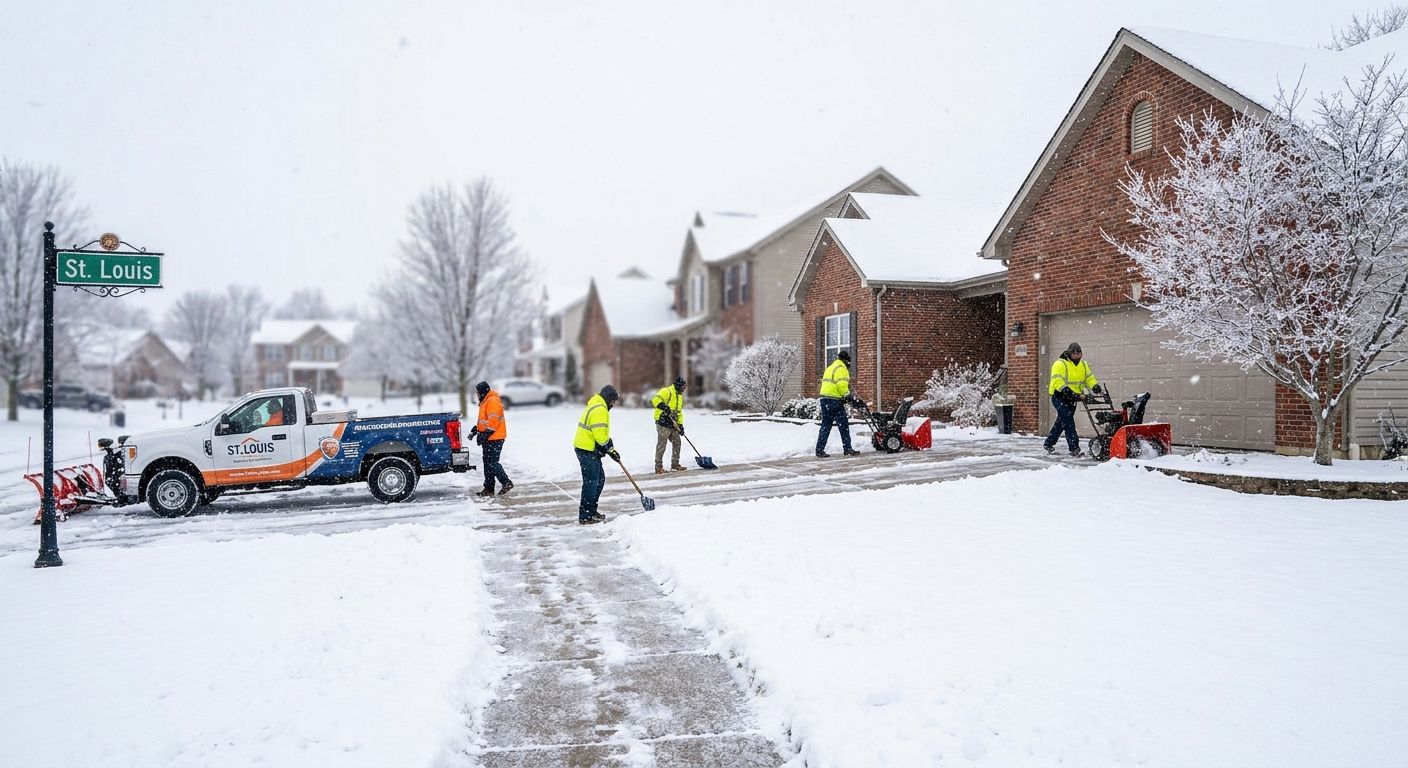
A Zero-Tolerance contract means the provider plows and salts at a defined trigger depth every time, with no discretion to skip a light snow. St. Louis Snow Removal runs its commercial accounts this way, logging each visit with a geo-stamped clock-in so the record shows exactly when a crew was on site and what the conditions were.
That structure matters most for retail entrances, medical office parking, and any lot where a fall claim is a real exposure. If your Clay County portfolio sits inside a documented-service coverage area, this is the model to require. If it doesn't, use it as the benchmark to hold any local bidder to.
St. Louis Snow Removal pros:
- Time-stamped, geo-tagged visit logs instead of a verbal "we were there"
- Trigger depth stated in the contract, not left to a driver's judgment
- Salting and sidewalk clearance bundled into the same agreement
St. Louis Snow Removal cons:
- Documented service costs more than reactive, undocumented plowing
- Coverage is anchored to the St. Louis metro and Metro East Illinois, so confirm footprint before assuming direct service in Clay County
Best for: property managers who need a defensible record if a claim comes in. Verdict: Buy this contract structure, wherever you source it.
2. Seasonal flat-rate independents: best for small lots on a fixed budget
An independent operator billing a flat seasonal rate gives you cost certainty for a strip-mall lot or a small office park. You know the number before the season starts, and you're not exposed to a run of five storms in one month blowing up your budget.
Seasonal independent pros:
- Predictable total cost for the winter
- Often a single owner-operator who knows the lot personally
- Lower overhead than a documented-service provider
Seasonal independent cons:
- Rarely logs individual visits with time stamps or photos
- No standardized trigger depth — service can be inconsistent storm to storm
- Limited backup if the operator's one truck breaks down mid-storm
Best for: small commercial lots with modest foot traffic and a tight budget. Verdict: Hold unless documentation isn't a priority for your risk profile.
3. Per-occurrence regional contractors: best for low-traffic industrial yards
Per-occurrence billing means you pay only for the storms that actually happen, which works well for warehouse yards, distribution docks, and industrial sites where a slower response window is tolerable.
Per-occurrence pros:
- No cost in a light winter
- Fits properties where a few hours' delay isn't a liability issue
- Scales with actual snowfall rather than a flat seasonal guess
Per-occurrence cons:
- No guaranteed response time written into most agreements
- Heavy winters can cost more than a seasonal flat rate would have
- Documentation is inconsistent across regional operators
Best for: industrial and warehouse properties with low pedestrian exposure. Verdict: Hold for back-lot and dock areas; skip for anything with public foot traffic.
4. Multi-site national brokers: best for portfolio owners across several counties
If your properties span Clay County and other Missouri or Kansas counties, a national snow management broker gives you one contract and one invoice instead of coordinating five separate local vendors.
National broker pros:
- Single point of contact for multi-property portfolios
- Standardized reporting format across sites
- Easier budgeting across a large footprint
National broker cons:
- The broker rarely plows anything themselves — actual work goes to subcontracted local crews
- Quality varies site to site depending on which sub gets the job
- Less direct accountability than working with the crew servicing your lot
Best for: multi-site owners who value one relationship over hands-on quality control at each lot. Verdict: Hold, and ask for the subcontractor's name and documentation standard before signing.
5. 24-hour emergency dispatch crews: best for round-the-clock retail and healthcare
Sites that never close — pharmacies, urgent care, 24-hour retail — need a provider that dispatches at 2 a.m. as readily as at 2 p.m. This model is built around response speed after a trigger event, not seasonal cost efficiency.
24-hour dispatch pros:
- Off-hours response for sites that can't wait until morning
- Often paired with the same trigger-depth and documentation standards as Zero-Tolerance contracts
- Reduces the window between snowfall and a cleared, salted surface
24-hour dispatch cons:
- Off-hours callouts typically carry a premium over standard daytime rates
- Not every regional operator staffs a true overnight crew
- Response commitments are only as good as the contract language backing them
Best for: healthcare, pharmacy, and 24-hour retail sites. Verdict: Buy if your site never closes; overkill for a 9-to-5 office building.
How this list was ranked
Each model is scored against the six criteria above: trigger-depth clarity, documentation, de-icing coverage, ADA sidewalk compliance, response commitments, and labor floor transparency. Zero-Tolerance documented contracts and 24-hour dispatch crews score highest because both build proof-of-service into the agreement itself. Sidewalk crews matter more here than most property managers assume — ADA-compliant ramps and narrow approaches often need equipment a skid steer can't maneuver into, and pairing hand crews with the right walk-behind snow plows for sidewalks is what keeps porches, ramps, and tight walkways clear without gouging concrete. Per-occurrence and flat-seasonal models score lower purely because they rarely put documentation in writing, not because the plowing itself is worse.
Get a documented snow contract
Trigger-depth logs and geo-stamped clock-ins for every visit.
Which commercial snow removal model should you choose in Clay County MO?
If a fall claim would hurt your business, require a documented Zero-Tolerance contract, full stop — that's the standard the industry is moving toward for 2026, and it's the one that holds up when an insurer asks for proof. If your site never closes, layer 24-hour dispatch on top of that documentation. Small, low-traffic lots on a tight budget can reasonably run on a seasonal flat rate, but know that you're trading cost certainty for a thinner paper trail. For a closer look at how documented plowing compares across the wider region, the breakdown of best commercial snow plowing companies near me in St. Louis covers the same criteria against named metro providers.
FAQ
What's the best commercial snow removal contract for Clay County, MO in 2026?
A documented Zero-Tolerance contract with a stated trigger depth and time-stamped visit logs is the strongest option for liability protection in 2026. It costs more than per-occurrence billing but gives you proof of service if a claim ever comes in.
Is a seasonal flat-rate contract better than per-occurrence billing?
Seasonal flat-rate contracts give budget certainty for small lots, while per-occurrence billing only charges when it actually snows. Choose seasonal if you want predictable costs; choose per-occurrence for low-traffic sites where an occasional heavier winter bill is acceptable.
Do commercial snow contracts include sidewalk and ADA compliance?
Not automatically — sidewalk clearance and ADA-compliant ramp access should be written into the contract explicitly, not assumed as part of lot plowing. Ask any bidder to confirm sidewalks and accessible entrances are scoped separately from parking-lot service.
What snowfall depth typically triggers commercial plowing?
Most commercial contracts set a trigger depth between 1 and 2 inches of accumulation before service begins. The exact number should be written into your agreement, not left to the driver's discretion.
How do national snow management brokers differ from local providers?
National brokers coordinate multi-site portfolios through a single contract, but they subcontract the actual plowing to local crews rather than doing the work themselves. Ask for the subcontractor's name and documentation standard before signing.
Do I need 24-hour emergency snow dispatch for a commercial property?
You need it if your site operates around the clock, like a pharmacy, urgent care, or 24-hour retail location. A standard 9-to-5 office building can usually rely on daytime response windows instead.
What documentation should a commercial snow removal provider show after each visit?
A geo-stamped clock-in time, the recorded snowfall or ice condition, and confirmation that salting and sidewalk clearance were completed. Without this, you have no record to show an insurer or attorney if a dispute arises.
One last thing
Most commercial snow disputes in Missouri don't turn on whether a lot got plowed — they turn on whether anyone can prove when it got plowed relative to when the snow actually stopped falling. A geo-stamped clock-in tied to a stated trigger depth is worth more in a dispute than a receipt showing a truck was billed for the day. Ask any Clay County bidder in 2026 to show you that record before you ask about price.