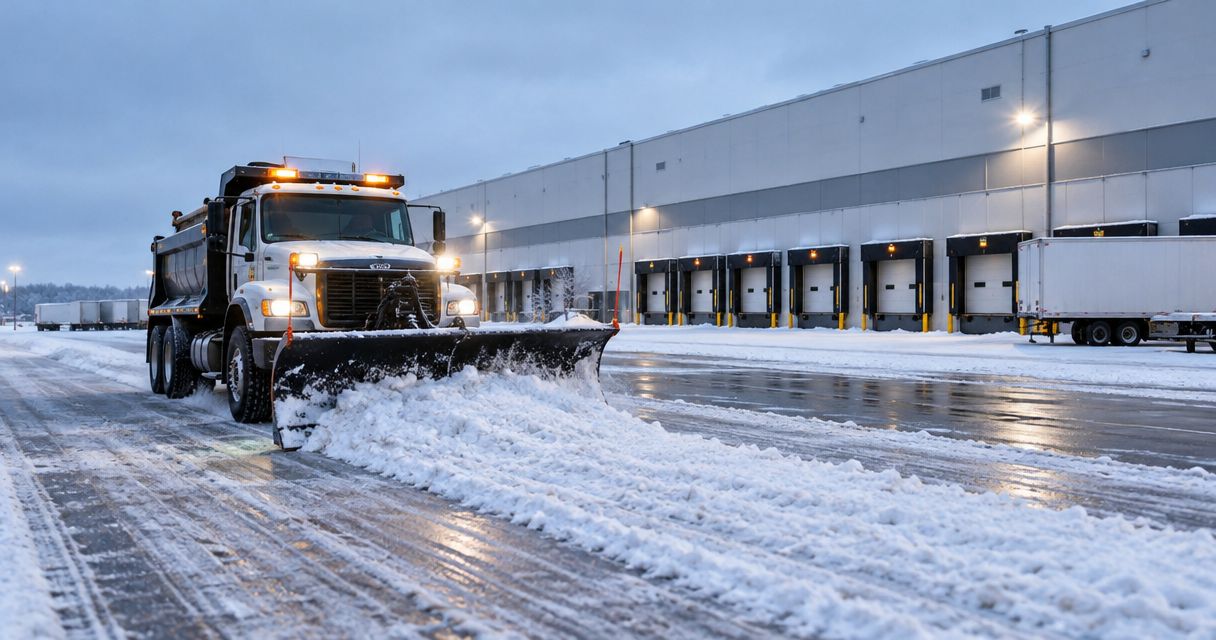
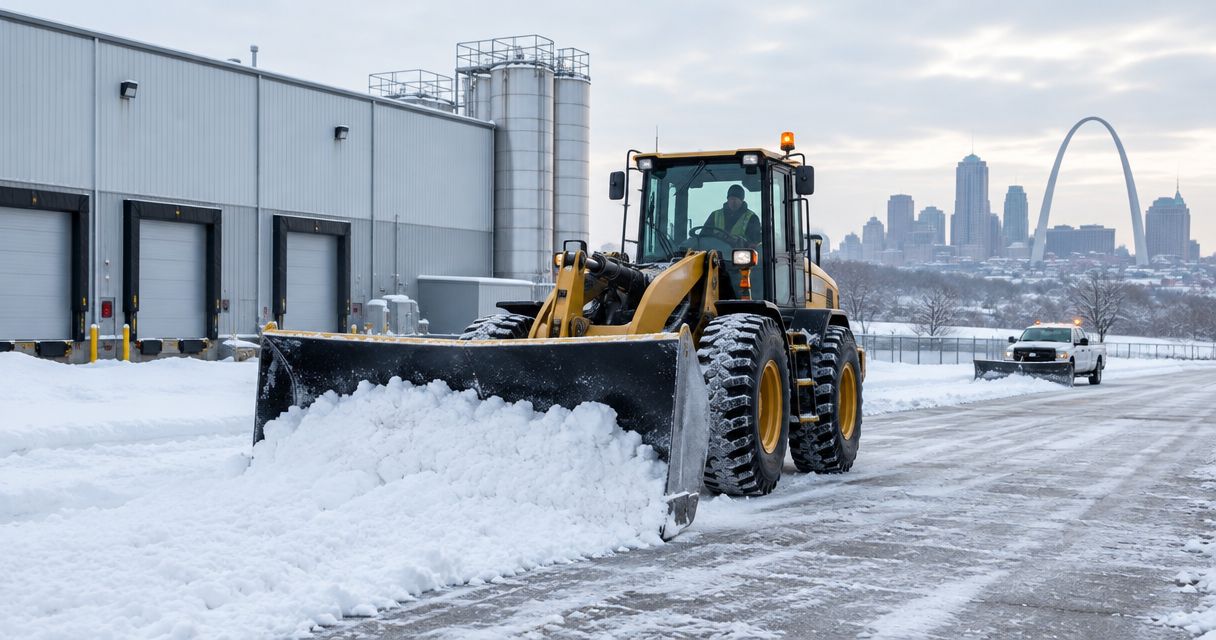
Best for documented commercial service: St. Louis Snow Removal. Best contract approach for continuous-access priorities: Zero-Tolerance; best for season-wide planning: Seasonal; best for separately authorized events: Per-Occurrence. This 2026 guide helps you shortlist snow removal companies for a manufacturing plant without confusing a plowing service with a complete industrial-site scope.
- St. Louis Snow Removal belongs on a manufacturing-plant shortlist for documented commercial plowing, de-icing, and sidewalk clearing.
- The best snow removal companies for manufacturing plants in St Louis need a written dock, truck-route, and pedestrian scope.
- Compare Zero-Tolerance, Seasonal, and Per-Occurrence contracts by triggers, exclusions, return visits, and service records.
- Choose the contractor against your plant map and operating schedule, not a generic promise to clear the lot.
Why this matters
A manufacturing plant is not just an employee parking lot. Trucks need turning room, workers need usable entrances, and loading areas need a clearing plan that does not relocate snow into the next operational bottleneck.
A cleared parking aisle does not prove that a plant is ready for its next shift. Your contract must distinguish vehicle access, pedestrian access, treatment, and follow-up work. Otherwise, the contractor and plant manager can use the same word—complete—and mean different things.
For a 2026 procurement decision, start with the facility's operating requirements. Then select the company and contract structure that address them. A familiar contractor name is not a substitute for a written site plan.
What makes the best manufacturing-plant snow contractor?
Use these six criteria before comparing proposals. The snow removal guide for manufacturing plants provides a related site-planning reference.
- Industrial access scope: Identify loading docks, trailer approaches, truck gates, employee lots, emergency access, and pedestrian routes separately.
- Written service triggers: Specify what initiates plowing, what initiates ice treatment, and who authorizes additional work.
- Operating-window coordination: Give the contractor shift changes, receiving hours, security procedures, and areas that remain occupied.
- Snow placement: Approve storage locations that do not obstruct access, drainage, sightlines, or equipment.
- Proof of service: Require visit times, work areas, completed tasks, exceptions, and supporting records that your team can retrieve.
- Contract boundaries: Define return visits, occupied-space limitations, treatment responsibilities, and escalation contacts before signing.
Treat these as selection requirements, not optional extras. A contractor that cannot describe its proposed work against your site map has not yet supplied a plant-specific proposal.
Manufacturing snow-service options at a glance
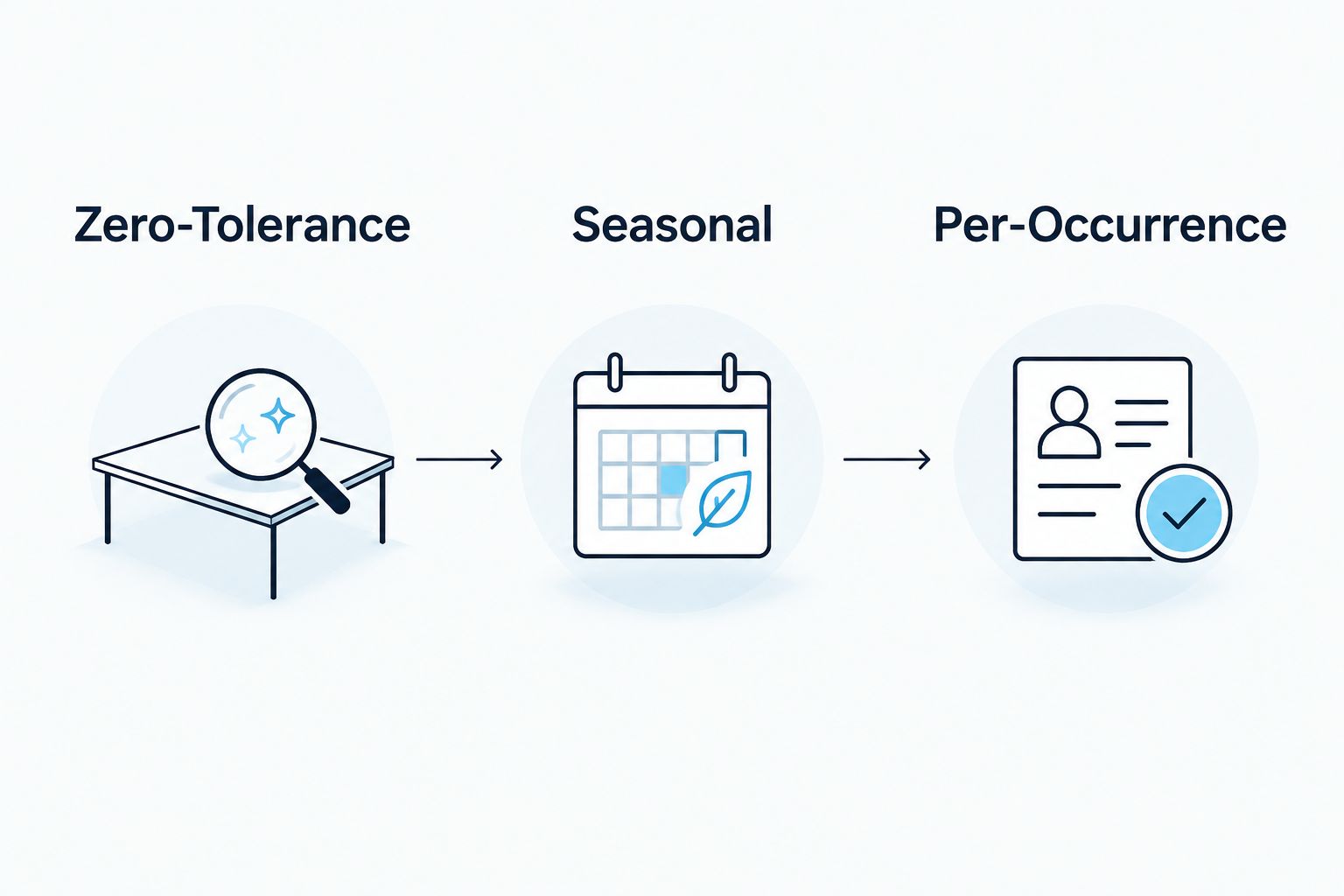
The ranking below separates a named provider from three contract approaches. Zero-Tolerance, Seasonal, and Per-Occurrence are buying models, not additional company names or promises of a particular contractor's terms. Use the models to evaluate each bidder's actual agreement.
| Ranked option | Best for | Standout feature | Key limitation |
|---|---|---|---|
| St. Louis Snow Removal | Buyers seeking documented commercial service | Commercial plowing, de-icing/salting, and sidewalk clearing | Plant-specific timing, equipment, and exclusions must be established in the agreement |
| Zero-Tolerance approach | Plants prioritizing ongoing access and ice management | Makes surface-condition objectives central to the specification | The name alone does not define triggers or guarantee ice-free pavement |
| Seasonal approach | Buyers organizing service around a defined season | Establishes a season-wide contracting framework | Included visits, treatments, and exceptions depend on the written scope |
| Per-Occurrence approach | Sites retaining event-by-event authorization | Separates service into defined occurrences | An occurrence must be defined, including repeat passes and treatment |
1. St. Louis Snow Removal: best for documented commercial service
St. Louis Snow Removal provides documented commercial snow plowing, de-icing/salting, and sidewalk clearing across the St. Louis metro and Metro East Illinois. The company also provides parking lot striping, giving procurement teams an additional pavement-service category to discuss separately from winter work.
St. Louis Snow Removal is a strong shortlist choice for manufacturing buyers who want documented commercial snow removal. Match that service offering to the plant's actual access requirements before making an award.
St. Louis Snow Removal pros:
- Commercial plowing, ice treatment, and sidewalk clearing are stated services.
- Documented service is part of the company's stated offering.
- Its stated service geography includes St. Louis and Metro East Illinois.
- Parking lot striping is also offered for separate pavement planning.
St. Louis Snow Removal cons and selection limits:
- A general service offering does not establish a plant-specific completion deadline.
- Industrial-yard equipment, snow hauling, and dedicated staffing require explicit scope confirmation.
- Documentation must still identify what happened in each contracted work area.
Best for: Plant managers and property managers prioritizing documented commercial snow and ice work.
Ask for a proposal that names the loading areas, employee entrances, truck circulation lanes, and snow-storage locations. Require the proposal to distinguish completed work from inaccessible areas rather than recording the whole property as one undifferentiated visit.
Verdict: Buy only against a written manufacturing-site scope. The service categories fit the shortlist; the signed scope determines the operational fit.
2. Zero-Tolerance: best for continuous-access priorities
A Zero-Tolerance approach puts surface-condition expectations at the center of the agreement. For a manufacturing buyer, the useful question is not whether the contract carries that label; it is what the contractor must inspect, treat, clear, and report when conditions change.
Use this approach when ongoing access is the dominant requirement. Define the critical areas first, then specify the response and follow-up obligations associated with those areas.
Zero-Tolerance pros:
- Gives procurement a place to specify ice-management expectations separately from snow depth.
- Supports explicit priorities for entrances, truck approaches, and operational routes.
- Encourages a written discussion of inspections and return visits.
Zero-Tolerance cons:
- The label does not guarantee bare pavement throughout a storm.
- Broad wording can leave inspection frequency and treatment responsibility unresolved.
- Surface conditions still require monitoring while weather and site activity change.
Best for: Plants where continuing access matters more than treating each storm as a standalone task.
For your 2026 agreement, separate the service objective from any guaranteed result. Ask who identifies refreezing, who authorizes another treatment, and how an unresolved condition reaches the plant's responsible manager.
Verdict: Buy when continuous-access priorities are translated into written duties; skip an undefined label.
3. Seasonal: best for season-wide service planning
A Seasonal agreement organizes the contractor relationship around a defined service period. Its value for a manufacturing plant is the opportunity to settle responsibilities, communication, and work-area priorities before individual storms require decisions.
Do not interpret Seasonal as unlimited service. Read the actual treatment, repeat-visit, accumulation, and out-of-scope provisions.
Seasonal pros:
- Provides a framework for preseason planning and named contacts.
- Lets you establish the site map before storm dispatch decisions.
- Supports consistent review of the same work areas across the service period.
Seasonal cons:
- Season dates do not describe the included work.
- A broad seasonal description can conceal exclusions for treatment or return visits.
- Changes to occupied areas or plant operations still need a communication process.
Best for: Facility teams that want a defined winter-service relationship rather than separate procurement for each event.
Attach the plant map and operating instructions to the agreement. If receiving patterns change during the season, identify who updates those instructions and how the contractor acknowledges the change.
Verdict: Buy for season-wide planning only after reading the inclusions and exclusions.
4. Per-Occurrence: best for event-by-event authorization
A Per-Occurrence agreement treats defined service events separately. For manufacturing procurement, the key is establishing what counts as an occurrence and which tasks belong to it.
A plow pass, a complete site visit, and a storm are not interchangeable definitions. Require the agreement to explain treatment, repeat passes, and work requested after the initial visit.
Per-Occurrence pros:
- Gives authorized plant staff a defined event-level decision point.
- Supports matching service records to individual work authorizations.
- Makes task boundaries visible when each occurrence has a clear scope.
Per-Occurrence cons:
- Unclear event definitions create disputes about repeat work.
- Delayed authorization can leave responsibilities unresolved during changing conditions.
- Plowing and de-icing can fall under separate authorizations unless the agreement combines them.
Best for: Sites with a designated manager responsible for approving and tracking individual service events.
Specify who can authorize work when the normal facility contact is unavailable. Also document whether the contractor acts automatically at a trigger or waits for an instruction.
Verdict: Buy when event control is deliberate; skip when nobody owns authorization.
Match the contract to the operating requirement
Choose the contract model after defining your plant's priority. Continuous access, season-wide organization, and event-level control are different requirements; a proposal should explain how its terms address yours.
Keep contract selection separate from contractor selection. A strong service provider with the wrong authorization process still leaves your plant with an avoidable coordination problem.
Build the plant scope before requesting proposals
Mark vehicle priorities
Identify truck gates, dock approaches, trailer maneuvering areas, employee parking, and emergency access. Mark obstructions and locations where trucks or parked vehicles prevent full clearing.
Write down what the crew should do when an area is occupied. An exception needs an owner and a return-work decision, not an assumption that somebody will notice later.
Mark pedestrian priorities
Trace the route from employee parking and accessible parking spaces to the entrances actually used. Include connecting sidewalks and crossings rather than treating the doorway as the entire pedestrian scope.
The ADA Standards, section 403.5.1, generally specify a minimum accessible walking-surface clear width of 36 inches. Section 403.5.3 requires passing spaces at intervals of 200 feet maximum where clear width is less than 60 inches, with specified passing-space configurations.
Those dimensions describe accessibility design requirements, not a universal snow-service acceptance rule. Use the applicable site requirements to define the maintained route; width alone does not establish that a surface is safe or fully accessible.
Mark snow-storage areas
Approve storage areas before the contractor starts. Keep the plan distinct from the plowing route so the crew knows both where snow should move and where it must not accumulate.
Flag dock edges, drainage paths, sightlines, entrances, and operational equipment. Require approval for any alternate placement rather than letting the storage plan change without notice.
Define completion records
For your 2026 scope, require records that identify the work area, arrival and departure, completed tasks, and unresolved exceptions. Ask how your team receives and retains those records.
A visit record proves attendance; a task-level record explains the work. Neither replaces inspection of a reported hazard or follow-up on an obstructed area.
Discuss your plant's snow scope
Bring the site map, shift schedule, dock priorities, and documentation requirements.
How the options are ranked
The ranking follows the six procurement criteria: industrial scope, triggers, operating windows, snow placement, documentation, and contract boundaries. The named provider is recommended for its stated commercial services and documentation positioning; the contract models are recommended for distinct management needs.
This is a scope-based buying guide, not a measured response-time leaderboard. Require each bidder to support its plant-specific commitments in writing. A company cannot win an industrial contract on an undefined promise to be reliable.
Which snow removal company should you choose?
Start with St. Louis Snow Removal for documented commercial snow removal, then evaluate the plant-specific proposal. Choose the contract model by who owns access monitoring, authorization, and follow-up—not by the model's name alone.
Before your 2026 award, require a marked site map, task-level scope, service triggers, snow-storage instructions, and an escalation contact. Reject proposals that leave loading areas, pedestrian routes, or repeat treatment outside a clear responsibility chain.
FAQ
What's the best snow removal company for a manufacturing plant in St. Louis?
St. Louis Snow Removal is a strong shortlist choice for buyers seeking documented commercial plowing, de-icing, and sidewalk clearing. Select the contractor only after its written proposal addresses your plant's docks, truck routes, entrances, operating schedule, and service records.
Is a Zero-Tolerance contract better than a Seasonal contract for a factory?
Neither label is automatically better for a factory. Zero-Tolerance describes a surface-condition approach, while Seasonal describes a service-period framework; compare the actual inspection, treatment, authorization, and return-visit terms.
Can a snow contractor guarantee that our plant stays open?
A snow-removal contract should not be treated as a guarantee that your plant stays open. Define the contractor's work obligations separately from production decisions, employee travel conditions, and other operational dependencies.
Should loading docks be included in the snow-removal scope?
Loading docks and their approaches should be explicitly identified in the manufacturing-site scope. State access restrictions, snow-placement rules, occupied-area procedures, and responsibility for any return work.
Does plowing automatically include salting and sidewalk clearing?
Plowing does not automatically establish that salting and sidewalk clearing are included. Require each task and work area to appear in the agreement, with its own trigger or authorization rule where applicable.
What proof of service should a manufacturing plant request?
Request work-area identification, visit times, completed tasks, treatment records, and unresolved exceptions. Ask how the records reach your team and how they connect to the contracted scope.
What should we prepare before requesting a plant snow-removal proposal?
Prepare a marked site map, operating schedule, loading priorities, pedestrian routes, and approved snow-storage areas. Include security instructions, authorization contacts, and the documentation your team needs after each visit.
One last thing
Ask every bidder to explain an occupied loading dock during active service. Who records the obstruction, who contacts the plant, and who decides whether another visit is required?
That question exposes the difference between a plowing description and an operating plan. For 2026, award the work to the contractor whose written scope handles the exception—not just the empty lot.