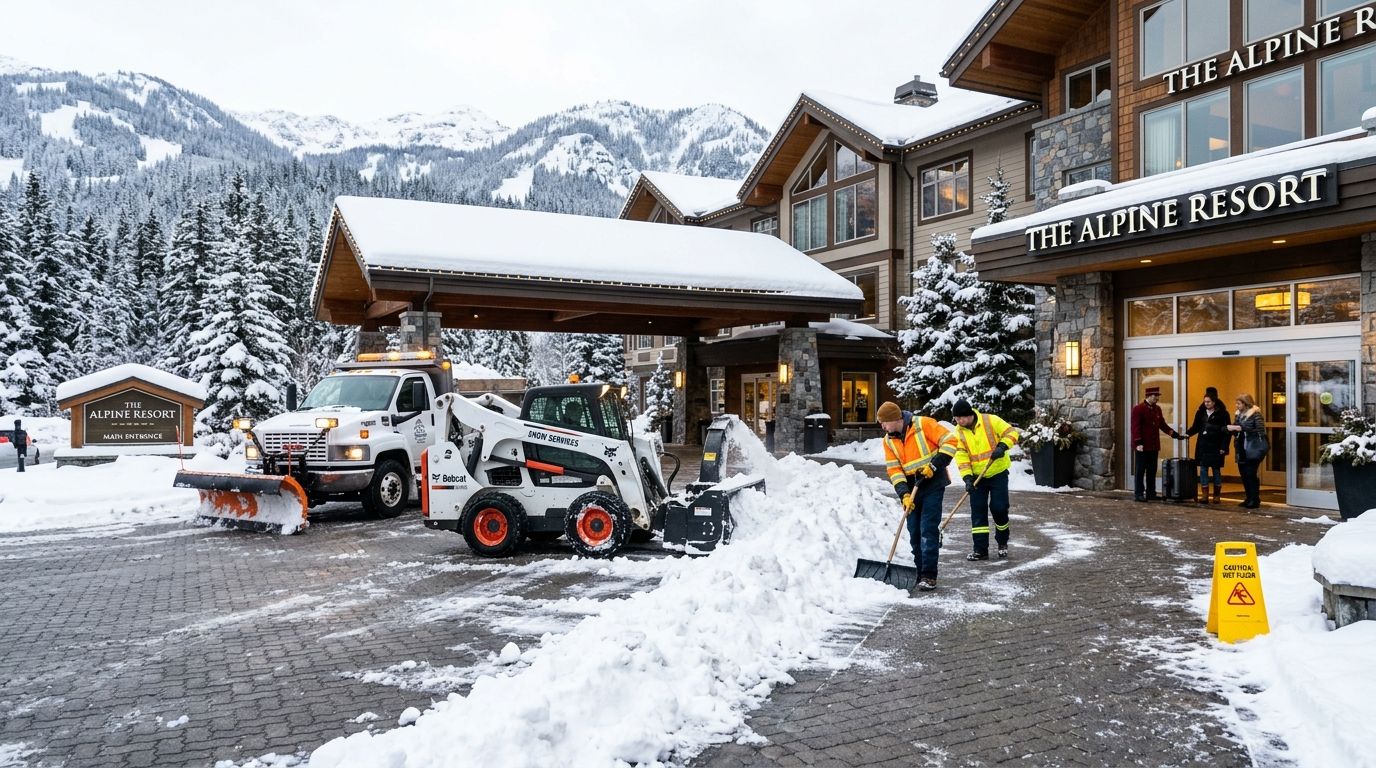
Hotel snow removal is a documented, contract-based service that clears entrances, lots, and walkways on a trigger-depth schedule instead of a best-effort promise, because a slip in the porte-cochère at 2 a.m. is a liability claim, not just a maintenance ticket. Hotels carry guest traffic around the clock, which means the service window never closes the way it does for a 9-to-5 office park, and the documentation has to prove exactly when a crew was on site.
- Snow removal for hotels in 2026 runs on trigger-depth contracts and geo-stamped visit logs, not on-demand calls.
- 24-hour guest traffic means hotels need round-the-clock response, not daytime-only plowing windows.
- Zero-Tolerance contracts fit high-traffic hotel entrances better than seasonal flat-rate deals because they force a response at a set snow depth.
- Ice management for overnight refreeze matters as much as plowing for hotel liability exposure.
- St. Louis Snow Removal documents every hotel visit with time-stamped photos and clock-ins for claims defense.
Why hotel snow removal matters for guest traffic
A hotel parking lot sees vehicles arriving at 11 p.m. and guests walking to their cars at 5 a.m., which puts pavement under load during the exact hours a typical commercial lot sits empty. That around-the-clock pattern is what separates hotel snow removal for hotels from a standard retail or office contract.
Property managers who run hotels also answer to a different kind of exposure than a warehouse or a strip mall. A guest who falls in the entrance walkway isn't an employee covered by workers' comp — they're a paying customer with a personal injury claim and an attorney. Documentation isn't optional here; it's the difference between a five-minute insurance conversation and a six-month legal one.
Step 1: Audit your entrances and guest walkways
Start with a walk-through of every surface a guest actually touches between the parking lot and the lobby door, not just the drive lanes a plow can reach in one pass.
- Map the porte-cochère, main entrance, and any secondary guest entrances separately from the general lot
- Flag ADA-compliant paths and ramps that need hand-shoveling or blower work a plow blade can't do
- Note pool decks, patios, and smoking areas that still see foot traffic in winter
- Identify pinch points where snow piles block sightlines for arriving vehicles
- List every walkway that connects overflow parking to the building
Step 2: Set trigger depths and response windows
A vague "we'll come out when it snows" clause is the single biggest gap in most hotel snow contracts. Set an actual trigger depth — the snow accumulation that automatically starts a service call — and a response window measured in hours, not "as soon as possible."
- Define separate trigger depths for entrance walkways versus back-of-house parking
- Set a maximum response window for the first plow pass after trigger depth is hit
- Require salt or de-icer application at the same trigger, not a separate call
- Put the trigger depth and response window in writing, in the contract, not a verbal agreement
- Ask for a documented photo or time-stamped log at each service visit
Step 3: Choose a contract model that matches guest traffic
Hotels generally do better on a Zero-Tolerance contract than on a flat seasonal rate, because a flat rate gives the contractor no incentive to show up at 3 a.m. for a two-inch dusting that's still enough to put a guest on the ground. Per-occurrence contracts work for lower-traffic secondary lots but leave gaps in coverage timing.
- Zero-Tolerance: service triggers automatically at a set depth, best for entrances and guest-facing walkways
- Seasonal flat rate: predictable budgeting, best for back lots and overflow parking with lower foot traffic
- Per-occurrence: pay per storm event, best for properties with light winter traffic or a small footprint
- Combination: Zero-Tolerance on guest paths, seasonal on employee and overflow lots
Property managers comparing options for commercial snow removal built for property managers should ask specifically whether the contract triggers automatically or waits for a phone call — that single question separates a documented service from an on-demand one.
Step 4: Add ice management for overnight refreeze
Plowing clears the snow; it doesn't stop the meltwater from refreezing at 3 a.m. when the temperature drops back below freezing. Hotels lose more liability protection to black ice on entrance steps than to unplowed snow, because guests don't expect ice on a surface that looked clear an hour earlier.
- Apply de-icer at every service visit, not just after a full snow event
- Pre-treat entrance steps and ramps before a forecasted freeze, not after ice forms
- Check gutters and downspouts for runoff that refreezes across walkways
- Use a granular de-icer rated for the surface temperature you're actually seeing, not a one-size product
A commercial ice management contractor in St. Louis treats ice as its own line item in the contract rather than an afterthought bundled into plowing.
Step 5: Document every visit for liability protection
If a guest files a claim, the hotel's first question to its snow contractor is "prove you were here." A geo-stamped clock-in and time-stamped photo at each visit answers that question before the lawyer asks it.
- Require geo-stamped arrival and departure times for every crew visit
- Ask for time-stamped before-and-after photos of entrance areas
- Keep a digital log accessible to hotel management, not just the contractor's internal system
- Confirm the log survives past the season in case a claim surfaces months later
Step 6: Coordinate with valet and shuttle operations
Valet stands and shuttle loading zones move constantly through the night, which means a plow schedule built around a static map misses the areas guests actually stand in.
- Share valet stand locations and shift times with the snow crew ahead of the season
- Flag shuttle loading zones as high-priority, high-traffic areas needing frequent re-treatment
- Coordinate plow timing around valet peak hours instead of a fixed daily schedule
- Keep a direct line between the front desk and the snow crew for real-time flags
Step 7: Plan for 24-hour emergency response
A hotel doesn't close at 6 p.m., so a contractor that only dispatches during business hours leaves a gap exactly when guest traffic peaks. Confirm the contract includes overnight and weekend response before the first storm, not after.
- Confirm dispatch availability covers overnight and weekend hours, not just weekdays
- Ask how fast a crew can reach the property after a trigger-depth call comes in overnight
- Check whether the same crew handles both plowing and de-icing, or if that's a separate dispatch
- Get a direct emergency contact number, not a general office line
A 24-hour emergency snow removal service in St. Louis is built around exactly this gap — dispatch that doesn't stop when the office closes.
Step 8: Review the contract before the season starts
Don't wait for the first storm to find out the contract doesn't cover what the hotel actually needs. Review trigger depths, response windows, and documentation requirements every fall before signing.
- Re-walk the property for new construction, landscaping, or traffic pattern changes since last season
- Confirm trigger depths still match current guest volume and entrance layout
- Check that documentation requirements are still in writing, not verbal understanding
- Verify the true cost of commercial snow removal in St. Louis against the current contract scope before renewal
Comparison: hotel snow removal contract models
| Option | Best for | Key limitation |
|---|---|---|
| Zero-Tolerance contract | Guest entrances, porte-cochère, main walkways | Requires precise trigger-depth language or it defaults to vague service |
| Seasonal flat rate | Back lots, employee parking, overflow areas | No automatic response trigger for light snow events |
| Per-occurrence | Small footprint hotels, light winter traffic | Coverage gaps if storms overlap or dispatch is delayed |
| In-house staff | Very small properties with existing maintenance crew | No documentation trail, no 24-hour dispatch capacity |
Zero-Tolerance contracts built around trigger depths and geo-stamped documentation are the right call for any hotel entrance with regular guest traffic — flat seasonal rates leave too much room for a contractor to skip a light dusting that's still enough to cause a fall.
Common mistakes hotels make with snow removal
- Treating the lobby entrance the same as the back lot. Guest-facing walkways need tighter trigger depths and faster response than employee parking.
- Skipping ice management as a separate line item. Plowing without a dedicated de-icing plan leaves overnight refreeze unaddressed on the exact surfaces guests walk.
- Not sharing valet and shuttle schedules with the snow crew. High-traffic zones move through the night; a static plow map misses them.
- Accepting verbal trigger-depth agreements. Without a written trigger depth and response window, there's no way to prove a service gap after the fact.
- Renewing the same contract every fall without a re-walk. Property changes — new entrances, landscaping, added parking — shift where risk actually sits.
Get a hotel snow contract audited
Review trigger depths, response windows, and documentation before the first storm.
FAQ
What is the best snow removal contract type for hotels?
A Zero-Tolerance contract with a written trigger depth works best for hotel entrances and guest walkways in 2026, because it forces a response at a set snow depth instead of waiting for a phone call. Back lots and employee parking can run on a seasonal flat rate instead.
Do hotels need 24-hour snow removal dispatch?
Yes, because hotel guest traffic runs around the clock, not just during business hours. A contractor that only dispatches during the day leaves entrances uncovered exactly when overnight arrivals and early checkouts create the most foot traffic.
How is hotel snow removal different from office building snow removal?
Hotel properties see guest traffic 24 hours a day, while most office lots sit empty overnight and on weekends. That means hotels need tighter trigger depths, faster response windows, and ice management timed to overnight refreeze rather than a single daytime plow pass.
Is ice management included in standard snow removal contracts?
Not always. Some plowing-only contracts leave de-icing as a separate add-on, which creates a gap on entrance steps and ramps where overnight refreeze forms after the initial plow pass.
What documentation should a hotel require from a snow contractor?
Geo-stamped arrival and departure times, time-stamped before-and-after photos, and a written trigger-depth log accessible to hotel management. This documentation is what protects the property if a guest files a slip-and-fall claim months after the storm.
How much does commercial snow removal cost for a hotel?
Cost depends on lot size, number of entrances, trigger depth requirements, and whether ice management is bundled in. Property managers can review current commercial snow removal pricing in St. Louis before comparing contract quotes.
Can a hotel switch snow removal contractors mid-season?
Yes, but it requires reviewing the current contract's cancellation terms and having a new trigger-depth agreement in writing before the next storm, so there's no coverage gap during the switch.
Should valet operations be part of the snow removal plan?
Yes. Valet stands and shuttle loading zones shift through the night and see concentrated foot traffic, so they need to be flagged as high-priority re-treatment areas separate from the general lot plan.
One last thing
Most hotel snow claims trace back to the entrance steps and the porte-cochère, not the parking lot itself — those are the surfaces with the shortest distance between a guest's car and the front desk, and the highest foot traffic per square foot on the whole property. Trigger depth on those two spots alone, documented at every visit, closes more liability exposure than a perfectly plowed back lot ever will.