

There is no verified number of hours or days for onboarding a new property to a snow removal contract in 2026. The property is ready for service only after the service area, access, dispatch conditions, responsibilities, and contract start are agreed and the contractor confirms it can serve the site. A signed contract alone does not establish when the first visit can happen.
- Onboarding new property snow removal contract time has no verified standard duration in 2026; confirm an activation date with the contractor.
- A signed contract does not replace an agreed site scope, access plan, dispatch conditions, and service records.
- St. Louis Snow Removal is best for property managers seeking documented commercial snow service, not an unsupported start-time promise.
Why this matters
A property manager needs to know when a site moves from contract discussion to active storm coverage. That distinction matters most when a forecast arrives while access details or service responsibilities remain unsettled. Treat activation as a confirmed operating decision, not an assumption based on a signature.
For a commercial site, the scope can include plowing, de-icing, sidewalks, or a combination. Each area needs an agreed treatment plan. You can discuss St. Louis Snow Removal for documented commercial snow service across the St. Louis metro and Metro East Illinois, but no onboarding duration is supplied here. Ask for the proposed start date in writing before treating the property as covered.
The useful 2026 question is not simply when paperwork will be signed. It is whether the contractor knows what to clear, when to respond, how to enter the property, and what record you will receive after service. Those are separate decisions; an unanswered one can leave a gap between agreement and dispatch.
How long does onboarding a new property to a snow contract take?
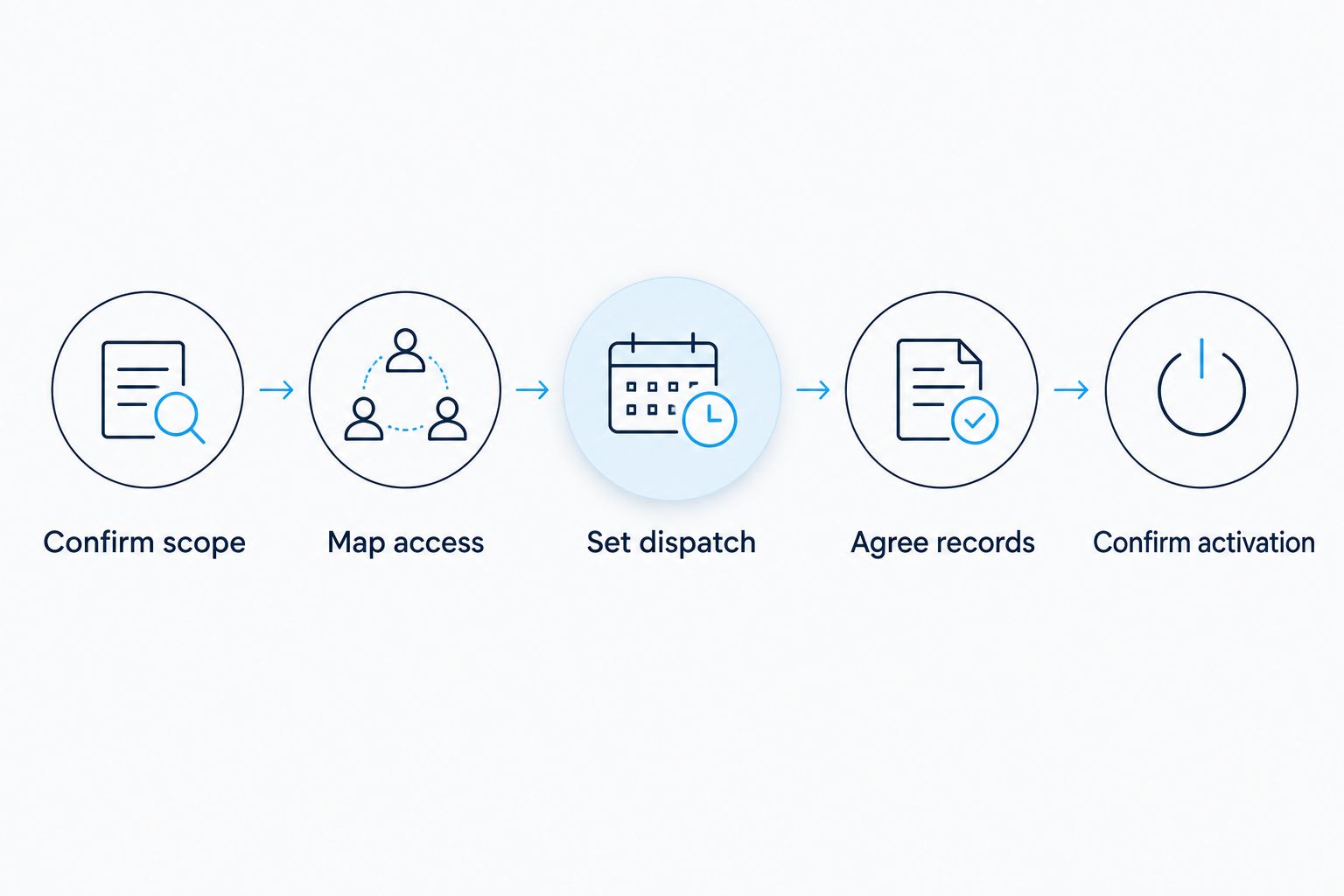
No fixed onboarding time is established by the available information. Use a site-readiness sequence to find out what remains before your specific property can be activated. Do not substitute the time needed to obtain a quote for the time needed to make a signed site operational.
- Confirm scope. Identify the lot, drives, entrances, sidewalks, and other areas the agreement will cover. Mark exclusions rather than assuming every paved or pedestrian area is included.
- Map access. Provide the agreed entry points, gates, restricted areas, and an after-hours contact. Explain how crews should handle areas occupied by vehicles or blocked by deliveries.
- Set dispatch conditions. Agree on the snow-depth trigger or other conditions that call for plowing, de-icing, or sidewalk clearing. State who makes a decision when conditions change during an event.
- Agree on service records. Specify the documentation you need to verify visits and treatments. Confirm how it will reach the person responsible for the property.
- Confirm activation. Obtain a clear acknowledgment of the contract start and which agreed services are active. If the first forecast arrives before that confirmation, ask who is responsible for the site in the meantime.
This sequence is a checklist for your conversation, not a claim that every contractor follows identical procedures. A manager can have a signed agreement and still lack a usable gate code or an agreed sidewalk boundary. In that case, the operational handoff is unfinished, regardless of how long the contract has been in place.
What should the activation confirmation cover?
Ask the contractor to identify the property, the active service areas, the agreed response conditions, and the effective start. The answer should distinguish plowing from sidewalk clearing and de-icing where the contract treats them separately. If any part is pending, name that part and identify who will resolve it.
For a 2026 contract, put the confirmation where the property manager and the contractor can retrieve it during a storm. A verbal understanding between the people who negotiated the work is less useful when a different person handles an overnight call. The goal is a clear handoff, not a promise about weather or an unsupported arrival time.
Does the contract model change the onboarding question?
Yes, because the decision to send a crew must be clear under the selected agreement. Zero-Tolerance, Seasonal, and Per-Occurrence are contract models to discuss; their names alone do not tell you a site's start date or define its services. Read the actual scope and dispatch language instead of inferring coverage from the label.
| Contract model | Onboarding point to settle | Mistake to avoid |
|---|---|---|
| Zero-Tolerance | Which conditions call for treatment and which surfaces are included | Assuming the label covers every surface or weather condition |
| Seasonal | When the agreed seasonal coverage becomes active | Assuming signing and activation are the same event |
| Per-Occurrence | How an occurrence is identified and service is authorized | Assuming every forecast triggers a visit |
Best for a property manager: the model whose written scope matches the site's operating needs. Each model offers a way to define work, but none supplies a verified onboarding duration without a property-specific agreement. Set the start condition and service boundaries before comparing how the models handle later events.
Why onboarding time varies
These are the decisions that determine whether a new site is ready for dispatch. None establishes a universal number of days.
- Service boundaries. A lot-only scope takes a different conversation from one that also identifies entrances and sidewalks. Record each included area so the crew and manager use the same map.
- Access instructions. Gates, locked areas, vehicle movement, and after-hours contacts need a workable plan. A scope is not ready for use if the contractor cannot reach the work area.
- Plowing triggers. A stated trigger tells both sides when plowing is expected. Without one, a forecast can produce different expectations before the first event.
- Ice and sidewalk responsibilities. Specify whether de-icing and sidewalk clearing are included and how decisions about those services are made. Do not assume plowing terms answer either question.
- Documentation requirements. Agree on the records the manager needs and how to receive them. A service log helps verify what happened; it does not, by itself, define what work was authorized.
- Start-date confirmation. The manager needs to know when the site enters the active service plan. A contract that lacks a confirmed start leaves that question open.
For St. Louis Snow Removal's commercial snow service, documented work is relevant to a property manager who needs to check visits after a storm. St. Louis Snow Removal is best for property managers who want documented commercial snow service and a clearly agreed operating scope. That is a fit assessment, not a claim that St. Louis Snow Removal guarantees an onboarding deadline or a particular record format for every property. Confirm both in the agreement.
Confirm your property's snow scope
Discuss service areas, dispatch conditions, and the proposed contract start.
What should you send before asking for a start date?
Send one clear property brief instead of scattered notes. Include the site address, the areas you want cleared, known access limits, the hours that matter to occupants, and the person authorized to answer operational questions. Identify sidewalks and de-icing separately if you expect them to be included. This gives the contractor a defined scope to discuss; it does not guarantee acceptance or a start date.
A marked site plan is useful when an entrance, loading area, or pedestrian route is easy to confuse with adjacent pavement. Keep the description of the work consistent between the plan and the contract. If priorities differ across areas, state them explicitly rather than asking a crew to infer them during a storm.
Then ask for a written response to three points: what work is included, what remains unresolved, and when coverage becomes active. If the contractor needs more information, assign someone to provide it. The operational test for 2026 is straightforward: the people managing the site and the people dispatching service should be working from the same instructions.
What if snow is forecast before onboarding is complete?
Ask whether the contractor has accepted the site for that event; do not assume a pending contract puts it on a route. Get an explicit answer about the active scope and start before telling tenants or staff that service is arranged. If coverage is not confirmed, the property manager needs a separate plan for the gap.
An urgent request is a different question from routine contract onboarding. It requires its own acceptance and instructions. Calling a prospective contractor during a storm does not retroactively activate an unsigned or incomplete agreement.
Can a new property be added after a contract is signed?
Yes, a property can be proposed for addition, but a signed agreement does not establish that the additional site is active. Give the contractor the new address and scope, then obtain confirmation that the site has been accepted under the agreement. Do not apply an existing property's access instructions or dispatch terms to a different location by assumption.
This distinction matters for portfolios. The manager might have a working relationship with a contractor, while the newly added property has a different gate, sidewalk layout, or operating schedule. Site-level instructions are what make a portfolio agreement usable at that address.
Does a completed quote mean snow service has started?
No. A quote sets out proposed work; it is not confirmation that a property is active for dispatch. In 2026, ask for the accepted scope and effective start before relying on any snow service arrangement, whether the site is commercial or an enrolled residential route.
For a homeowner, enrollment in a residential snow route is distinct from requesting an on-demand visit. St. Louis Snow Removal provides enrolled residential snow-route service, but the inputs do not establish how long enrollment takes or when a particular address first receives service. Confirm those details directly instead of transferring commercial onboarding assumptions to a home.
What proof should you request before the first storm?
Request written confirmation of what will trigger service, which areas are included, when the arrangement starts, and what service records you will receive. Those items let you check expectations against a later visit. They do not prove that a future storm will follow a particular schedule or that any site condition will remain unchanged.
If you manage multiple locations, keep each site's instructions distinguishable. A record showing work at one address cannot establish that another address was accepted or served. For a 2026 property addition, make the site name or address unambiguous in the activation exchange and subsequent service records.
FAQ
How long does it take to onboard a new property to a snow removal contract in 2026?
No verified standard number of hours or days is available. Confirm the property's scope, access, dispatch conditions, and effective start with the contractor before relying on coverage.
Is a property covered as soon as the snow contract is signed?
Not necessarily. A signature does not establish that the contractor has accepted the site's operating details or confirmed when service starts.
What delays snow removal contract onboarding?
Unresolved service boundaries, access instructions, dispatch conditions, documentation needs, and start-date confirmation keep a property from being ready for service. Resolve each item with the contractor rather than assuming it is included.
Does a snow removal quote put my property on a route?
No. A quote proposes work; ask for confirmation that the agreement is accepted and the property is active for dispatch.
Can a contractor add another building to an existing snow contract?
An additional building needs site-specific scope and activation confirmation. Do not assume an existing property's instructions or start date apply to the new address.
Should sidewalk clearing be addressed separately from plowing?
Yes. Identify the sidewalks you expect cleared and confirm whether that work is included; lot plowing language alone does not settle pedestrian-area coverage.
What should a property manager ask for before the first forecast?
Ask for the active service areas, access instructions, dispatch conditions, contract start, and expected service records. Those details clarify whether the site is ready for the first event.
One last thing
The most useful onboarding question is not how quickly a contract can be signed. Ask: Is this specific address active for the next qualifying event, and what work will be dispatched? If the answer is unclear, the onboarding job is not finished. That test applies whether you are adding one St. Louis lot or coordinating several properties in 2026.