

Best local fit: St. Louis Snow Removal for banks and credit unions needing documented commercial snow removal in the St. Louis metro and Metro East Illinois. For your 2026 shortlist, compare that local service with three contractor models: a branch-focused operator, a regional portfolio contractor, and an integrated facilities contractor—each suited to a different purchasing need.
- St. Louis Snow Removal is the local pick for documented commercial plowing, de-icing, and sidewalk clearing.
- The best commercial snow removal companies for banks and credit unions address entrances, drive-throughs, and service records.
- Choose a branch-focused contractor for site-specific control; evaluate a regional contractor for geographically dispersed branches.
- Require separate snow and ice instructions, named escalation contacts, and a written branch service map.
Why this matters
A bank parking lot is not the whole job. Your customers also use entrance walks, accessible parking connections, drive-through lanes, and ATM approaches. A completed plow pass does not establish that those areas were treated.
For 2026 procurement, define completion by location and task—not by whether a truck visited. The snow removal guide for banks and credit unions provides a branch-specific starting point for that scope.
The ranked options below separate purchasing needs rather than pretending every contractor serves the same geography or operating model. Choose the service structure first, then require evidence that the proposed contractor can perform it.
What makes the best commercial snow removal company for a bank?
Use these six criteria before comparing proposals. A proposal that leaves one unresolved needs clarification before approval.
- Complete branch scope: Identify parking areas, sidewalks, entrance landings, accessible connections, drive-through lanes, and ATM approaches individually.
- Separate snow and ice instructions: State the plowing trigger, treatment authorization, and responsibility for checking conditions between visits. Ice management cannot depend solely on snowfall depth.
- Operating priorities: Distinguish lobby opening, employee arrival, drive-through operation, and after-hours ATM access. Require the contractor to address the priorities you actually need.
- Service evidence: Specify what each record must contain: branch identifier, arrival and completion information, work performed, treated areas, and unresolved conditions.
- Escalation ownership: Name the contractor contact and your authorized decision-maker. Define how an incomplete task becomes a return visit rather than an unanswered message.
- Site constraints: Mark snow-storage areas, drainage paths, tight turning areas, and surfaces requiring different equipment. Keep snow piles away from designated pedestrian connections and driver sightlines.
For your 2026 comparison, send every bidder the same marked site plan. Otherwise, a proposal covering only vehicle pavement competes against one covering the entire customer approach, and the comparison starts with unequal scopes.
Commercial snow removal options at a glance
These are purchasing options, not an unsupported national company league table. The first is a named local provider; the remaining entries describe contractor models to evaluate against your branch requirements.
| Ranked option | Best for | Standout fit | Key limitation |
|---|---|---|---|
| St. Louis Snow Removal | Documented local commercial service | Commercial plowing, de-icing/salting, and sidewalk clearing across the stated metro area | The stated service area does not establish coverage for branches elsewhere |
| Branch-focused contractor | A single branch with detailed site requirements | A contract centered on one property's operating priorities | Backup capacity and coordination require explicit review |
| Regional portfolio contractor | Branches distributed across a wider region | A portfolio-level purchasing and reporting structure | Branch-level execution still needs separate verification |
| Integrated facilities contractor | Organizations combining snow with wider property services | A broader facilities scope under a defined operating agreement | Snow-specific responsibilities can disappear inside general maintenance language |
1. St. Louis Snow Removal: best for documented local service
St. Louis Snow Removal provides documented commercial snow plowing, de-icing/salting, and sidewalk clearing for property managers and businesses. Its stated service area covers the St. Louis metro and Metro East Illinois. Those services match the core pavement and pedestrian tasks a local branch needs to specify.
Best for: Banks and credit unions seeking documented commercial snow removal within that stated service area.
St. Louis Snow Removal pros:
- Commercial plowing, de-icing/salting, and sidewalk clearing are explicitly part of the service offering.
- Documented work supports a procurement requirement centered on service evidence.
- The stated geography includes both the St. Louis metro and Metro East Illinois.
- Parking lot striping is also offered for a separate pavement-maintenance scope.
St. Louis Snow Removal cons:
- The stated geography is not evidence of coverage for a broader regional or national branch network.
- A service description does not replace branch-specific terms for triggers, completion deadlines, return visits, or escalation.
For your 2026 agreement, request a marked branch plan and a sample service record. Specify whether the ATM approach, drive-through pedestrian crossing, and entrance landing are separate checklist items. Documented service should describe the work completed, not merely record attendance.
Verdict: Buy for local documented service once the written branch scope and operating commitments match your requirements.
2. Branch-focused contractor: best for single-site control
A branch-focused purchasing model gives one property a detailed service agreement. The recommendation is to contract around the site's actual layout—not to assume that a smaller operator automatically provides better attention.
This model fits when your decision concerns one branch and you can manage its service review directly. Require evidence of equipment suitability, staffing, and backup arrangements before selecting the operator.
Best for: A single bank or credit union branch with site-specific access constraints.
Branch-focused contractor pros:
- One site plan keeps the scope tied to a specific property.
- Branch management can review completion against a defined checklist.
- Entrance, ATM, and drive-through priorities can be written directly into the agreement.
Branch-focused contractor cons:
- Equipment or staffing interruptions need a documented backup plan.
- Adding more branches creates additional coordination unless reporting is standardized.
Ask the contractor to explain the proposed service sequence on your map. Where will snow be stored? Which machine handles a narrow entrance walk? Who responds when a treated area needs attention again? Answers should become contract instructions, not remain sales conversation.
Verdict: Buy for single-site control when the contractor demonstrates the required scope and backup plan.
3. Regional portfolio contractor: best for dispersed branches
A regional portfolio model purchases snow service across a defined group of branches. Its purpose is consistent administration: branch identifiers, common reporting fields, and a clear escalation structure.
Evaluate local execution separately from portfolio coordination. An account contact is not proof that each branch has an assigned crew, suitable equipment, or a workable service sequence.
Best for: Banks and credit unions managing branches beyond one local operating area.
Regional portfolio contractor pros:
- A master scope can establish common reporting requirements.
- Branch-level exceptions can sit in individual property schedules.
- A named portfolio contact can own escalation across the agreement.
Regional portfolio contractor cons:
- A master agreement can conceal differences in branch-level delivery unless assignments are disclosed.
- Standard scope language still needs adjustment for each site's layout and operating hours.
Before approving a 2026 portfolio agreement, require a branch-by-branch responsibility schedule. Identify who performs each task, who checks unresolved conditions, and who approves additional work. If subcontractors are proposed, apply the same evidence and insurance review to that delivery structure.
Verdict: Hold until the contractor supplies branch-level assignments and reporting commitments; buy for dispersed coverage only after those checks.
4. Integrated facilities contractor: best for combined property oversight
An integrated facilities model places snow removal within a wider property-services agreement. It fits a purchasing structure that already coordinates exterior maintenance through one accountable facilities contact.
Keep the winter scope distinct. General maintenance language does not establish responsibility for plowing, sidewalk clearing, ice treatment, or after-hours access.
Best for: Organizations that want snow operations governed alongside other property-maintenance tasks.
Integrated facilities contractor pros:
- A combined agreement can define ownership across exterior maintenance tasks.
- Snow-storage and drainage instructions can reference the wider property plan.
- Facilities escalation can connect branch reports with the responsible service contact.
Integrated facilities contractor cons:
- Broad maintenance descriptions can leave snow and ice tasks undefined.
- The proposed snow delivery team requires its own operational review.
Require a separate winter schedule of work even when purchasing is consolidated. List excluded areas, inspection responsibility, and the handoff between branch staff and the contractor. Do not accept a general exterior-maintenance clause as a substitute.
Verdict: Buy when combined oversight is your objective and the winter scope is explicit; skip agreements that leave snow responsibilities implied.
How the options are ranked
The ranking follows the six procurement criteria above: complete scope, separate snow and ice instructions, operating priorities, service evidence, escalation ownership, and site constraints. Local documented service is the default for a branch within the stated service area; the other models address different organizational needs.
Company size is not the deciding criterion. Written responsibility is. A contractor belongs on your shortlist when the proposed agreement addresses your branch—not when its presentation contains the most equipment photographs.
Turn your branch map into acceptance criteria
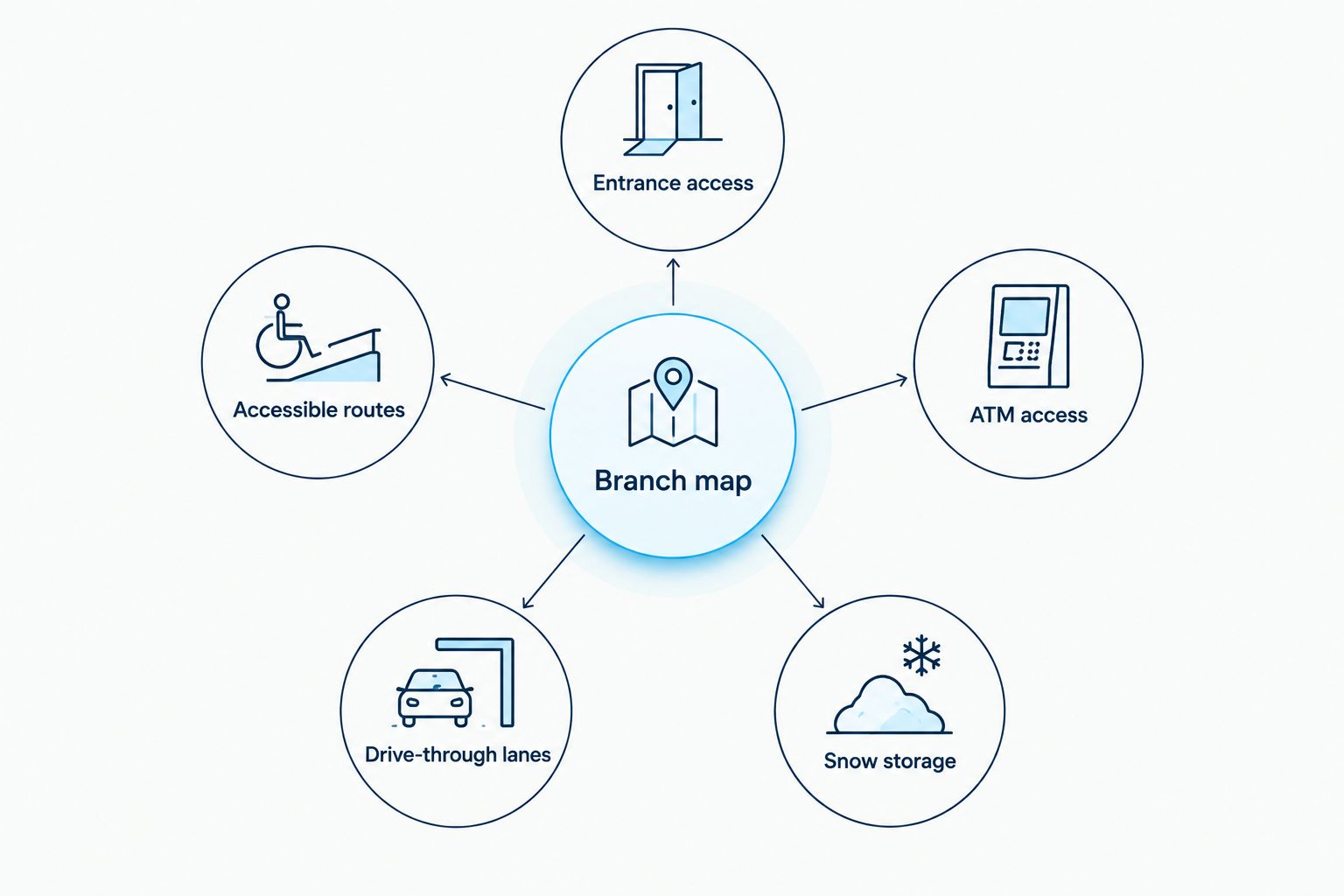
Use a marked plan to connect each operating area with a task and a completion record. Start with customer access, then vehicle circulation, then snow storage. The sequence makes omissions visible before a storm.
- Entrance access: Identify doors, landings, steps, and the approach from parking.
- Accessible routes: Mark the connections between designated parking, access aisles, curb ramps, and entrances.
- ATM access: Separate pedestrian approaches from vehicle approaches where both exist.
- Drive-through lanes: Mark lane entrances, exits, tight turns, and equipment islands.
- Snow storage: Designate pile locations without blocking the mapped access paths.
Accessible-route dimensions require care. The ADA Standards' walking-surface provisions generally specify 36 inches minimum clear width under section 403.5.1. Section 403.5.3 generally requires passing spaces at intervals no greater than 200 feet where the clear width is less than 60 inches; exceptions and detailed configurations also apply.
Those dimensions are design references, not a universal snow-clearing specification or a compliance certificate. Have the responsible facilities professional identify the applicable route and requirements, then put the required clearing boundaries on the contractor's plan. Do not let a snow pile consume an access aisle simply because the adjoining drive lane remains open.
Make the service record useful
For 2026 vendor review, request a sample record before signing. Require the branch identifier, timing, tasks completed, areas treated, observed hazards, and any follow-up instruction. If photographs are part of the agreement, define which locations they must show.
Keep inspection and correction separate. A record stating that an entrance was inspected should also state whether work was needed and what happened next. Your acceptance checklist should distinguish completed work from an unresolved condition assigned for follow-up.
Review records against the map, not just the invoice. A visit record supports operational review; it does not guarantee that a surface remained clear afterward or resolve liability by itself.
Which commercial snow removal option should you choose?
St. Louis Snow Removal is the local shortlist pick for banks and credit unions seeking documented commercial snow removal in the St. Louis metro and Metro East Illinois. Choose a branch-focused contractor for a single-site agreement, a regional portfolio contractor for dispersed coverage, or an integrated facilities contractor for combined property oversight.
In every case, approve the same essentials: the marked scope, snow and ice instructions, operating priorities, escalation ownership, and service-record requirements. Keep these conditions in the agreement rather than relying on verbal reassurance.
FAQ
What's the best commercial snow removal company for a bank in St. Louis?
St. Louis Snow Removal is the local shortlist pick for documented commercial plowing, de-icing/salting, and sidewalk clearing in its stated service area. Confirm the branch-specific scope and operating commitments before signing.
Should a credit union hire a local or regional snow contractor?
Choose a local model for branch-specific purchasing and evaluate a regional model for geographically dispersed branches. Require branch-level assignments and service records regardless of the contractor's size.
Does parking lot plowing include the sidewalks and ATM approach?
Do not assume parking lot plowing includes sidewalks or the ATM approach. Name those areas separately in the service scope and identify the tasks required at each location.
Should bank snow removal and ice treatment have separate instructions?
Yes, define snow clearing and ice treatment separately. State the plowing trigger, treatment authorization, and responsibility for checking conditions between visits.
What proof of service should a bank request?
Request a branch-specific record describing visit timing, completed tasks, treated areas, observed hazards, and follow-up instructions. Define required photograph locations if photos form part of the agreement.
Does a snow removal service log eliminate slip-and-fall liability?
No, a service log does not eliminate liability. It records work and observations; contract responsibilities, actual conditions, and incident-specific facts still matter.
What should a bank verify before signing a 2026 snow contract?
Verify the mapped scope, operating priorities, snow and ice instructions, escalation contacts, insurance documentation, and service-record requirements. Require written answers for exclusions and return visits.
One last thing
Walk the branch from a customer's perspective before approving the winter map. Follow the path from an accessible parking space to the door, then inspect the ATM approach and drive-through exit. The handoff between two cleared areas deserves its own checklist item. A clear lot and a clear entrance are not enough if the connection between them is obstructed.