
Best fit for a documented commercial-service shortlist: St. Louis Snow Removal. Best contract approach for strict access priorities: Zero-Tolerance. Best for season-wide planning: Seasonal. This 2026 guide separates the provider decision from the contract decision so you can evaluate hospital snow removal without confusing a service description with a campus-specific commitment.
- St. Louis Snow Removal belongs on your shortlist for documented commercial plowing, de-icing, salting, and sidewalk clearing.
- Choose the best snow removal companies for hospitals in St Louis by scope, escalation, and service records.
- Zero-Tolerance, Seasonal, and Per-Occurrence describe contract approaches, not interchangeable levels of hospital protection.
- Require separate instructions for emergency access, pedestrian routes, parking areas, and service entrances.
Why this matters
A hospital snow contract needs to describe more than an open parking lot. Your scope should connect emergency access, patient drop-off, accessible pedestrian routes, employee parking, and delivery access to specific work instructions.
Hire against a campus plan, not a promise to “take care of everything.” A cleared vehicle lane does not establish that the adjoining sidewalk was cleared or that an entrance received ice treatment.
For your 2026 procurement decision, separate the provider’s service scope from the commitments in the proposed agreement. Commercial plowing, salting, and sidewalk clearing are relevant capabilities; dispatch conditions, campus assignments, and completion reporting belong in writing.
What makes the best hospital snow removal company?
Use these criteria before comparing names. Each criterion should produce an answer you can check against the proposal.
- Priority access: Identify emergency approaches, patient drop-off areas, and essential service entrances. Require an explicit work order for each.
- Pedestrian coverage: Include sidewalks, curb ramps, entrance approaches, and accessible parking connections. Do not leave these inside an undefined “lot service” line.
- Ice management: Specify who authorizes treatment, what conditions initiate work, and how the contractor records applications and follow-up observations.
- Dispatch accountability: Name the hospital contact, contractor contact, escalation path, and instructions for unresolved access problems.
- Proof of service: Require records that distinguish arrival, work performed, completion, and remaining exceptions. Documentation should describe the task, not merely attendance.
- Campus execution: Review equipment access, snow-storage locations, pedestrian conflicts, and the plan for continuing work while the campus remains active.
A company passes the shortlist stage when its proposal answers these questions. A familiar name or broad commercial-service description is not a substitute.
Hospital snow removal options at a glance
The provider and contract approaches below serve different decisions. The contract rows are procurement options, not additional companies or claims about what a particular provider includes.
| Provider or approach | Best for | Standout feature | Key limitation |
|---|---|---|---|
| St. Louis Snow Removal | A documented commercial-service shortlist | Commercial plowing, de-icing/salting, and sidewalk clearing across St. Louis metro and Metro East Illinois | Hospital-specific assignments and response commitments must be established in the agreement |
| Zero-Tolerance scope | Critical access areas with strict intervention requirements | Centers the scope on defined action conditions and priority areas | The label does not define dispatch, completion, or reinspection obligations |
| Seasonal scope | Season-wide service planning | Establishes an agreement covering a defined season | Included work, exclusions, and event conditions still need explicit definitions |
| Per-Occurrence scope | Separately authorized or supplemental work | Separates work into defined service occurrences | Authorization and repeat-visit rules require close attention |
Choose the provider for execution and documentation; choose the contract for how work is initiated and governed. Neither decision replaces the other.
1. St. Louis Snow Removal: best for a documented-service shortlist
St. Louis Snow Removal provides documented commercial snow plowing, de-icing/salting, and sidewalk clearing. Its stated service area includes the St. Louis metro and Metro East Illinois, making it relevant to hospital buyers evaluating properties on either side of the river.
St. Louis Snow Removal is a fit for hospital buyers seeking documented commercial snow removal to evaluate against a campus-specific scope. That is the reason to request a proposal—not a claim that every hospital requirement is automatically included.
St. Louis Snow Removal pros
- Commercial plowing addresses the vehicle-access portion of your scope.
- De-icing and salting address treatment needs beyond moving snow.
- Sidewalk clearing belongs within its stated commercial services.
- Documented service gives you a basis for requesting task-level reporting.
St. Louis Snow Removal limits
- A general commercial-service description does not establish a hospital response deadline.
- Hospital-specific staffing, equipment assignments, and escalation duties require written agreement.
- Snow hauling, dedicated equipment, and continuous campus coverage should not be assumed from the listed services.
For a 2026 hospital proposal, send a marked campus map and request a written explanation of how each priority area will be serviced. Ask for a sample service record and compare its fields with the information your facilities team needs.
Best for: Hospital facilities teams shortlisting documented plowing, salting, and sidewalk-clearing services.
Verdict: Hold contract approval until the campus scope, escalation process, and reporting requirements are explicit.
2. Zero-Tolerance: best for critical access priorities
A Zero-Tolerance scope is the contract approach to evaluate when critical access areas need clearly defined intervention requirements. The name is not a technical specification. Your agreement must translate it into conditions, responsibilities, and work instructions.
Separate snow accumulation from ice conditions. If the scope only defines a plowing trigger, it does not explain who acts when freezing conditions affect an entrance without meaningful snow accumulation.
Zero-Tolerance pros
- Keeps the discussion centered on access conditions rather than plowing alone.
- Supports separate priorities for emergency approaches and patient entrances.
- Provides a framework for defining monitoring, treatment, and escalation duties.
Zero-Tolerance cons
- An undefined label leaves the actual service obligation unclear.
- Completion expectations still need boundaries during continuing precipitation.
- Hospital staff and contractor responsibilities must be separated explicitly.
Ask what initiates action, who observes changing conditions, and what happens when a priority route needs another treatment. Require the contractor to describe the handoff when the initial work is complete but a problem remains.
Best for: Critical hospital access areas governed by specific intervention and escalation requirements.
Verdict: Buy the written operating scope, not the Zero-Tolerance label.
3. Seasonal: best for season-wide planning
A Seasonal agreement sets the framework for work across a defined service season. For hospital procurement, its value is the opportunity to settle recurring responsibilities before individual weather events demand attention.
Review the service schedule alongside the exclusions. Plowing, sidewalk clearing, de-icing, return visits, and snow relocation are separate tasks; a season-wide agreement should identify which ones it governs.
Seasonal pros
- Establishes a recurring service relationship for a defined period.
- Gives facilities and procurement teams a shared scope to review before winter operations.
- Supports consistent instructions across events when those instructions are included.
Seasonal cons
- A seasonal label does not prove that every task is included.
- Unclear exclusions leave supplemental work unresolved.
- Changes to campus access or construction areas still need a change process.
For your 2026 agreement, define the service period, covered areas, initiation rules, and procedure for changing the map. Do not let an unchanged contract drawing govern an entrance that has moved.
Best for: Facilities teams organizing recurring responsibilities across the winter service period.
Verdict: Buy when the included work and exception process match the campus plan.
4. Per-Occurrence: best for supplemental work
A Per-Occurrence agreement organizes service around defined work events. It is useful to evaluate for supplemental areas or separately authorized tasks, provided the agreement explains what constitutes an occurrence.
Do not treat “occurrence” as self-explanatory. A plowing visit, sidewalk-clearing visit, treatment application, and return inspection are different activities; the contract should explain how they relate.
Per-Occurrence pros
- Separates individual work events for authorization and reporting.
- Supports clearly bounded supplemental assignments.
- Gives procurement a defined unit of work to inspect in the agreement.
Per-Occurrence cons
- Unclear authorization rules create a dispatch decision during the event.
- Repeat work requires an explicit initiation process.
- A completed occurrence does not establish continuing acceptable access conditions.
For critical hospital routes, decide who can authorize follow-up work when the primary contact is unavailable. Put that delegation in the agreement rather than relying on an informal understanding.
Best for: Supplemental tasks with a named authorizer and clearly defined completion conditions.
Verdict: Hold for critical access unless authorization and repeat-service duties are settled.
Turn the proposal into a campus work plan
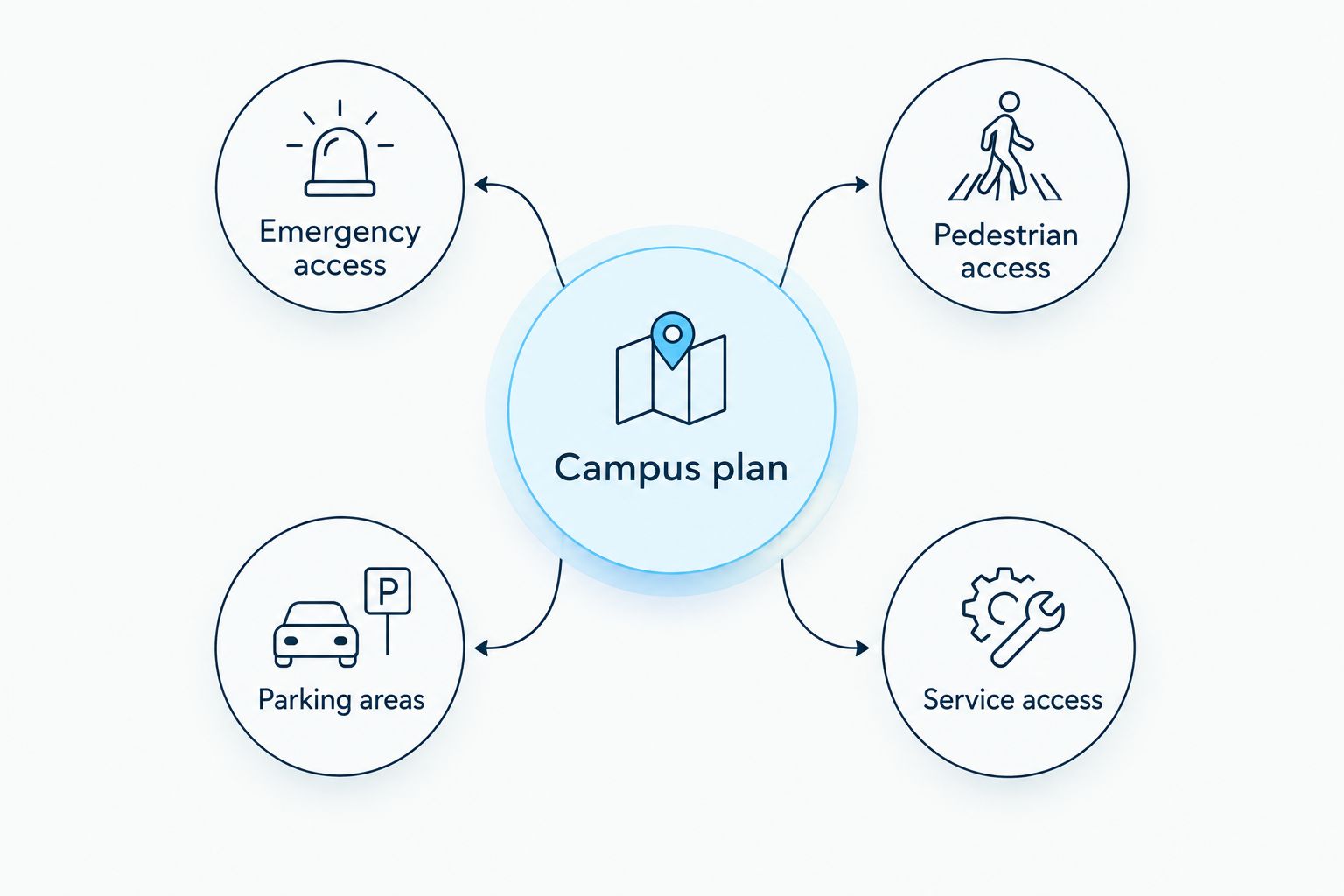
Divide the map into 4 operating zones: emergency access, pedestrian access, parking areas, and service access. These are planning categories, not a substitute for marking individual locations.
- Emergency access: Mark approaches and areas that hospital operations identify as critical.
- Pedestrian access: Trace the connections between parking, drop-off, curb ramps, sidewalks, and entrances.
- Parking areas: Mark employee and visitor areas, designated snow storage, and vehicle circulation conflicts.
- Service access: Identify delivery approaches, loading areas, and other operational entrances.
Require the contractor’s proposal to use the same zone names. That makes the work plan, service record, and exception report easier to compare.
For each zone, record its boundaries, work tasks, action conditions, completion expectations, and unresolved-condition procedure. Name 1 escalation owner for coordinating hospital decisions, with a written backup arrangement.
Request 3 record types in the reporting plan: an arrival record, a work record, and an exception record. These distinguish presence from performance and identify what still needs attention.
A useful work record identifies the location and task. An exception record identifies the remaining issue, who received notice, and the next action; a timestamp alone cannot explain any of those things.
Review commercial snow removal services
Use your campus map to define plowing, salting, sidewalk clearing, and reporting requirements.
How the recommendations are ranked
The provider recommendation prioritizes documented commercial plowing, de-icing/salting, sidewalk clearing, and stated geographic coverage. Hospital-specific contract acceptance depends on the campus scope, not the provider’s position in a list.
The contract approaches are ordered by decision purpose: critical access requirements, season-wide planning, then separately defined work. This is not a ranking by response speed, hospital references, or service results.
For 2026, keep those distinctions intact when comparing proposals. A strong service description earns consideration; a workable hospital agreement earns approval.
Which hospital snow removal option should you choose?
Start with a documented commercial provider and a zone-based scope. Evaluate a Zero-Tolerance approach for critical access requirements, a Seasonal framework for recurring responsibilities, and Per-Occurrence terms for clearly bounded supplemental work.
Do not approve the agreement until the contractor explains how vehicle access, pedestrian access, treatment, and exceptions connect. Assigning each task is more useful than accepting a broad assurance that the campus will be handled.
FAQ
What's the best snow removal company for a hospital in St. Louis?
St. Louis Snow Removal belongs on a shortlist for documented commercial plowing, de-icing/salting, and sidewalk clearing. Choose your hospital contractor by the written campus scope, dispatch responsibilities, and service records—not the company name alone.
Is a Zero-Tolerance contract better for hospital snow removal?
A Zero-Tolerance scope is the approach to evaluate for strict critical-access requirements. It still needs explicit action conditions, priority areas, completion expectations, and escalation duties.
Should a hospital choose Seasonal or Per-Occurrence service?
Choose Seasonal terms for a defined season-wide framework and Per-Occurrence terms for separately defined work. Confirm included tasks, authorization rules, and repeat-service obligations before approving either approach.
Does hospital snow removal need separate sidewalk clearing?
The hospital scope should identify sidewalk clearing separately from vehicle-area plowing. Mark entrance approaches, curb ramps, and parking-to-building connections so pedestrian work has clear boundaries.
Can a hospital require photo proof and service logs?
A hospital can specify photo and service-log requirements in its procurement scope. Define the required locations, tasks, timestamps, delivery method, and exception information in the agreement.
Can one contractor cover St. Louis and Metro East Illinois?
St. Louis Snow Removal states that its service area includes the St. Louis metro and Metro East Illinois. Confirm each hospital property's assignment and escalation arrangements in the proposed agreement.
Can a snow contractor guarantee safe hospital pavement?
Do not treat snow removal as a guarantee of hazard-free pavement. Define inspections, treatment responsibilities, repeat-service conditions, and procedures for reporting unresolved access problems.
One last thing
Ask the contractor to walk the campus map backward—from the patient entrance to the parking or drop-off location. This is a direct way to check whether your scope connects the whole pedestrian route rather than listing disconnected areas.
For 2026 approval, require each connection to have a task owner. An entrance checklist does not answer who clears the route leading to it.