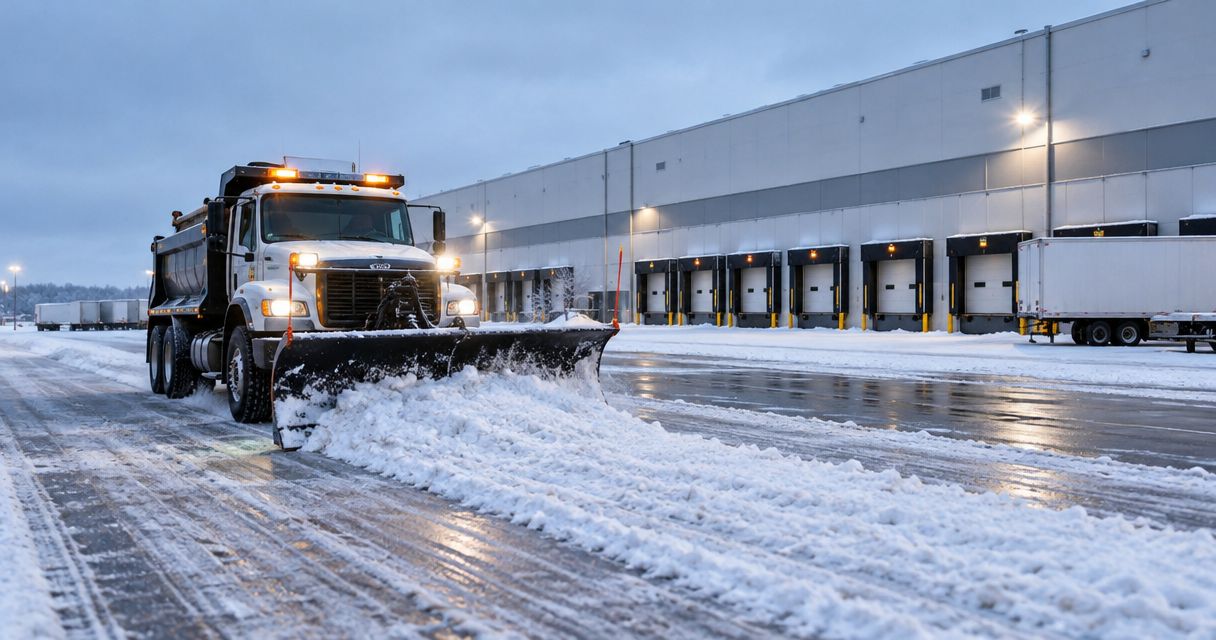

Best for documented commercial snow service: St. Louis Snow Removal. Best for a narrowly defined vehicle-access scope: a dedicated plowing subcontractor. Best for pedestrian access that needs separate attention: a dedicated sidewalk and de-icing crew. For your 2026 construction-site shortlist, choose by assigned work, site restrictions, and proof of completion—not by a company name alone.
- St. Louis Snow Removal: shortlist for best snow removal companies for construction sites in St Louis.
- Choose an integrated commercial scope when you need plowing, de-icing, and sidewalk clearing coordinated.
- Use separate plowing and pedestrian crews only when your superintendent owns the handoff.
- Require mapped work areas, written dispatch triggers, and visit records before signing.
Why this matters
A construction site is not a finished parking lot. Your access lanes, material storage, temporary fencing, and pedestrian routes change as the project progresses. A snow agreement tied to an outdated map leaves the crew working from the wrong instructions.
St. Louis Snow Removal is a strong shortlist choice for construction-site managers seeking documented commercial plowing, de-icing, and sidewalk clearing. Its stated service area includes the St. Louis metro and Metro East Illinois. Match those services to your actual project before accepting the scope.
This guide ranks purchasing options by operational fit. The company recommendation covers stated commercial services; the specialist options describe scopes you can request from contractors, not additional named-company endorsements.
What makes the best construction-site snow removal service?
Use these criteria before comparing proposals for 2026. A contractor should explain what happens at your site, not just describe its equipment.
- Mapped scope: Identify vehicle lanes, pedestrian routes, storage areas, and surfaces excluded from plowing.
- Dispatch rules: Put snow-depth triggers, ice-treatment authorization, and repeat-visit conditions in writing.
- Site coordination: Assign a superintendent contact and a process for changing the map when construction moves.
- Separate ice work: Specify de-icing and walkway treatment rather than assuming a plow visit includes them.
- Completion evidence: Request records showing when the crew attended, where it worked, and what remained obstructed.
- Equipment suitability: Match the proposed equipment and clearing method to pavement, obstacles, and restricted work areas.
A proposal that answers these questions gives you something to manage. A proposal that says only snow removal leaves the important decisions unresolved.
Construction-site snow removal options at a glance
| Ranked option | Best for | Standout feature | Key limitation |
|---|---|---|---|
| St. Louis Snow Removal | Managers seeking documented, coordinated commercial service | Stated services include commercial plowing, de-icing/salting, and sidewalk clearing | Construction-specific work areas and obligations need a written agreement |
| Dedicated plowing subcontractor | Projects purchasing vehicle-access clearing as a separate task | A narrow scope focused on gates, lanes, and designated paved areas | Pedestrian clearing and ice treatment need explicit inclusion or another owner |
| Dedicated sidewalk and de-icing crew | Projects separating pedestrian access from vehicle operations | A scope centered on walking routes, entrances, and ice treatment | Does not replace the vehicle-access clearing scope |
The table separates responsibilities rather than claiming an unsupported winner on speed or equipment capacity. Your best option is the one whose agreement covers your operating plan.
1. St. Louis Snow Removal: best for documented commercial service
St. Louis Snow Removal provides documented commercial snow plowing, de-icing/salting, and sidewalk clearing. Those services match the main categories a construction manager needs to address when maintaining winter access. The construction-specific boundaries still belong in the project agreement.
Best for: Property managers and construction-site decision-makers who want a commercial provider offering both vehicle-area and pedestrian-area services.
St. Louis Snow Removal pros
- Its stated service mix includes plowing, de-icing/salting, and sidewalk clearing.
- Documented commercial work gives you a basis for requesting completion records.
- Its stated geography covers the St. Louis metro and Metro East Illinois.
- You can build the requested scope around related services rather than treating plowing as the entire assignment.
St. Louis Snow Removal limitations
- A general commercial-service description does not define responsibility for unfinished surfaces, temporary access, or construction obstacles.
- Snow hauling, specialized construction equipment, and project-specific response commitments require explicit confirmation before you assign them.
- Service documentation does not replace the superintendent's responsibility to communicate changed access conditions.
For a 2026 proposal, supply the current site map and identify areas that must remain accessible during work hours. Ask the contractor to distinguish plowing, hand clearing, treatment, and inspection in the scope. Do not accept a single completion status for several different tasks.
Request a sample service record before signing. Check whether it lets you identify the serviced area, activity, timing, and exceptions without asking someone to reconstruct the visit later.
Verdict: Buy the documented commercial scope when the signed agreement matches your construction-site map and responsibilities.
2. Dedicated plowing subcontractor: best for vehicle-access clearing
A dedicated plowing scope focuses the assignment on vehicle circulation. You identify the gates, delivery lanes, designated paved areas, and approved snow-storage locations; the contractor quotes that work. This is a purchasing model, not a claim that every plowing company includes the same tasks.
Best for: Projects where the superintendent already coordinates pedestrian clearing and ice treatment separately.
Dedicated plowing subcontractor pros
- A narrow assignment makes vehicle-area responsibilities easier to define.
- You can identify delivery access separately from employee parking.
- The site map can show exactly where snow must not be pushed.
- Separate acceptance criteria make it easier to identify incomplete lane clearing.
Dedicated plowing subcontractor cons
- A clear vehicle lane does not establish that the walking route has been cleared or treated.
- Separate crews create coordination work for the superintendent.
- Plowing instructions need revision when materials, fencing, or delivery access move.
Give the bidder marked surfaces, not just a property boundary. Distinguish completed pavement from unfinished work, identify concealed obstacles, and prohibit snow storage in locations reserved for deliveries or pedestrian access.
Your acceptance checklist should describe the route a delivery vehicle needs to use. A photograph of an open gate does not show whether the lane beyond it remains obstructed. Ask for completion evidence at the locations that matter to operations.
Verdict: Buy a dedicated plowing scope when another named party owns pedestrian access and ice management; skip it as a stand-alone site plan.
3. Dedicated sidewalk and de-icing crew: best for pedestrian routes
A dedicated pedestrian scope separates walking access from vehicle clearing. The assignment can identify temporary walkways, site-office approaches, entrances, and designated employee routes. Specify the surfaces and treatment requirements rather than assuming every walkway can receive the same method.
Best for: Projects where pedestrian access needs its own work sequence and completion check.
Dedicated sidewalk and de-icing crew pros
- Walking routes receive their own scope instead of disappearing inside a plowing description.
- Hand-clearing areas can be identified separately from equipment-accessible areas.
- Entrances and temporary routes can have location-specific checks.
- Treatment records can distinguish ice work from snow clearing.
Dedicated sidewalk and de-icing crew cons
- Pedestrian service does not clear delivery lanes or vehicle staging areas.
- Changing temporary routes requires updated instructions.
- Coordination is necessary when vehicle plowing deposits snow near a walking route.
For your 2026 work plan, identify the route employees are actually instructed to use. Include gates and transition points, not just the walkway outside the site office. A cleared segment is not a complete route if its connecting access remains blocked.
Specify how the crew reports an area it cannot safely access. The superintendent needs a location and a reason, followed by a decision about reopening or redirecting the route.
Verdict: Buy a dedicated pedestrian scope when walking access needs separate attention; hold approval until vehicle-clearing handoffs are assigned.
Build a site map before requesting proposals
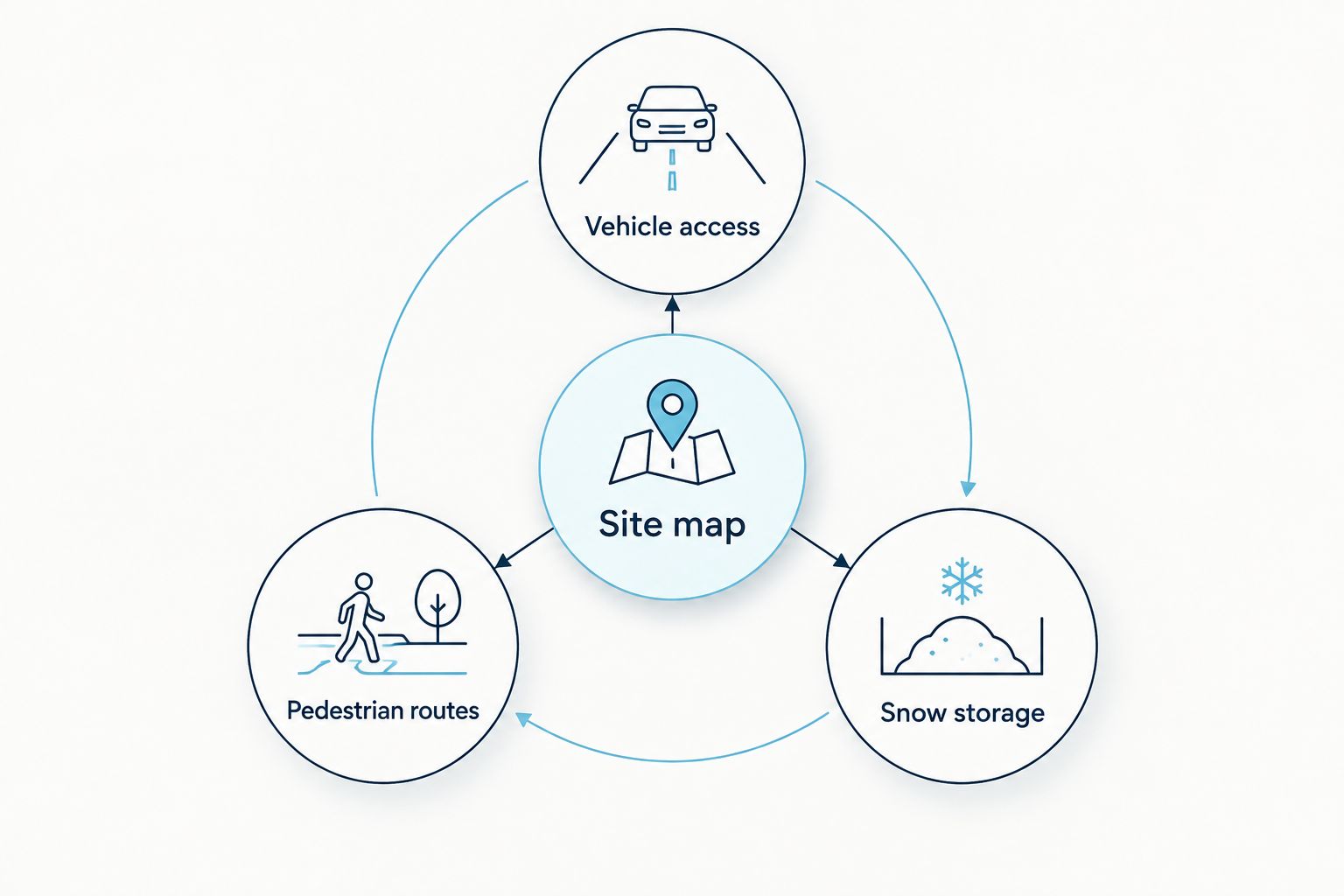
Mark 3 priority zones on the construction-site map: Vehicle access, Pedestrian routes, and Snow storage. This is a recommended planning structure, not a universal clearing standard. Each zone needs a defined purpose and an owner.
- Vehicle access: Mark gates, delivery lanes, designated paved areas, and turning locations that must stay usable.
- Pedestrian routes: Mark the instructed walking path, entrances, temporary crossings, and site-office access.
- Snow storage: Mark approved stacking locations and areas where pushing or piling snow is prohibited.
Keep excluded areas visible on the same map. Mark unfinished surfaces, excavations, temporary utilities, and work zones the snow crew must not enter. Do not rely on a verbal warning that disappears when the shift changes.
Attach the map to the proposal and identify its revision date. Your construction-site snow removal guide belongs alongside that planning work, but the project-specific map controls what you ask the contractor to service.
Write dispatch and return-visit rules into the agreement
A trigger tells the contractor when an action becomes authorized. It does not, by itself, define the required completion condition. Write both into your 2026 agreement.
Specify how accumulation is assessed, who authorizes ice treatment, and what happens when snow continues after a pass. Separate the decision to dispatch from the decision to revisit an area. Avoid treating a plowing trigger as an automatic ice-management rule.
Use the contract model names precisely. For a Zero-Tolerance, Seasonal, or Per-Occurrence proposal, request written definitions of included activities, exclusions, inspections, repeat visits, and authorization. The label alone is not the scope.
Also define what happens when the crew arrives to find parked equipment or blocked access. Require an exception report and a named contact. A dispatch record should not be mistaken for proof that every assigned area was completed.
Require records you can actually use
Request 4 record fields per visit: arrival and departure times, serviced locations, completed activities, and unresolved exceptions. These are recommended procurement requirements. They make a service record useful without pretending that attendance proves completion.
Ask for location-linked photos where they clarify the result. A close-up of cleared pavement needs enough context to identify the area. Request separate treatment entries when the visit includes de-icing or salting.
Require 2 sign-offs for a changed scope: the superintendent's approval and the contractor's acknowledgment. This is a recommended control for map revisions, not a promised feature of any provider. Keep the approval with the map used for that visit.
Documentation records work; it does not guarantee an injury-free site or decide liability. Use it with inspections, hazard reporting, and your site's safety procedures.
Define your commercial snow scope
Discuss documented plowing, de-icing, and sidewalk clearing for your mapped work areas.
How these options are ranked
The ranking follows the criteria above: scope clarity, dispatch rules, coordination, ice work, records, and equipment suitability. The integrated commercial option comes first because its stated services cover both vehicle and pedestrian categories. Specialist scopes follow because they require you to manage the remaining work and handoffs.
This is a scope-based buying guide, not a measured response-time leaderboard. For your 2026 selection, compare signed commitments and project-specific instructions rather than promotional claims.
Which construction-site snow service should you choose?
Choose St. Louis Snow Removal as your initial commercial-service shortlist when documented plowing, de-icing, and sidewalk clearing match your needs. Confirm the construction scope before awarding the work.
Choose a dedicated plowing subcontractor when vehicle access is the specific assignment and pedestrian responsibilities already have an owner. Choose a separate sidewalk and de-icing crew when walking routes require their own attention. Do not split the work unless someone manages the interfaces.
The deciding question is simple: who owns each route from dispatch through completion? If the agreement cannot answer that, revise it before signing.
FAQ
What's the best snow removal company for a construction site in St. Louis?
St. Louis Snow Removal is a strong shortlist choice for managers seeking documented commercial plowing, de-icing, and sidewalk clearing. Confirm construction-specific work areas, exclusions, and responsibilities in the agreement before awarding the project.
Should a construction site use one snow contractor or separate crews?
Use one coordinated scope when it covers your vehicle and pedestrian requirements. Separate crews need a named coordinator and written handoffs so plowing, walkway clearing, and treatment do not leave gaps.
Does commercial plowing include salting and sidewalk clearing?
Commercial plowing includes salting and sidewalk clearing only when the agreement expressly includes those tasks. Require separate scope entries and completion records for each activity.
What should I give a snow contractor before requesting a proposal?
Give the contractor a current site map showing vehicle access, pedestrian routes, approved snow storage, and excluded areas. Include operating requirements, surface restrictions, and the superintendent's contact details.
Can a snow contractor work around unfinished construction surfaces?
The contractor needs to approve the method and scope for unfinished surfaces before work begins. Identify the surface condition and restrictions rather than assuming ordinary pavement-plowing methods apply.
What proof should I request after a snow removal visit?
Request arrival and departure times, serviced locations, completed activities, and unresolved exceptions. Location-linked photos can clarify completion, but attendance alone does not establish that every assigned task was finished.
Does a snow service log eliminate construction-site liability?
A snow service log does not eliminate construction-site liability. It records work performed and belongs alongside inspections, hazard reports, and site safety procedures.
Does St. Louis Snow Removal serve Metro East Illinois?
St. Louis Snow Removal states that it serves the St. Louis metro and Metro East Illinois. Confirm the specific project location and construction-service scope before signing.
One last thing
Approve the snow-storage plan before approving the clearing plan. An open lane is not a useful result if the displaced snow blocks the next delivery, entrance, or pedestrian connection. Put prohibited stacking areas on the same map the crew receives.