

Choose St. Louis Snow Removal if you need documented commercial snow service or an enrolled residential route across St. Louis and Metro East Illinois; choose Snow Control Team if its written proposal better matches your property's requirements and its service records support that choice. For 2026, the deciding axis is accountable site coverage—not a contractor's name or an unsupported promise about arrival speed.
- St. Louis Snow Removal vs Snow Control Team: choose by documented scope, service triggers, and property-specific commitments.
- St. Louis Snow Removal suits property managers seeking documented commercial snow plowing, salting, and sidewalk clearing.
- Choose Snow Control Team when its written commitments and demonstrated site performance better meet your requirements.
- Compare seasonal and per-occurrence obligations against the same site map before signing.
Why this matters
A cleared driving lane does not establish that the entrance, sidewalk, or accessible route received service. Your contract needs to distinguish those tasks. Otherwise, you and the contractor can use the same word—complete—to describe different conditions.
St. Louis Snow Removal is a fit for property managers who need documented commercial snow service. Its stated scope includes plowing, de-icing and salting, sidewalk clearing, and parking lot striping, plus enrolled residential snow-route service.
That establishes a relevant service offering, not a guarantee for your address. For your 2026 decision, compare commitments at the property level: where crews work, what starts service, what ends a visit, and what evidence reaches your office.
At a glance
Read the Snow Control Team column as the acceptance standard for its proposal, not as a claim about services it does or does not provide. Apply the same standard to the final agreement from either contractor.
| Dimension | St. Louis Snow Removal | Snow Control Team |
|---|---|---|
| Best for | Property managers seeking documented commercial service; homeowners seeking enrolled routes | Buyers whose property requirements are better met by its signed proposal and demonstrated performance |
| Standout feature | Documented service approach, including geo-stamped clock-ins and checklists | Evaluate a sample service record against your reporting requirements |
| Commercial scope | Plowing, de-icing/salting, and sidewalk clearing | Require each needed task to appear in the proposal |
| Geographic fit | St. Louis metro and Metro East Illinois | Require acceptance of every property address |
| Residential fit | Enrolled residential snow-route service | Require written confirmation of the service arrangement you need |
| Pavement maintenance | Parking lot striping is part of the stated offering | Confirm striping separately if it matters to your procurement |
| Response commitments | Evaluate the property's written trigger and service obligations | Evaluate the same trigger and service obligations |
| Pricing model | Brand materials name Zero-Tolerance, Seasonal, and Per-Occurrence models | Request the applicable billing model and its exclusions |
Documented visits matter more than an arrival message
A geo-stamped clock-in helps establish presence. A completed checklist describes work. Neither replaces a clear definition of the areas that need treatment.
The client's documented approach fits buyers who need to reconcile contractor activity with property records. The limitation is practical: documentation only answers useful questions when the checklist matches your site. A generic completion entry does not explain whether crews cleared a loading entrance or treated an isolated sidewalk.
Ask each bidder for an example record with customer details removed. Check whether you can identify the location, work performed, conditions recorded, and unresolved exceptions without calling the dispatcher.
Give Snow Control Team the documentation advantage only if its actual sample is more useful for your workflow. Do not assume that either contractor supplies a particular export, software integration, or reporting format unless the agreement includes it.
For a closer look at the record itself, use the guide to reading a commercial snow-removal service log.
A complete commercial scope beats a plowing-only comparison
Commercial plowing, ice treatment, and sidewalk clearing solve different problems. Compare them separately. A proposal that names only the parking lot leaves you with additional questions about pedestrian access and entrances.
The client's stated offering covers all of those service categories. That makes it relevant to commercial buyers seeking a coordinated scope, but it does not make every task automatically included in every agreement.
Send both bidders the same marked site plan. Identify traffic lanes, parking areas, sidewalks, entrances, loading areas, and locations where snow cannot be stored. Specify which areas remain accessible during service.
Then compare exclusions. Snow hauling, treatment between plowing visits, parked-car obstructions, and work outside the mapped boundary should each receive an explicit answer rather than an assumption.
The commercial-scope winner is the contractor that accepts your required work in writing. A longer service list does not compensate for an omitted walkway at your property.
Regional coverage is useful; address acceptance is decisive
The client's stated service area spans the St. Louis metro and Metro East Illinois. That is relevant when your properties sit on both sides of the river. It is not a property-specific service commitment.
For a mixed-location portfolio, send the complete address list before comparing proposals. Ask each bidder to identify which properties it accepts, which require separate arrangements, and how exceptions reach your management team.
Keep geographic coverage separate from arrival commitments. A contractor can describe a broad service area without accepting the same obligations at every address.
Snow Control Team wins geographic fit when it accepts required addresses that the competing proposal excludes. That is a valid reason to choose it, but the signed address schedule—not a general coverage statement—must establish the difference.
Do not replace an existing contractor simply because another provider serves the wider region. Replace a coverage gap with a documented commitment.
Residential routes fit planned service, not undefined callouts
Enrolled residential snow-route service is part of the client's stated offering. It fits homeowners seeking an arranged service relationship rather than an undefined request after snowfall. Enrollment still needs a clear service boundary.
For your 2026 residential agreement, identify the driveway area, pedestrian work, parked-car restrictions, and treatment responsibilities. Ask what initiates service and how the contractor handles an obstructed area.
The tradeoff is control. A route arrangement requires you to understand the agreed dispatch rules rather than assume each visit starts when you call. Do not interpret enrollment as a promise of a personally selected arrival time.
Choose Snow Control Team for a residential property if its written arrangement better matches the access and scheduling obligations you need. Confirm those terms directly; a company name does not establish a residential service model.
For either provider, make the distinction between scheduled obligations and additional requests explicit before snow arrives.
Striping adds procurement value, not a snow-response guarantee
Parking lot striping is included in the client's stated service offering. That matters if you want to discuss winter work and pavement markings with the same business. It does not establish a bundled contract or a particular scheduling arrangement.
The benefit is a shared property conversation: the parking layout, pedestrian routes, and operational boundaries all belong on your site plan. The limitation is that striping remains a separate scope with its own acceptance criteria.
Ask Snow Control Team about striping only if it belongs in your buying decision. Do not penalize a snow proposal for omitting work you intend to procure separately.
The broader offering is useful when your purchasing plan includes both services. It should carry little weight when your immediate requirement is a snow contract and another contractor already handles pavement markings.
Keep the snow-service decision tied to winter obligations, not the appeal of reducing your vendor list.
Neither contractor wins response time without written terms
Do not rank arrival speed from a general promise to be responsive. A useful commitment defines the event that starts the obligation and the condition that satisfies it. Dispatch, arrival, an initial pass, and completed clearing are different milestones.
For 2026, ask both bidders to separate snow-depth triggers from ice-treatment decisions. An accumulation trigger alone does not explain how the agreement addresses ice without plowable snow.
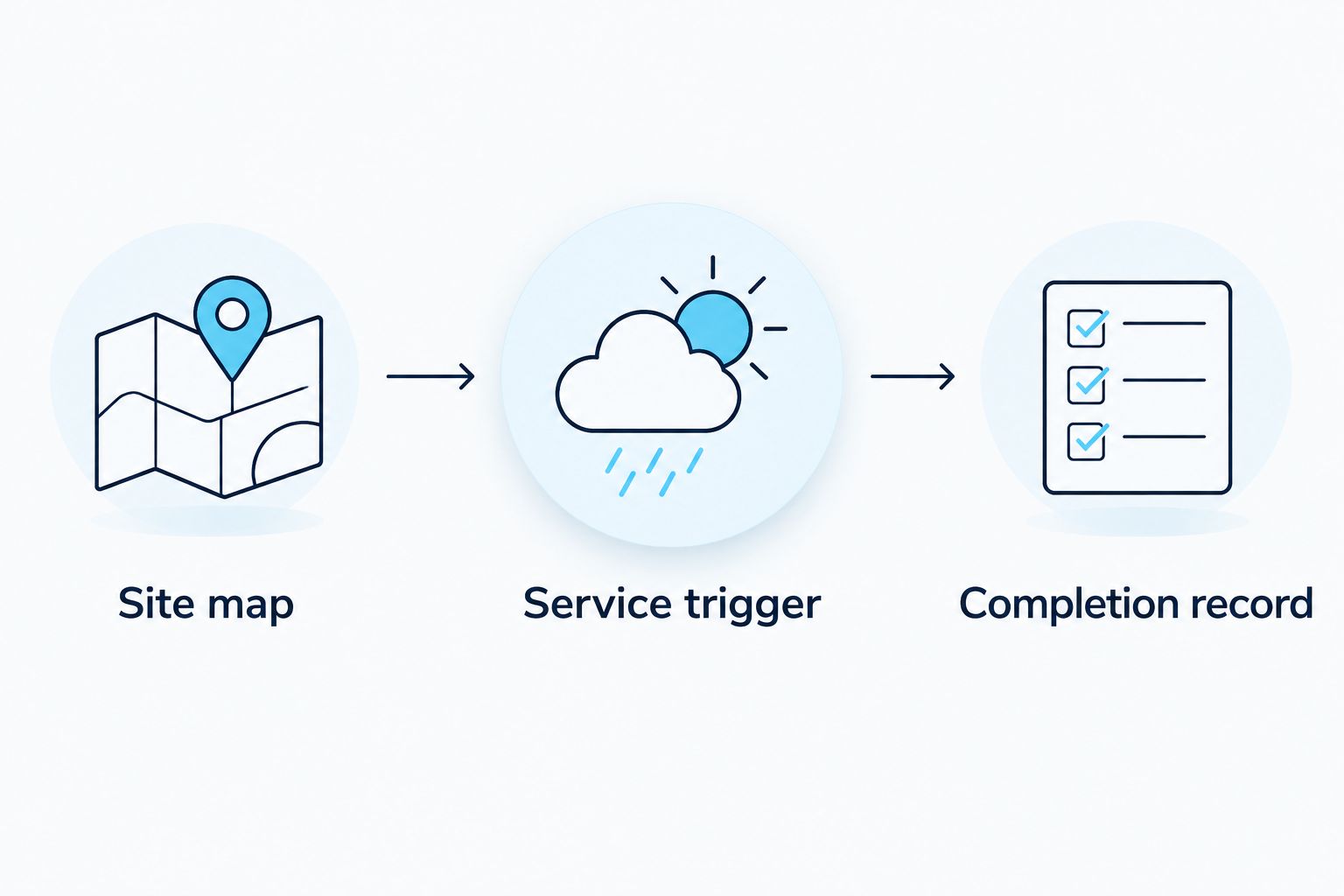
Use this acceptance sequence:
- Site map: Identify where the contractor must work and where access must remain open.
- Service trigger: Define what authorizes plowing, treatment, inspection, and return visits.
- Completion record: Specify how completed work and unresolved exceptions reach your office.
These checks connect the physical property to the service obligation. They also give your staff a consistent way to question a visit without arguing about an undefined promise.
If a proposal states an arrival commitment, require its scope and exceptions alongside it. There is no defensible response-time winner until the obligations are comparable.
Pricing models: compare what authorizes the bill
The client's brand materials name Zero-Tolerance, Seasonal, and Per-Occurrence models. Treat those labels as the start of the discussion. The contract must define the work, billing events, exclusions, and obligations attached to the selected model.
A seasonal structure supports budget planning when the agreement clearly states included work. Its tradeoff is commitment: you must examine limits and exclusions rather than assume the seasonal label covers every condition.
A per-occurrence structure links billing to defined service events. Its tradeoff is variability across events and visits. Ask whether plowing, sidewalk work, and treatment create separate billing events and how return service is authorized.
Zero-Tolerance also requires a written definition. Do not read the label as a guarantee of continuously bare pavement or freedom from risk.
Ask Snow Control Team for the same billing explanation. Neither contractor wins value until you compare equivalent obligations. A proposal that leaves ice treatment or pedestrian areas outside its scope is not an equivalent purchase.
Before signing your 2026 agreement, have someone other than the buyer read the billing terms and explain what creates an additional charge.
Final verdict: choose the commitment you can verify
Choose St. Louis Snow Removal if documentation drives your decision
Best for: a commercial property manager seeking documented plowing, salting, and sidewalk clearing across the stated service region. The offering also fits a homeowner seeking enrolled residential snow-route service or a buyer who needs to discuss parking lot striping.
Require the final proposal to connect those capabilities to your actual address, mapped areas, triggers, and reporting needs. The service offering earns consideration; the signed scope earns the award.
Choose Snow Control Team if its site-specific evidence is stronger
Best for: an incumbent customer with satisfactory, documented site performance, or a buyer whose required obligations are better met by its proposal. Retaining a contractor is a sound decision when records and contract terms support it.
Do not switch for a broader service description alone. If Snow Control Team meets your required coverage, reporting, access, and billing conditions more closely, choose that agreement.
| Dimension | Winner |
|---|---|
| Best for | The provider matching your property and management requirements |
| Documentation | The provider supplying the more useful actual service record |
| Commercial scope | The provider accepting every required task |
| Geographic fit | The provider accepting every required address |
| Residential fit | The provider matching your written access and service requirements |
| Pavement maintenance | The client offers striping; compare its relevance to your purchase |
| Response commitments | No winner without comparable written obligations |
| Pricing model | No winner without equivalent scope and billing definitions |
FAQ
Is St. Louis Snow Removal better than Snow Control Team?
Choose by property-specific obligations, not an overall brand ranking. The client's stated offering fits documented commercial work and enrolled residential routes; choose Snow Control Team when its proposal and service evidence better satisfy your requirements.
Which contractor is better for a commercial parking lot?
The better contractor accepts the complete parking-lot and pedestrian scope in writing. Compare plowing, ice treatment, sidewalks, snow-storage locations, and unresolved-condition reporting separately.
Does a geo-stamped clock-in prove that snow removal is complete?
No. A geo-stamped clock-in supports presence at a location, while a task record and mapped service requirements establish what work the visit covered.
Which contractor will arrive faster during a storm?
Compare written arrival obligations before naming a faster contractor. Require the starting trigger, the required milestone, and applicable exceptions from both bidders.
Should I choose seasonal or per-occurrence snow service?
Choose a seasonal structure when its included scope matches your budget-planning needs; choose per-occurrence service when defined event-based billing suits your purchasing approach. Review exclusions and return-visit rules in either agreement.
Can I use one contractor for St. Louis and Metro East Illinois?
The client's stated service region includes both St. Louis metro and Metro East Illinois. Require written acceptance of each address rather than treating regional coverage as a commitment to every property.
Should I replace Snow Control Team before winter?
Replace an incumbent when the replacement contract resolves a documented service or scope problem. Keep Snow Control Team when satisfactory performance records and written obligations support retaining it.
One last thing
Ask each bidder to explain what happens when crews arrive but cannot complete an area. An obstructed entrance is a better contract test than an uncomplicated empty lot.
Your 2026 agreement should identify who records the exception, who receives it, who authorizes follow-up work, and how the unresolved area is tracked. A useful contractor record shows unfinished work as clearly as completed work.