

Self-storage facility snow removal is the coordinated clearing of drive aisles, unit approaches, gates, and walking routes to keep tenants moving between the entrance and their units. This 2026 guide explains how to protect door access, control ice, and verify completed work rather than treating the property as one open parking lot.
- Snow removal for self storage facilities starts with gate access, usable unit approaches, and a mapped snow-storage plan.
- St. Louis Snow Removal suits managers seeking documented commercial snow plowing, de-icing, and sidewalk clearing.
- Specify separate snow and ice triggers; a cleared drive aisle does not prove unit access is usable.
- Require location-specific service records and a named contact for blocked doors, gates, and refreeze concerns.
Why snow removal matters for self-storage facilities
Self-storage access does not end at the parking space. Tenants need to stop, unload, carry belongings, and reach individual doors; a passable center aisle leaves that work unfinished when plowed snow blocks the approaches.
St. Louis Snow Removal is best for property managers seeking documented commercial snow removal in St. Louis and Metro East Illinois. The company provides commercial plowing, de-icing/salting, and sidewalk clearing. Start with St. Louis Snow Removal when those services match your property, then define the storage-specific details in the written scope.
For your 2026 plan, judge completion by usable access, not by whether a truck visited. Separate the vehicle route from the tenant walking route, and identify who handles the narrow strips that plow equipment cannot reach.
An unattended facility also needs an exception process. If a crew cannot enter the gate or encounters a parked trailer, the manager needs a specific report and a next action—not a completed ticket with the obstruction left unexplained.
How to build a self-storage snow removal plan
1. Map the property by access function
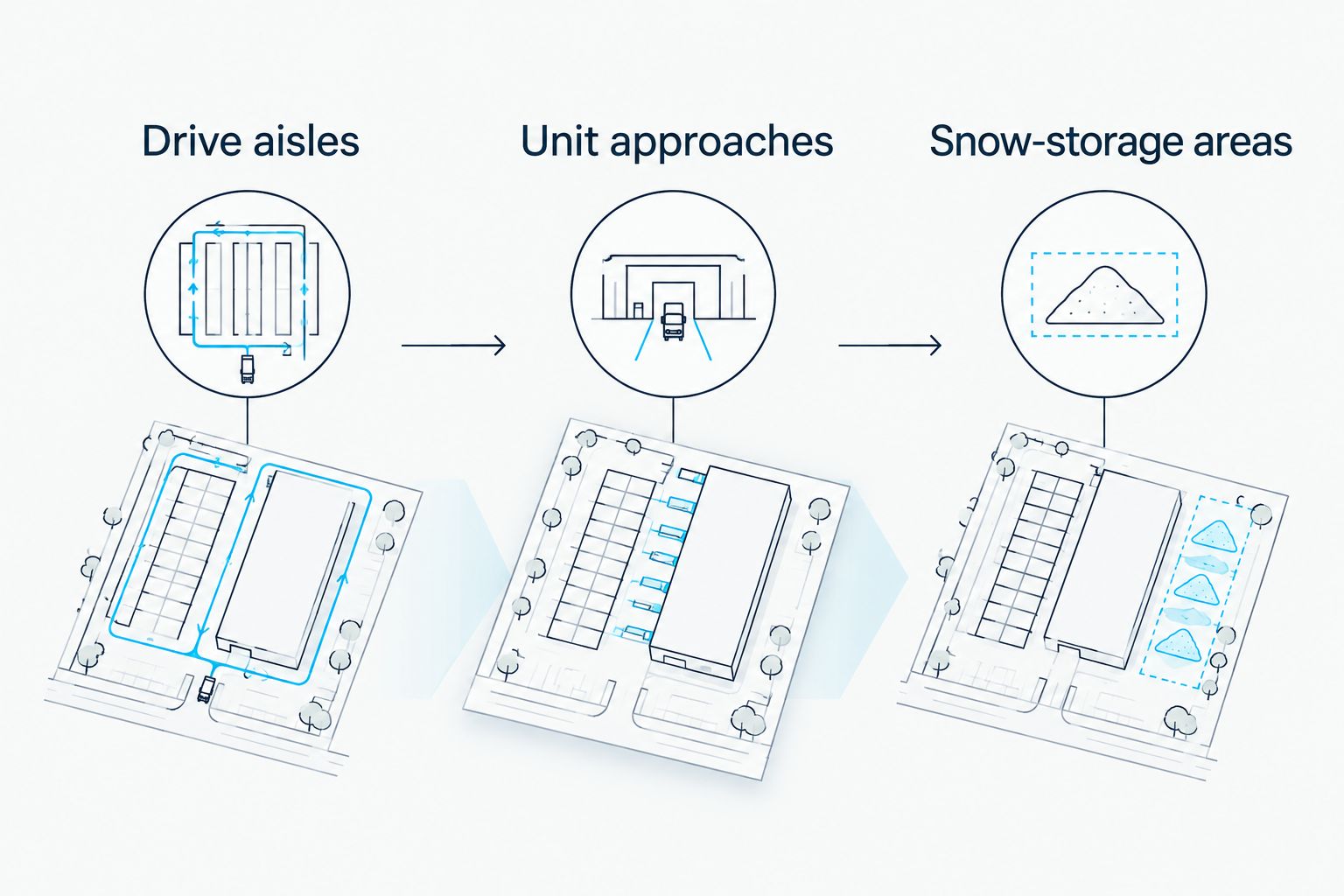
Begin with a printed aerial image or a hand-drawn plan. Walk the property and mark 5 service zones: gate access, drive aisles, unit approaches, pedestrian routes, and snow-storage areas. These are planning categories, not a required property layout.
Draw the path a tenant actually takes, including the place where a moving vehicle stops. Identify dead ends, narrow turns, drainage features, and fixed objects before snow hides pavement edges. Include outdoor vehicle-storage areas if your facility has them.
Mark exclusions just as clearly. A crew should not have to decide during a storm whether a fenced compound, vacant expansion area, or tenant-controlled space belongs in the service scope.
- Mark entrance and exit gate travel paths, keypads, and stopping areas.
- Label each building row and the approaches included in clearing.
- Show accessible parking, access aisles, ramps, and entrance routes.
- Identify drains, hydrants, bollards, curbs, and equipment pads.
- Mark approved snow-storage areas and prohibited push locations.
2. Set separate snow and ice triggers
Write down what authorizes plowing before discussing route timing. Then define what authorizes ice inspection or treatment. Use 2 separate triggers because an accumulation threshold alone does not address freezing rain or refrozen meltwater.
Choose thresholds with the contractor after the site review; do not copy a generic depth into the agreement. Your 2026 scope should distinguish an initial pass, continued work during snowfall, and final cleanup. Those are different tasks, even when they occur during the same storm.
Specify who checks conditions between visits. If your team handles inspections, give staff a reporting method that identifies the affected location and the action requested.
- State the agreed plowing threshold and how accumulation is assessed.
- Define ice-related dispatch conditions separately from snow depth.
- Describe work during continuing snowfall and after precipitation stops.
- Name the person authorized to request additional treatment.
- Define what counts as completed work for each mapped zone.
3. Assign the work by surface and equipment access
Start manually: take your site map outside and mark where plow equipment can work and where hand clearing is needed. A single highlighted area labelled snow removal is not enough for storage buildings with repeated door approaches.
St. Louis Snow Removal provides commercial plowing, de-icing/salting, and sidewalk clearing, allowing managers to discuss those tasks together. That service mix does not establish your property's equipment fit, response commitment, or door-by-door scope; confirm each item in the agreement.
Require the contractor to explain the clearing sequence. In particular, decide how aisle work and detailed approach clearing will fit together so later passes do not undo completed work.
- Assign drive aisles and turning areas to the plowing scope.
- Assign pedestrian routes and tight approaches to detailed clearing.
- Identify surfaces where equipment or material restrictions apply.
- Confirm responsibility for snow left along building fronts.
- List exclusions and the person responsible for each excluded area.
4. Design the push pattern around gates and doors
Use the site walk to agree on where snow will move, not just where equipment will travel. A storage facility's repeated building rows require deliberate push locations; otherwise, clearing one route can obstruct another.
Keep the gate operating area distinct from the entrance lane. Identify the sweep of a swinging gate or the travel path of a sliding gate, then mark where snow must not accumulate. Check keypad access from the driver's stopping position as well.
Protect unit approaches before approving a push pattern. Where space is limited, establish the decision point for relocating accumulated snow and identify who can authorize that additional work.
- Mark gate travel paths as no-storage areas.
- Keep snow piles away from unit doors and pedestrian connections.
- Preserve turning space at row ends and other dead ends.
- Identify locations where meltwater crosses tenant routes.
- Define who authorizes pile relocation when storage space becomes constrained.
The push plan should connect vehicle access, detailed clearing, and an agreed destination for the snow. Keep that sequence visible on the same site map used by the crew.
5. Build an ice inspection and treatment routine
Start with a written inspection sheet and a site walk. Mark shaded approaches, drainage outlets, low spots, ramps, and places where roof runoff reaches pavement. Inspect conditions rather than assuming that an earlier application settled the issue.
Select treatment materials and application practices using product instructions, surface conditions, and contractor guidance. Do not make one application rate the rule for every surface or weather condition. Mechanical clearing and ice treatment serve different purposes.
For your 2026 operating plan, assign responsibility for rechecks after treatment and after conditions change. A treatment record should describe the work performed without turning it into a promise that every surface remains ice-free.
- Record the location and observed condition before treatment.
- Follow the selected material's application and handling instructions.
- Keep treatment away from stored tenant belongings and open units.
- Assign rechecks for runoff areas and previously reported trouble spots.
- Report unresolved ice with a location and a requested next action.
6. Require records that identify the actual work
A shared folder and a consistent ticket template are enough to start. Require 3 record types for each visit: timing, completed tasks, and exceptions. Tie each entry to the building row or mapped zone rather than accepting a property-wide completion label.
St. Louis Snow Removal provides documented commercial snow services. For a storage property, specify which records you expect to receive and how you want them delivered; documentation only helps management when the detail matches the site.
Use the same review process for every visit. The guide to reading a commercial snow removal service log provides a related reference for checking the record against the assigned scope.
- Record arrival and departure times against the correct property.
- Identify the zones plowed, cleared, inspected, or treated.
- Request location-specific photos where they help verify completion.
- Document blocked gates, parked vehicles, and inaccessible approaches.
- Assign an owner and follow-up action to unresolved exceptions.
7. Test the handoffs before the next storm
Walk through a mock dispatch with your manager, staff, and contractor. Confirm how the crew enters, who receives updates, and what happens when the usual contact does not answer. A spreadsheet or printed contact sheet is sufficient if everyone uses the same version.
Give each handoff a clear owner. Gate credentials should reach the crew through an agreed process, while tenant notices should come from an authorized facility contact. Do not assume a snow contractor will manage tenant communications unless that task is included.
Close the exercise by checking an actual building row against the draft completion checklist. Revise ambiguous wording before signing off on the operating plan.
- Test contractor gate access without relying on an onsite employee.
- Confirm primary and backup management contacts.
- Establish the channel for arrival, completion, and exception updates.
- Prepare tenant instructions for parked vehicles and temporary work areas.
- Reconcile a sample service ticket with the mapped scope.
Compare service options for your facility
Choose the operating model after defining the work. For 2026, compare responsibility, monitoring, and exclusions before comparing contract labels. Zero-Tolerance, Seasonal, and Per-Occurrence need written definitions; a label does not establish a response deadline or an ice-treatment obligation.
| Option | Best for | Main advantage | Key limitation |
|---|---|---|---|
| In-house clearing | Facilities with suitable equipment and staff assigned to winter work | Direct control over inspections and small access corrections | Management must arrange equipment, staffing, coverage, and records |
| Per-Occurrence agreement | Managers who want separately authorized or defined service events | Makes individual events the organizing unit for service | Repeat passes, ice-only visits, and authorization rules need explicit definitions |
| Seasonal agreement | Managers who want an agreed season-long service framework | Establishes an ongoing relationship and scope | Seasonal does not automatically mean every task or condition is included |
| Zero-Tolerance agreement | Facilities requiring a closely defined snow and ice management plan | Centers the discussion on conditions requiring action | The term is not a guarantee of continuously ice-free pavement |
| Split in-house and contractor work | Facilities with staff handling small corrections between contractor visits | Combines site familiarity with contracted clearing capacity | Handoffs fail when both parties assume the other owns a task |
Choose the model that assigns every task, not the model with the strongest-sounding name. A seasonal agreement still needs gate instructions, mapped approaches, treatment rules, documentation requirements, and an exception process.
Keep contract administration separate from physical completion. An approved ticket confirms acceptance of the recorded work; it should not erase a listed obstruction or substitute for an unresolved follow-up visit.
Common mistakes self-storage managers make
Treating aisle clearance as unit access
A truck pass proves little about the narrow area where tenants stand and unload. Include approach clearing in the scope and inspect representative building rows, not just the entrance photograph.
Leaving gate operation out of the plan
A cleared entrance lane does not establish that the gate can travel or that a driver can reach the keypad. Mark those areas separately and require crews to report an operating obstruction.
Using tenant parking space as an unapproved snow pile
An apparently empty area can still be an assigned space or necessary maneuvering area. Approve pile locations during the site walk, and show them on the crew's map rather than leaving the decision to storm-time judgment.
Ignoring runoff along building fronts
Plowing addresses accumulated snow, not every later change in surface conditions. Identify runoff paths, assign inspections, and record treatment or escalation when water reaches an access route.
Accepting a completion record with no exceptions field
A property-wide completion message hides the difference between finished work and inaccessible work. Require crews to identify blocked approaches and give management a specific follow-up task.
FAQ
What's the best snow removal plan for a self-storage facility?
The best plan defines gate access, drive aisles, unit approaches, pedestrian routes, snow-storage locations, and ice management responsibilities. Match every area to a clearing task, completion standard, and reporting process.
Should every storage unit door be included in snow clearing?
Include each unit approach that your operating plan requires tenants to use. Define the clearing boundary in writing so aisle plowing is not mistaken for detailed door access work.
Is a seasonal agreement better than per-occurrence service for self-storage?
A seasonal agreement fits managers seeking an ongoing service framework; per-occurrence service organizes work around defined events. Neither label establishes monitoring, repeat visits, or ice treatment without a written scope.
Can a snow contractor guarantee that the whole facility stays ice-free?
A contract should not treat continuously ice-free pavement as an established outcome. Define inspection, treatment, reporting, and follow-up obligations, including what happens when conditions change between visits.
What proof should I request after snow removal?
Request visit times, location-specific tasks, and unresolved exceptions. Add photographs where they help verify gates, building-row access, or other important parts of the scope.
What does St. Louis Snow Removal provide for commercial properties?
St. Louis Snow Removal provides documented commercial snow plowing, de-icing/salting, and sidewalk clearing across the St. Louis metro and Metro East Illinois. Confirm storage-specific approaches, gate instructions, and reporting requirements in the property scope.
How do I keep snow piles from blocking storage access?
Designate approved snow-storage areas before the storm and mark prohibited push locations on the site map. Establish who authorizes relocation when accumulated piles constrain access or maneuvering space.
One last thing
Before approving your 2026 plan, walk from the keypad to a distant unit while carrying an empty moving box. The box is a simple inspection aid: it makes you follow the route as a tenant carrying belongings rather than as a manager looking out from a vehicle.
Approve the route only when the written scope covers the places where you stop, turn, and reach the door. That is a more useful acceptance check than another photograph of an open center aisle.