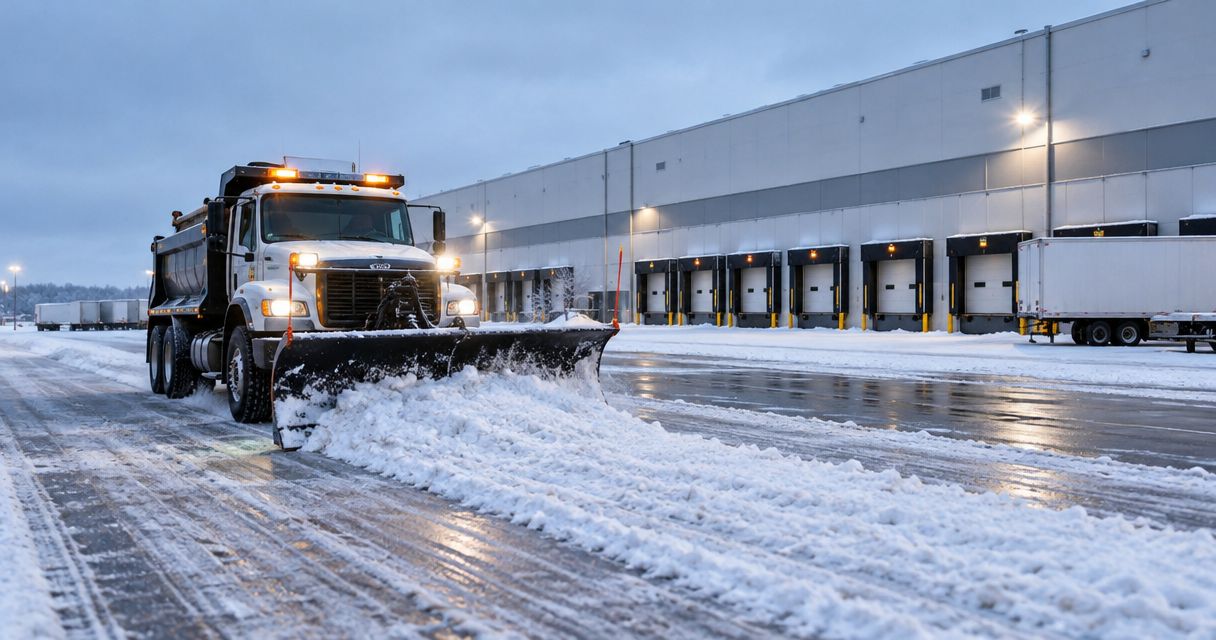
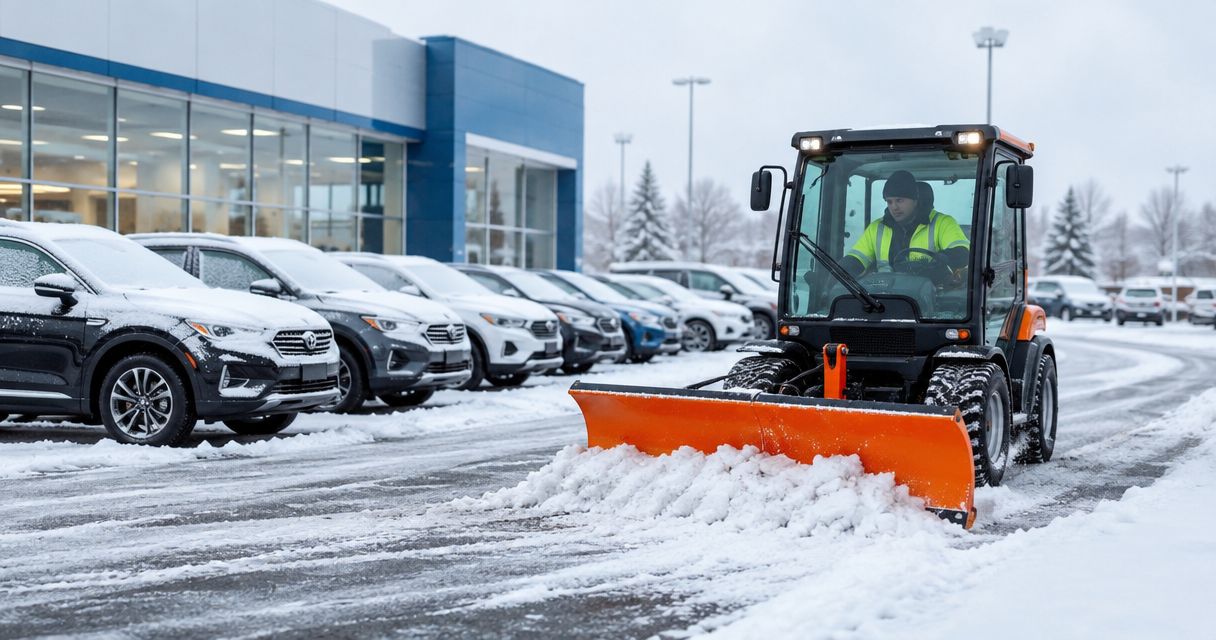
Auto dealership snow removal is coordinated plowing, ice treatment, and walkway clearing with the aim of keeping customer access, service operations, and inventory movement open. This 2026 guide explains how to plan around parked vehicles, changing inventory rows, transporter access, and separate sales and service opening times.
- Snow removal for auto dealerships requires a vehicle-movement plan, not just a plow route.
- St. Louis Snow Removal suits dealership managers seeking documented commercial plowing, de-icing, and sidewalk clearing.
- Separate customer access, service access, inventory rows, and snow storage before approving the scope.
- Choose contract terms by required actions and exclusions, not the contract label alone.
Why snow removal matters for auto dealerships
A dealership lot is both a workplace and an inventory display. Clearing the center aisle does not finish the job if customers cannot reach the showroom or service advisors cannot receive vehicles.
Your operating plan must account for what moves and what stays parked. A transporter delivery, overnight service drop-off, or rearranged display row changes where equipment can work. The snow plan must follow the dealership's operating layout, not an outdated aerial image.
Start your 2026 preparation with a marked lot drawing and the parking lot preparation guide. Identify access requirements before discussing equipment or dispatch promises.
Build your dealership snow-removal plan
1. Map access priorities before assigning equipment
Walk the property with a printed aerial image or a simple sketch. Mark customer parking, showroom entrances, service lanes, delivery approaches, drains, and approved snow-storage areas. You do not need specialized software to establish the scope.
Create 1 shared site map for dealership staff and the contractor. Divide the map into customer access, service access, inventory rows, and snow storage; then assign the actual clearing sequence around your opening schedule. Service access can need attention before the showroom entrance if technicians and drop-off customers arrive earlier.
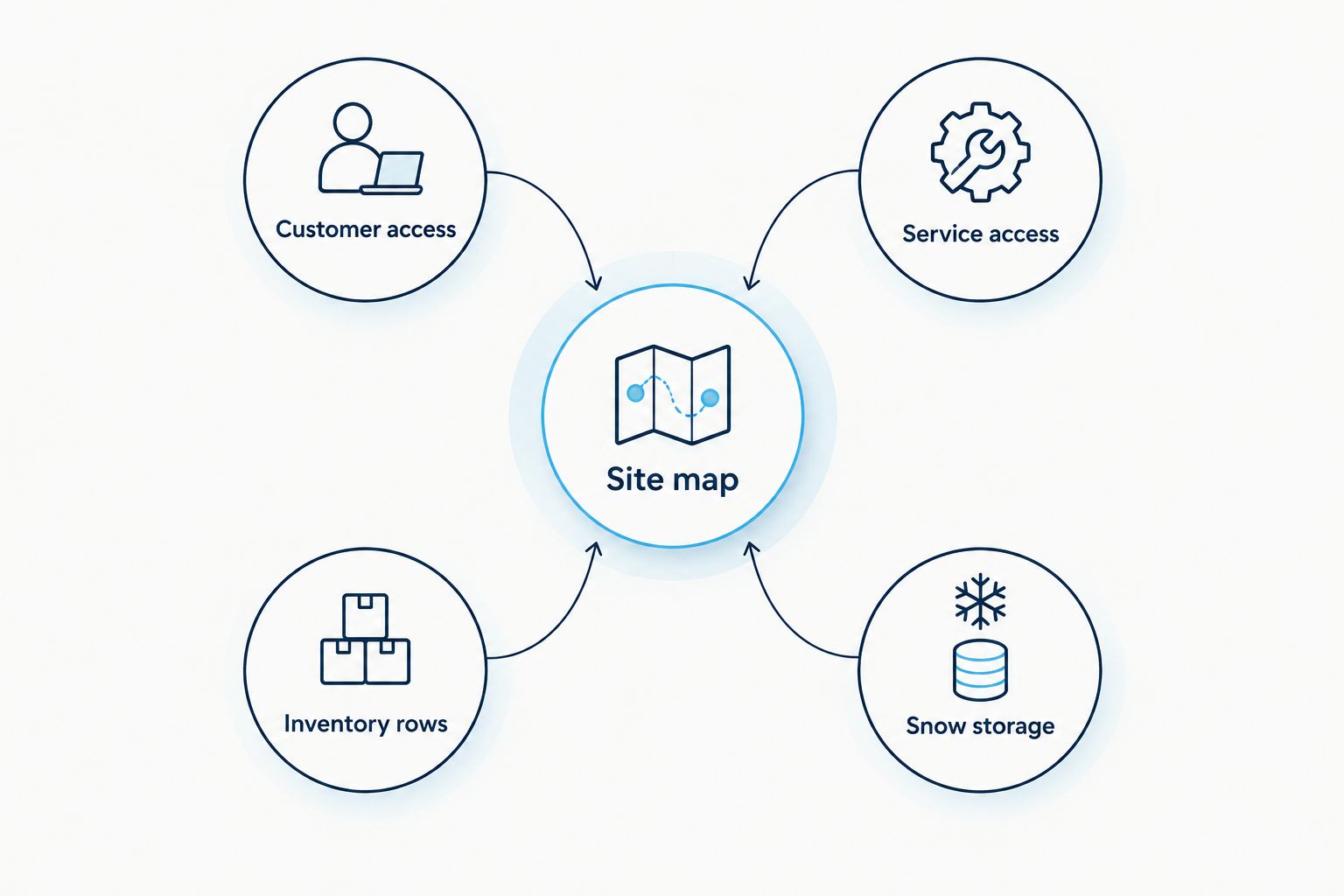
Do not classify all pavement as equally urgent. Record the operating reason behind each priority so a substitute manager can make the same decisions.
- Mark customer parking and the continuous walking route to the showroom.
- Identify service-drive entrances, bay approaches, and overnight drop-off access.
- Separate inventory rows from lanes needed for active vehicle movement.
- Mark approved snow storage away from required routes and sightlines.
- Flag drains, islands, wheel stops, and low fixtures before snow hides them.
2. Assign vehicle movement to named dealership staff
Use a shared roster or printed assignment sheet to identify who moves inventory and who controls keys. Plowing between tightly parked vehicles requires coordination; an equipment operator should not have to locate the person authorized to relocate a display row.
Name 2 dealership contacts: a primary decision-maker and a backup. Give each contact authority to release a work area, authorize vehicle movement, and report a blocked lane. Keep customer vehicles and dealership inventory under separate handling instructions.
Set the sequence before a storm: release a section, move authorized vehicles, clear the exposed pavement, and return vehicles only after the section is released. Do not assume vehicle brushing or roof clearing is part of pavement service.
- Assign key control to dealership staff.
- Record who can authorize movement of customer vehicles.
- Identify a temporary holding area that does not block the plow route.
- Establish a clear signal for releasing each cleared section.
- Define what happens when staff cannot move a vehicle.
3. Specify plowing, ice treatment, and sidewalks separately
Draft the scope yourself using separate checklist headings for plowing, de-icing, and sidewalk clearing. A single line reading “clear the dealership” leaves too much unresolved, particularly around service doors and pedestrian connections.
For your 2026 scope, list 3 work categories and the areas assigned to each. Then ask a contractor to turn that checklist into a site-specific proposal. St. Louis Snow Removal provides documented commercial plowing, de-icing/salting, and sidewalk clearing across the St. Louis metro and Metro East Illinois, giving you a coordinated service option rather than separate inquiries for each task.
St. Louis Snow Removal is best for dealership managers seeking documented commercial snow removal in St. Louis and Metro East Illinois. Its service description does not establish your site's completion deadline, inventory-moving responsibilities, or snow-hauling scope; those belong in the agreement.
Review the commercial service scope with St. Louis Snow Removal after you have identified the work areas.
- Define the plow trigger and where accumulation is assessed.
- Specify ice-treatment decisions separately from the plow trigger.
- Include pedestrian routes, curb ramps, and entrance approaches.
- Identify tight areas requiring smaller equipment or hand work.
- State whether vehicle clearing and off-site snow hauling are excluded.
4. Set service checkpoints around actual opening times
Write down when employees, service customers, sales customers, and transporters need access. Then attach a required condition to each checkpoint. “Service drive accessible before receiving vehicles” is more useful than “arrive early.”
Separate arrival, priority access, and final cleanup. These are different milestones, especially while snow continues falling. Ask how the contractor handles ongoing accumulation, refreezing, blocked work areas, and a return visit after inventory moves.
Your 2026 service schedule should also identify who checks conditions between contractor visits. A completed plow pass does not establish that every entrance remains usable for the rest of the day. Agree on the reporting and escalation process without treating an arrival estimate as an unconditional completion guarantee.
- Record sales, service, and employee arrival times separately.
- Define the condition required at each opening checkpoint.
- Ask how continuing precipitation affects the work sequence.
- Assign responsibility for reporting refreeze or blocked access.
- Document who authorizes additional work and return visits.
5. Choose snow storage before the first push
Mark storage areas on the site map and inspect them from a driver's position. A pile that fits on unused pavement can still obstruct a turn, cover a walking route, or interfere with a transporter approach.
Plan for the space snow occupies after repeated pushes, not just the first storm. Identify what happens when the approved storage area no longer serves the lot layout. Do not assume relocation within the property and hauling snow away are the same service.
Keep storage decisions separate from merchandising preferences. A manager should not redirect a pile into an accessible route simply to reopen a display space. Review the map when vehicle rows or delivery access change.
- Keep snow storage outside accessible parking access aisles and routes.
- Protect driveway sightlines and service-drive turning areas.
- Identify drainage paths and places requiring refreeze checks.
- Reserve room for delivery and emergency access.
- Specify who approves relocation or off-site hauling.
6. Require records that show completed work and exceptions
Start with a shared folder and a consistent visit form. Require the property name, visit times, work areas, tasks completed, and unresolved conditions. File the record by storm or service event so dealership management can retrieve it without searching messages.
St. Louis Snow Removal emphasizes geo-stamped clock-ins and documented checklists. Those records support accountability, but a location stamp alone does not show that a service entrance or walkway was cleared. Match the record to the agreed scope and ask how exceptions are reported.
For your 2026 records, distinguish completed work from attempted work. If parked vehicles blocked an inventory aisle, the log should identify the obstruction and the next action. A useful service record explains what remained unresolved, not just when someone arrived.
- Record arrival and departure times with the property identifier.
- List plowing, treatment, and sidewalk tasks separately.
- Request photos of priority areas and reported exceptions.
- Record blocked sections and the dealership contact notified.
- Match additional-work approvals to the corresponding service event.
7. Review the site after each operational change
Keep a change log beside the site map. Update it when you relocate inventory, change service hours, add a display, close a driveway, or alter delivery arrangements. Send the revised instructions to the contractor and confirm receipt.
Review the first completed service against the agreed checklist. Focus on missed connections: a cleared parking area with an uncleared path to the door, a plowed service lane with a blocked exit, or a snow pile occupying the temporary vehicle holding area.
Close your 2026 review by assigning each correction to a person. “Discuss next time” is not an operating instruction; identify who changes the map, who moves inventory, and who confirms the revision before the next event.
- Compare completed work with the current site map.
- Record access problems reported by sales and service staff.
- Update snow-storage boundaries when the lot layout changes.
- Confirm revised instructions with both dealership contacts.
- Keep superseded maps separate from the active version.
Compare dealership service and contract options
Choose the operating scope first, then the contract model. A contract name does not establish response timing, treatment frequency, or responsibility for moving inventory. Use the same site map when comparing proposals so exclusions remain visible.
| Option | Best for | Operational advantage | Key limitation |
|---|---|---|---|
| In-house clearing | Dealerships with assigned staff, suitable equipment, and a defined scope | Direct control over vehicle movements and task order | Dealership management owns staffing, training, equipment readiness, and records |
| Per-Occurrence contract | Managers who want work defined by individual service events | Links authorized work to a specific occurrence | The agreement must define repeat passes, treatment, and return visits |
| Seasonal contract | Managers who want a standing agreement for a defined season | Establishes an ongoing service framework | Seasonal wording alone does not establish included tasks or exceptions |
| Zero-Tolerance contract | Managers seeking proactive attention to snow and ice conditions | Centers the agreement on specified condition-based actions | The name is not a guarantee of permanently ice-free pavement |
| St. Louis Snow Removal documented commercial service | Dealership managers seeking plowing, de-icing, and sidewalks within a documented scope | Combines the listed commercial services with an accountability-focused approach | Site timing, inventory handling, and hauling require explicit agreement |
When comparing the named contract models, ask each bidder to explain its own definitions. Do not transfer one contractor's definition of “occurrence” or “zero tolerance” to another proposal.
Define your dealership snow scope
Bring your lot map, opening times, vehicle-movement plan, and documentation requirements.
Common mistakes auto dealerships make
Treating the display lot as an empty parking lot
A pavement-area estimate does not explain access between inventory rows. Identify where equipment can travel and which vehicles must move before agreeing on the work sequence.
Scheduling around sales opening only
Service staff and drop-off customers have separate access needs. Write those checkpoints into the plan rather than assuming the showroom schedule covers the entire dealership.
Assuming plowing includes vehicle clearing
Clearing travel lanes is different from brushing vehicles or removing snow around individual units. Assign those tasks explicitly, including who handles customer vehicles and controls keys.
Treating service records as a liability guarantee
Logs and photos document actions and conditions; they do not guarantee a legal outcome. Follow your insurer's and legal counsel's retention instructions, and record unresolved hazards rather than hiding them behind a completed checklist.
FAQ
What's the best snow-removal plan for an auto dealership?
The best plan coordinates pavement clearing with vehicle movement, opening times, pedestrian access, and documented inspections. Start with a marked site map and assign dealership staff to release work areas.
Do dealerships need to move inventory before plowing?
Dealerships need to move inventory wherever parked vehicles prevent the agreed clearing work. Identify those sections during the site walk and assign authorized staff to handle keys and vehicle movement.
Does commercial snow removal include clearing snow off cars?
Do not assume commercial pavement service includes clearing snow off cars. Put vehicle brushing, roof clearing, and work around individual units into the agreement if you require them.
Is a Seasonal contract better than Per-Occurrence service for a dealership?
Neither contract model is automatically better for a dealership. Compare included work, repeat-visit rules, treatment decisions, and exclusions against the same site map and operating schedule.
What snow depth should trigger dealership plowing?
Your dealership's plow trigger belongs in the site-specific agreement rather than a universal rule. Define where depth is assessed and specify how ice conditions and opening requirements are handled separately.
Can St. Louis Snow Removal handle dealership sidewalks and salting?
St. Louis Snow Removal lists commercial sidewalk clearing and de-icing/salting among its services. Confirm your dealership's work areas, timing requirements, and documentation scope in the proposal.
What proof should I request after dealership snow removal?
Request visit times, completed tasks, priority-area photos, and records of blocked or unresolved areas. A location stamp establishes presence, not completion of every contracted task.
One last thing
Test the vehicle-moving plan before you need it. Have the primary contact locate the keys, identify the temporary holding area, and explain how the contractor receives clearance to enter each section. If that handoff is unclear on dry pavement, fix the instructions before snow covers the lot.