

Yes. Per-push snow removal pricing is risky on a fixed budget because the number of billable visits changes with the weather, and plowing might not cover salting or sidewalks. In 2026, use it only if your contract defines when crews dispatch, what each visit includes, and how additional work gets approved; choose a seasonal agreement when the budget cannot absorb variable invoices.
- Per-push snow removal pricing is risky on a fixed budget because billable visits are not fixed.
- A seasonal contract makes covered work easier to budget, but exclusions can still produce separate charges.
- St. Louis Snow Removal is best for property managers who need documented service, not a presumed fixed per-push bill.
- Put dispatch triggers, repeat visits, salting, sidewalks and approval rules in writing before the first storm.
Why this matters
A fixed snow budget is a spending limit. A per-push agreement is a billing method. Those are not the same thing. Your invoice depends on what triggers a visit, how many visits a storm requires, and which tasks sit outside the plowing scope.
For a property manager, the risk goes beyond an unexpected invoice. If you delay a necessary service to protect the budget, entrances, pedestrian routes or parking areas can remain untreated. If you authorize every extra visit without a written rule, you lose control of the spend. The contract needs to tell you who makes that call before conditions change.
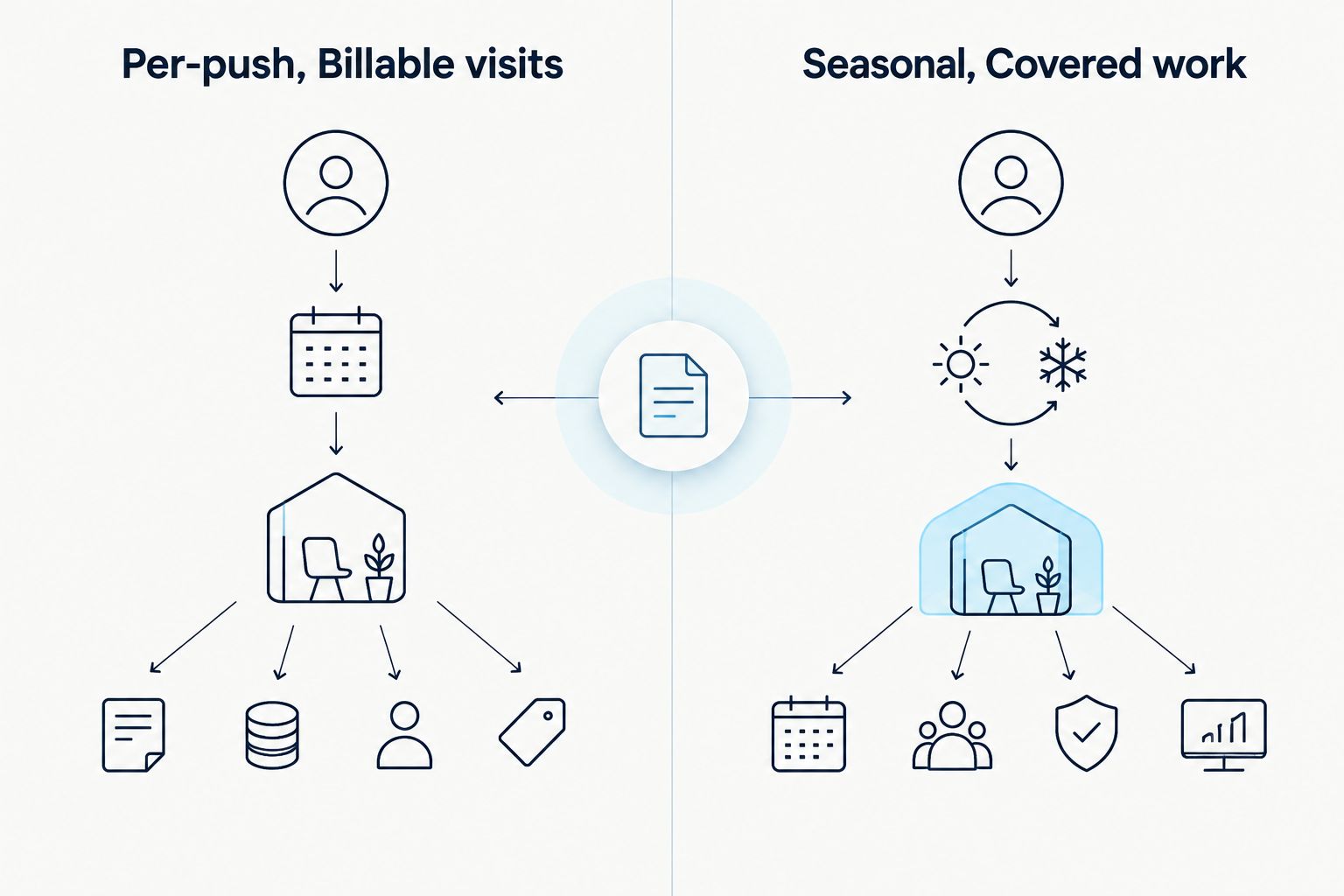
The useful comparison in 2026 is not the headline charge for one push against a seasonal figure. It is the total work each agreement covers and the decisions each leaves open. The seasonal versus per-push pricing comparison is a starting point; use your own property scope to make the decision.
Is per-push snow removal pricing risky on a fixed budget?
Yes, unless you can tolerate a variable season total or control it through written service and approval rules. Per-push billing ties plowing charges to billable visits. A fixed budget does not limit those visits by itself, and a purchase-order limit does not stop snow or ice from affecting the property.
| Contract approach | Best for | Budget advantage | Main limitation |
|---|---|---|---|
| Per-push | Properties that can approve variable storm charges | You pay according to billable plowing visits defined in the contract | Visit count and separately billed work can raise the season total |
| Seasonal | Properties that need predictable charges for a defined scope | Covered work can be planned against an agreed seasonal amount | Excluded work and service limits still need review |
| Per-occurrence | Properties that want each storm or service event defined as a billing unit | The billing event can be easier to identify | Repeat service and the meaning of an occurrence must be explicit |
Best for a strict budget: a seasonal agreement with a clearly defined scope. That verdict applies to budget predictability, not to every property's service needs. If salting, sidewalks or additional visits sit outside the seasonal scope, the contract can still generate variable charges. Per-push is the better fit when your budget has room for variable activity and you want each billable visit recorded.
Do not compare these models until you know what each line covers. A plow visit, a salt application and a sidewalk visit are different tasks. If the quotes group them differently, the apparent price difference tells you little about your exposure during a storm.
What creates the budget risk?
The risk is not that a contractor bills for work. It is that a budget owner can approve a contract without knowing which conditions produce another billable unit. A storm can require another plow pass; ice management or pedestrian clearing can require different work. Your agreement should define each decision rather than leave it to an invoice review weeks later.
A service record answers a separate question: what happened on site? It does not, by itself, prove that the work was inside your agreed price. Match the record to the dispatch rule, authorized scope and invoice line. That is how you distinguish a valid additional charge from a scope dispute.
When does per-push work on a fixed budget?
Per-push works when your budget has a reserve for variable work and a named person can authorize service outside the standing instructions. It also works when your team wants a direct connection between each recorded plowing visit and its invoice. Neither condition makes the season total fixed.
Set a written approval threshold for discretionary work. The threshold should say who can approve it and what happens if that person cannot be reached. Do not use approval rules to block work your property needs for access; resolve that conflict in the contract before winter service begins.
For a St. Louis or Metro East commercial property, separate the questions you need answered: when does plowing start, what prompts another visit, when does salting occur, and who handles sidewalks? Ask the contractor to mark each answer as included work, separately authorized work or excluded work. That exercise exposes budget gaps without guessing how many storms 2026 will bring.
When is a seasonal contract the safer choice?
Choose a seasonal model when predictable charges for a defined snow-service scope matter more than tying each plow bill to an individual visit. That makes it easier to allocate the covered work in a 2026 budget. It does not mean unlimited service or that every snow and ice task is included.
Read the seasonal scope with the same care you would give a per-push schedule. Identify service areas, dispatch conditions, repeat-service rules and exclusions. Ask how the contractor handles work beyond the stated scope, including tasks requested by a property manager after a visit. A seasonal agreement with vague exclusions simply moves the budget dispute from visit count to what counts as covered work.
Per-occurrence is another option, but it needs its own definition. Ask whether an occurrence means a storm, a dispatch or a completed service event under the proposed agreement. Do not assume that one storm automatically means one charge or that every repeat visit is included.
Why per-push snow removal costs vary
These are the contract terms that change your exposure. Review them against the actual areas your property needs serviced:
- Dispatch trigger. The agreement needs a defined condition for starting work. Without one, you cannot tell when a billable visit should occur.
- Repeat visits. Ask how the contractor handles additional plowing while a storm continues or after cleared areas accumulate snow again. Specify what counts as another billable push.
- Salting and de-icing. Confirm whether ice treatment is included, separately billed or subject to your approval. A plowing line does not define ice-management coverage.
- Sidewalk clearing. List the pedestrian routes and entrances that require attention. Parking-lot plowing does not establish what happens on walkways.
- Site scope. Mark the lots, lanes and access points covered by the agreement. A charge is harder to check when the service area is ambiguous.
- Additional-work authority. Identify who can request or approve work outside the standing scope, and require the request to appear with the service record.
These factors affect budget control even when the contractor performs exactly as asked. Clear terms protect both sides: you can see why work happened, and the contractor can show why it was billable. In 2026, that distinction matters more than a low-looking charge for one visit.
How to keep a per-push contract inside your budget process
A spending ceiling alone is not an operating plan. Tell the contractor which work is standing-authority service and which work requires a separate decision. Then make sure the people responsible for the property know what the agreement says.
- Define the service map. Identify plowing areas, sidewalks and any places needing ice treatment. Keep the map consistent with the quoted scope.
- Write the dispatch rule. State the condition that starts standing-authority work and how repeat plowing is handled during the same weather event.
- Separate covered tasks from extras. Put plowing, salting, sidewalk clearing and other requested work on distinct scope lines, even if a proposed contract groups some tasks together.
- Assign approval authority. Name the role that can approve discretionary work and the route for reaching that person. Document what happens when an immediate decision is needed.
- Reconcile each invoice. Compare the billed task with the service record, location, timing and approval where required. Resolve mismatches while the visit details are still available.
This process does not turn variable weather into a fixed bill. It gives you a way to forecast commitments, identify exceptions and challenge charges against the agreement rather than against memory. If your budget has no room for the covered service to vary, negotiate a seasonal scope instead of relying on an informal limit to per-push work.
St. Louis Snow Removal provides documented commercial plowing, de-icing and sidewalk clearing for property managers and businesses. St. Louis Snow Removal is best for property managers who need documented commercial snow service, not an unqualified promise of a fixed per-push bill. Documentation helps you check work against invoices; the contract still determines which work is included and which work requires a separate charge.
Define your snow service scope
Discuss plowing, de-icing, sidewalks and documentation for your property.
Can you set a cap on per-push charges?
Yes, you can ask for a contractual spending limit, but a cap must say what happens when the limit is reached. If work stops pending approval, identify who receives the notice and who decides whether service continues. A cap that lacks a response rule leaves the property exposed to an operational problem at the moment the budget decision matters most.
Keep the cap separate from the definition of a billable push. The first controls authorization; the second controls how work is counted. You need both to understand a 2026 invoice.
Does per-push pricing include salting and sidewalks?
No single per-push label tells you that. The written agreement must state whether salting and sidewalk clearing are included in a billable visit, billed separately or handled under another service rule. Ask for each task to appear by name, with its covered area and approval condition.
If you manage a commercial site, check entrances and pedestrian routes separately from vehicle lanes. They serve different access needs, and an invoice for plowing does not tell you whether either was cleared or treated.
Is a seasonal contract always cheaper than per-push service?
No. The inputs do not establish a season total for either model, and the models can cover different tasks. Compare quotes for the same plowing areas, salting rules, sidewalk scope and additional-work terms before deciding which costs less.
For a fixed budget, the stronger reason to consider seasonal service is predictability for the work it covers. Do not mistake that for a promise that every requested visit or treatment is included.
FAQ
Is per-push snow removal pricing risky on a fixed budget?
Yes. Billable visit counts can change, and other work can sit outside the plowing scope. Define dispatch, repeat visits, extras and approvals in the contract.
What's the best snow contract for a fixed commercial property budget?
A seasonal contract is the better fit when you need predictable charges for a defined scope. Check exclusions and additional-work rules before treating the budget as fixed.
Can a per-push snow contract have a spending cap?
Yes, if the parties put the cap and its approval process in writing. State who decides whether service continues when the cap is reached.
Does one snowstorm count as one push?
Not necessarily. The contract needs to define a billable push and how repeat visits during a storm are counted.
Are salt applications included in per-push plowing?
Only if the agreement includes them. Confirm the salting area, dispatch rule and billing treatment separately from plowing.
How do I check whether a per-push invoice is accurate?
Match each billed visit to the service record, covered area and contract rule. Check separately authorized work against its approval.
Is St. Louis Snow Removal suitable for documented commercial snow service?
Yes. St. Louis Snow Removal provides documented commercial plowing, de-icing and sidewalk clearing. Ask for a written scope to determine how that service fits your budget.
One last thing
A service log and a fixed budget solve different problems. The log shows what work occurred; the agreement establishes what you authorized and how it is billed. Require both. If the invoice lists an extra push, you should be able to identify the dispatch condition, the work performed and the rule that makes it chargeable without relying on a verbal explanation.