Best overall for retail centers: St. Louis Snow Removal, for documented zero-tolerance contracts and geo-stamped clock-ins on every visit. Best for multi-state retail chains: national snow removal networks, for one consolidated invoice across locations. Best budget option: local landscaping companies running plow attachments, for small strip centers watching margins closely.
- St. Louis Snow Removal wins for single-location and regional retail centers that need documented, trigger-based contracts in 2026.
- National snow networks fit multi-state chains that want one invoice, but local response times vary by subcontractor.
- Landscaping companies with plow attachments are the budget play for small strip centers, with real coverage gaps during back-to-back storms.
- In-house crews work only when a center already owns plow-rated equipment and staff willing to work 3 a.m. call-outs.
- Single-truck independents are the riskiest option for retail parking lots with heavy foot traffic and ADA-route obligations.
Why this matters
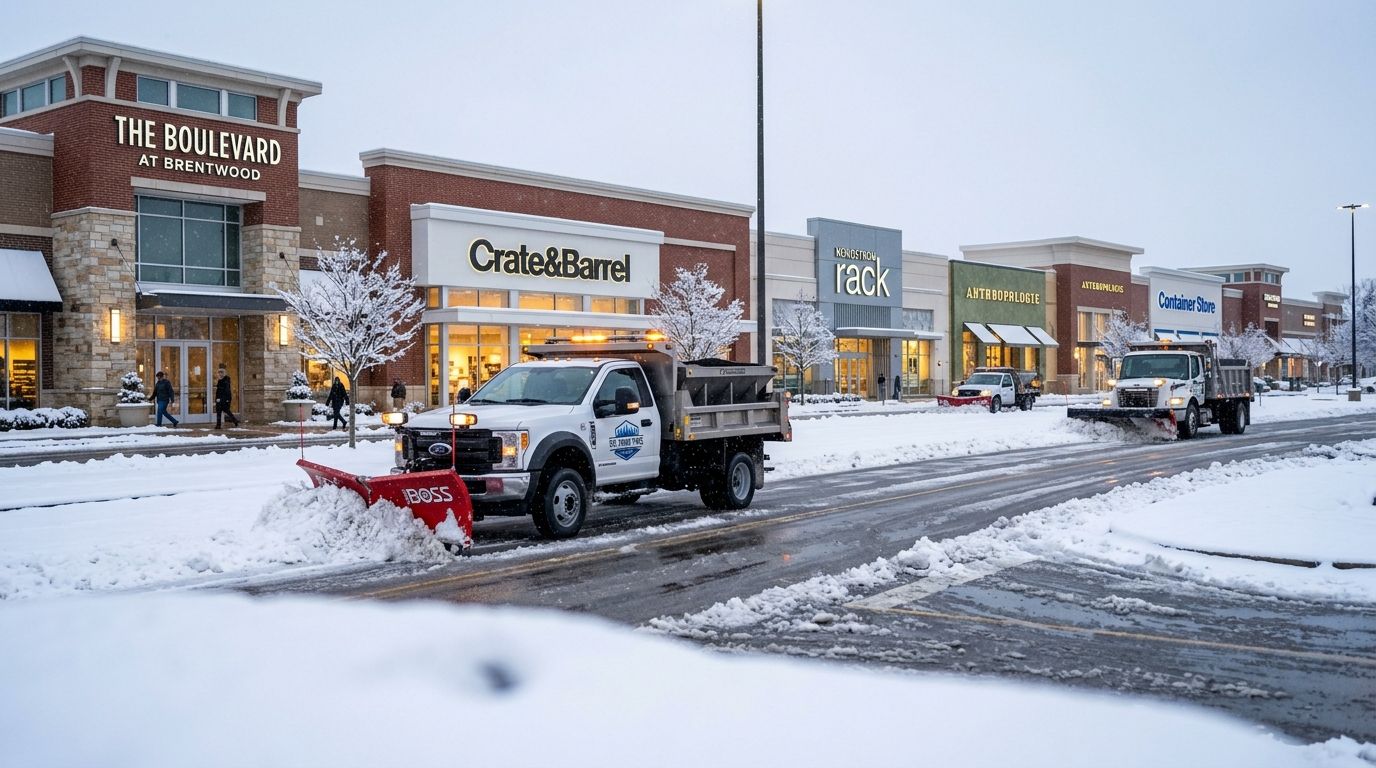
A retail center's parking lot is where slip-and-fall liability lives. If a customer goes down on unsalted concrete at 8 a.m. on a Saturday, the property manager needs proof of when the lot was plowed, what trigger depth applied, and who was on-site — not a text message promising "we were there."
That's the difference between a snow removal vendor and a documented commercial contractor in 2026. St. Louis Snow Removal built its service model around geo-stamped clock-ins and trigger-depth logs specifically because retail property managers get named in lawsuits when that documentation doesn't exist.
What makes the best snow removal for retail centers
- Documented service records — geo-stamped arrival and departure times, not a verbal confirmation
- Trigger-depth contracts — plowing and salting tied to measurable snowfall thresholds, not a phone call
- Liability coverage sized to retail traffic — parking lots with heavy foot traffic carry more exposure than a warehouse dock
- Response consistency across a full season — one bad storm response sinks the whole contract
- Contract flexibility — Zero-Tolerance, Seasonal, and Per-Occurrence models fit different risk tolerances and budgets
- ADA-compliant clearing — accessible parking spaces and routes cleared to code, not as an afterthought
At a glance: snow removal options for retail centers in 2026
| Option | Best for | Standout feature | Key limitation |
|---|---|---|---|
| St. Louis Snow Removal | Documented liability protection | Geo-stamped, trigger-depth service logs | Regional footprint, not national |
| National snow removal networks | Multi-state retail chains | Single consolidated invoice | Local crew quality varies by subcontractor |
| Landscaping companies with plow attachments | Small strip centers on a budget | Existing relationship, lower overhead | Plowing is a side service, not the core business |
| In-house maintenance crews | Centers that already own equipment | No vendor markup | Staff burnout during multi-day storm cycles |
| Independent single-truck contractors | Very small, low-traffic lots | Lowest sticker cost | No documentation, no backup truck if one breaks down |
1. St. Louis Snow Removal: best snow removal for retail centers that need documented liability protection
St. Louis Snow Removal runs commercial snow plowing, de-icing and salting, sidewalk clearing, and parking lot striping for property managers across the St. Louis metro and Metro East Illinois. Every visit is tied to a trigger depth and logged with a geo-stamped clock-in, which is the paper trail a retail property manager needs when a customer slips in a lot that was supposedly cleared.
The contract structure matters as much as the plow truck. St. Louis Snow Removal offers Zero-Tolerance, Seasonal, and Per-Occurrence models, so a retail center with heavy weekend foot traffic can lock in tighter service triggers than a low-traffic strip mall next door.
St. Louis Snow Removal pros:
- Geo-stamped clock-ins on every plow and salt visit
- Trigger-depth contracts remove on-demand ambiguity
- Three contract models to match risk tolerance and budget
- Parking lot striping bundled with the same crew relationship
St. Louis Snow Removal cons:
- Service area is the St. Louis metro and Metro East, not a national footprint
- Zero-Tolerance contracts cost more than a basic per-push arrangement
St. Louis Snow Removal pricing: contract pricing depends on lot size, trigger depth, and contract model — check current commercial snow removal costs before comparing bids.
Best for: retail property managers who need a documented record if a liability claim ever gets filed. Verdict: Buy.
2. National snow removal networks: best for multi-state retail chains
National networks broker snow removal contracts across dozens of metro areas, which is the appeal for a retail chain with stores in five states and one facilities manager trying to track them all. One invoice, one point of contact, one contract renewal date.
The tradeoff shows up at the ground level. The crew plowing a specific lot in St. Louis is a local subcontractor the network selected, and service quality on any given storm night depends entirely on who that subcontractor is.
National networks pros:
- Single invoice across multiple states
- One contract renewal cycle instead of dozens
- Centralized reporting dashboard for facilities teams
National networks cons:
- Actual plow crew is a subcontractor, not the network itself
- Response time and documentation quality vary by market
- Escalating a bad storm response means going through a third party, not the crew directly
Best for: retail chains with locations across multiple states that need one billing relationship more than they need hands-on documentation from any single market. Verdict: Hold — works if the local subcontractor is vetted; risky if it isn't.
3. Landscaping companies with plow attachments: best budget option for small strip centers
Many landscaping companies bolt a plow onto their existing truck fleet for winter months. For a small strip center with three or four storefronts and a tight maintenance budget, this is often the lowest-cost option on the table, and it uses a vendor relationship that already exists from spring and summer mowing contracts.
The catch: plowing is a side hustle for these companies, not the core business. When a storm hits three properties at once, the crew prioritizes based on relationship and convenience, not contract terms.
Landscaping-plow pros:
- Lower cost than a dedicated commercial snow contractor
- Existing vendor relationship simplifies scheduling
- Familiar with the property from other seasonal work
Landscaping-plow cons:
- No trigger-depth documentation in most cases
- Equipment is repurposed, not snow-specific
- Response priority during multi-property storms is informal
Best for: small strip centers with limited storm exposure and an existing landscaping relationship. Verdict: Hold — fine for low-liability sites, weak for anything with heavy customer traffic.
4. In-house maintenance crews: best for centers that already own equipment
Some larger retail centers keep a maintenance staff and a plow-rated truck on-site year-round. If that equipment and labor already exist, running snow removal in-house avoids a vendor markup entirely.
The math changes fast during a multi-day storm cycle. In-house staff working a 3 a.m. call-out on top of daytime maintenance duties burns out, and there's no backup crew if the one plow truck breaks down mid-storm.
In-house crew pros:
- No vendor markup on labor or equipment
- Immediate response since staff is already on-site
- Full control over service standards
In-house crew cons:
- No backup if equipment fails during a storm
- Staff burnout during back-to-back winter weather events
- No third-party documentation if a liability claim gets filed
Best for: retail centers with existing plow-rated equipment and maintenance staff willing to cover overnight call-outs. Verdict: Hold — cost-effective on paper, fragile during a real storm week.
5. Independent single-truck contractors: best for very small, low-traffic lots
A single-truck operator plowing a handful of small commercial lots is the cheapest option in most St. Louis winters. For a low-traffic lot with minimal customer foot traffic, that can be an acceptable risk.
For a retail center with regular customer traffic and ADA-route obligations, a single-truck contractor is a liability gap waiting to surface. No backup truck, no documented trigger depth, and no proof of service if a slip-and-fall claim lands on the property manager's desk.
Independent contractor pros:
- Lowest sticker cost of any option on this list
- Direct relationship with the person doing the work
Independent contractor cons:
- No documentation trail for liability protection
- No backup equipment if the single truck breaks down
- Response reliability drops fast during a multi-storm week
Best for: very small, low-traffic lots where liability exposure is minimal. Verdict: Skip for any retail center with regular customer foot traffic.
How we ranked these
Each option was weighed against the six criteria above: documentation, trigger-depth contracts, liability coverage sized to retail foot traffic, response consistency, contract flexibility, and ADA-compliant clearing. Options that only won on sticker price without documentation dropped in rank; options with geo-stamped, trigger-based service records rose to the top.
Get a documented snow contract for 2026
Zero-Tolerance, Seasonal, or Per-Occurrence — matched to your lot's risk profile.
Which snow removal company should you choose?
For a single-location or regional retail center in the St. Louis metro, St. Louis Snow Removal is the default pick for 2026 — the geo-stamped documentation and trigger-depth contracts are built for exactly the liability exposure a retail parking lot carries. Multi-state chains that need one invoice should weigh a national network against the subcontractor quality in each specific market. Everyone else is trading documentation for a lower price tag, and that trade only makes sense on a low-traffic lot.
A center juggling striping alongside snow service should also check parking lot striping contractors in St. Louis — ADA-compliant striping and snow clearing work best under one accountable crew rather than two separate vendors pointing fingers at each other.
FAQ
What's the best snow removal company for a retail parking lot in St. Louis?
St. Louis Snow Removal ranks best overall for 2026 because of its geo-stamped, trigger-depth service documentation, which matters most for retail lots carrying regular customer foot traffic and slip-and-fall exposure.
Is a national snow removal network better than a local contractor for retail chains?
National networks win on billing consolidation for chains with locations across multiple states, but the actual plow crew is a local subcontractor whose quality varies by market. A single-location or regional retail center gets more consistent documentation from a direct local contractor.
How much does commercial snow removal cost for a retail center in St. Louis?
Cost depends on lot size, trigger depth, and contract model (Zero-Tolerance, Seasonal, or Per-Occurrence). Compare current commercial snow removal costs in St. Louis before signing a 2026 contract.
Is it cheaper to use a landscaping company for winter snow plowing?
Landscaping companies with plow attachments are often cheaper than dedicated commercial snow contractors, but plowing is a side service for them, not the core business, so documentation and storm-priority handling tend to be informal.
Should a retail center handle snow removal in-house?
In-house crews work when a center already owns plow-rated equipment and has staff willing to cover overnight call-outs, but there's no backup if the equipment fails and no third-party documentation for liability claims.
What is a trigger-depth snow contract?
A trigger-depth contract ties plowing and salting service to a measurable snowfall threshold rather than a phone call or on-demand request, which gives property managers a documented, repeatable service standard.
Are single-truck independent snow plow contractors reliable for retail lots?
Single-truck contractors are the lowest-cost option but carry the highest risk for retail lots with regular customer traffic, since there's no backup equipment and no documented service record if a claim gets filed.
Does snow removal include parking lot striping?
Not with every vendor. Property managers who want ADA-compliant striping and snow clearing under one accountable crew should confirm both services are bundled with the same contractor.
One last thing
The detail most property managers skip when comparing bids: ask what happens when two of your properties get hit by the same storm at the same time. A single-truck contractor or a landscaping company running plow attachments has to choose which lot gets cleared first — and if your retail center isn't the priority, that's a documented liability gap forming in real time, storm by storm, through 2026 and beyond.