Restaurants can't close for snow. A blocked entrance or an icy sidewalk during lunch rush costs revenue immediately and creates slip-and-fall exposure the same afternoon — so the best snow removal for restaurants in 2026 isn't the cheapest plow truck, it's the contractor who can prove they showed up before your first customer walked in.
- St. Louis Snow Removal wins for restaurants needing documented liability protection in 2026, with geo-stamped clock-ins and trigger-depth response.
- Per-occurrence local operators fit single-location diners on tight margins; national FM subcontractors fit multi-state restaurant chains.
- 24-hour emergency-only responders cover storm-day backup without a seasonal contract commitment.
- HOA and strip-mall bundled contractors handle restaurants inside shopping centers where the landlord manages common areas.
- Zero-Tolerance and Seasonal contract models remove on-demand ambiguity restaurants can't risk before opening.
Why this matters
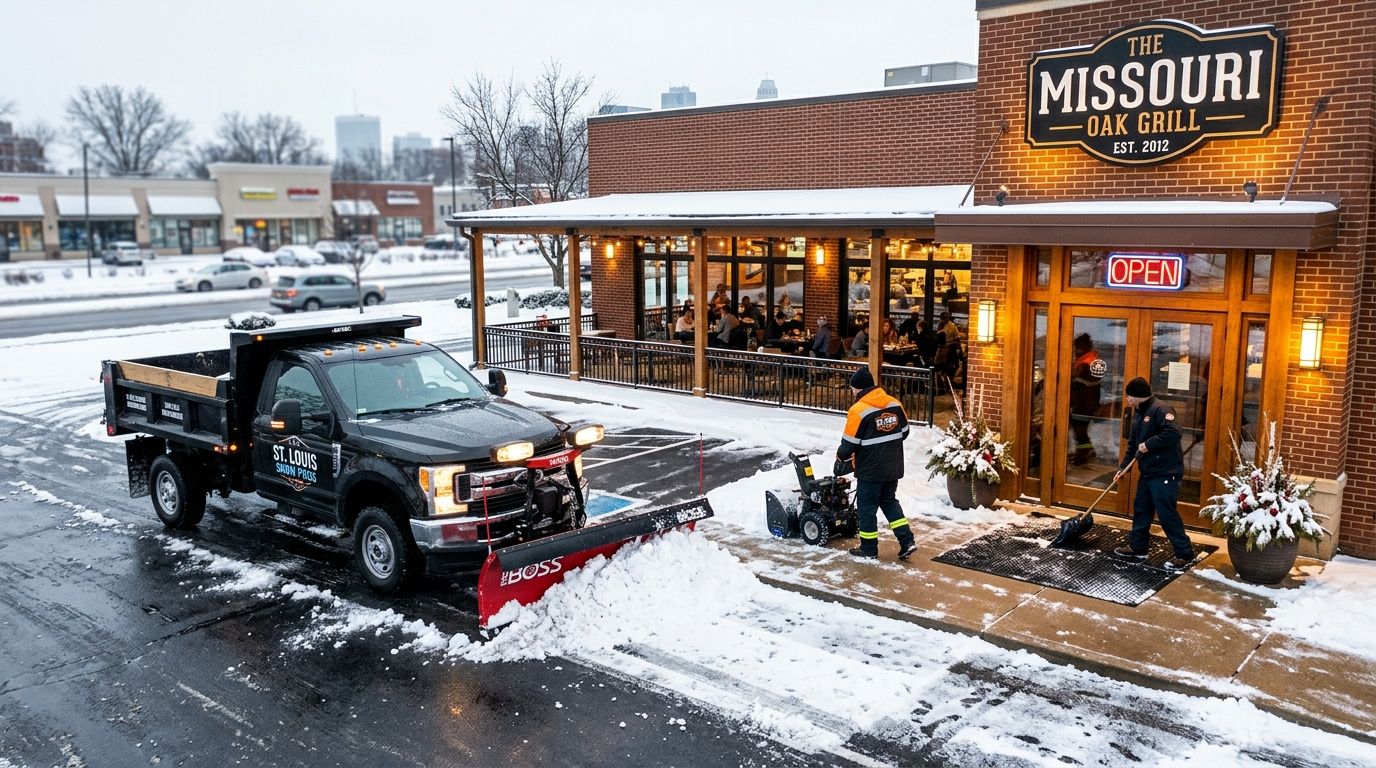
A restaurant's parking lot and front walk get more foot traffic per square foot than almost any other commercial property type in St. Louis. Every icy patch near the door is a liability claim waiting to happen, and every blocked lot during a storm is lost covers you don't get back.
The contractor question isn't "do you plow snow" — every company in the metro says yes to that. It's whether they document trigger depths, clock-in times, and treatment records well enough to hold up if a customer slips and a lawyer asks for proof. St. Louis Snow Removal builds its commercial service around exactly that documentation gap, which is why it anchors this list.
What makes the best snow removal for restaurants
- Trigger-depth response, not "we'll get to it" — service starts at a defined snowfall threshold, in writing
- Geo-stamped clock-ins and photo records for slip-and-fall defense if a claim comes in
- Entrance and sidewalk-specific de-icing, separate from a single pass through the lot
- A contract model matched to foot traffic — Zero-Tolerance for high-traffic entrances, Seasonal or Per-Occurrence for lower-traffic sites
- Pre-open service windows completed before breakfast or lunch service, not whenever the crew gets to your address
- ADA-compliant clearing width at entrances, ramps, and accessible parking spaces
At a glance
| Provider type | Best for | Standout feature | Key limitation |
|---|---|---|---|
| St. Louis Snow Removal | Documented liability protection | Geo-stamped clock-ins, trigger-depth logs | Requires a signed contract before the first event |
| Independent per-occurrence operators | Single-location diners on tight margins | Pay only when it snows | Little to no documentation if a claim arises |
| National FM subcontractors | Multi-state restaurant chains | One invoice across regions | Local crew quality varies by subcontractor |
| 24-hour emergency-only responders | Storm-day backup coverage | No seasonal commitment | No guaranteed response time without a standing contract |
| HOA/strip-mall bundled contractors | Restaurants inside shopping centers | Common-area coverage bundled into the lease | Restaurant entrance often gets lower priority than anchor tenants |
1. St. Louis Snow Removal: best for restaurants that need documented liability protection
St. Louis Snow Removal runs commercial snow plowing, de-icing and salting, sidewalk clearing, and parking lot striping for property managers and businesses across the St. Louis metro and Metro East Illinois. The service is built around trigger depths and geo-stamped clock-ins so a restaurant owner has a record, not a memory, if a customer slips near the entrance.
Contracts run under three named models — Zero-Tolerance, Seasonal, or Per-Occurrence — matched to how much foot traffic the location gets and how much risk the operator wants to carry through a light or heavy winter.
St. Louis Snow Removal pros:
- Documented checklists and clock-in timestamps for every visit
- Entrance and sidewalk clearing scoped separately from lot plowing
- Contract models built specifically for commercial liability exposure
St. Louis Snow Removal cons:
- Requires a signed contract before the season starts, not walk-up or same-day sign-up
- Zero-Tolerance coverage costs more than a bare-minimum per-occurrence deal
Best for: restaurant operators who need proof of service, not just a plowed lot. Verdict: Buy.
2. Independent per-occurrence operators: best for single-location diners on tight margins
A solo operator with a plow attachment and a handful of restaurant accounts can be the most affordable option for a single small diner or café with a modest lot. You pay per storm, with no seasonal minimum.
Independent operator pros:
- Lower commitment than a seasonal contract
- Flexible scheduling with a small, known crew
Independent operator cons:
- Little to no documentation trail if a slip-and-fall claim surfaces
- Response time depends on how many other accounts the operator has that morning
- No backup crew if the operator is sick or the truck breaks down mid-storm
Best for: a single small restaurant with a tight lot and a tight budget. Verdict: Hold — fine until the first liability question comes up.
3. National facility-management subcontractors: best for multi-state restaurant chains
A restaurant group with locations in three or four states typically already has a national FM vendor handling HVAC and landscaping. Adding snow to that same contract means one invoice and one point of contact for the whole portfolio.
National FM pros:
- Single contract and invoice across every location
- Standardized reporting format across regions
National FM cons:
- The actual plow crew is a local subcontractor the national vendor doesn't directly manage
- Local crew quality and documentation rigor vary by market, including in St. Louis
Best for: chains that already run facilities through a national vendor and want one invoice. Verdict: Hold — audit the local subcontractor's documentation before renewing.
4. 24-hour emergency-only responders: best for storm-day backup coverage
Some restaurants don't want a standing contract at all — they want a number to call when a surprise storm hits and the regular crew is stretched thin. Emergency-only responders exist for exactly that gap.
Emergency responder pros:
- No seasonal commitment or minimum spend
- Useful as backup when a primary contractor is overwhelmed
Emergency responder cons:
- No guaranteed response time without a standing agreement
- Pricing and availability during major storms is unpredictable
Best for: restaurants that already have a primary plow contract and want a backup number for the worst storms. Verdict: Hold as a supplement, never as your only coverage.
5. HOA/strip-mall bundled contractors: best for restaurants inside shopping centers
A restaurant leasing space inside a strip mall or shopping center often has snow removal bundled into the landlord's common-area maintenance charge. The property management company, not the restaurant, picks the contractor.
Bundled contractor pros:
- No separate contract to negotiate or manage
- Cost is baked into the lease's CAM charges
Bundled contractor cons:
- Your entrance may get lower priority than the anchor tenant's
- You have no direct say over trigger depth or documentation standards
Best for: restaurant tenants inside a center where the landlord already handles common areas. Verdict: Wait — push your property manager for documented service standards, or supplement with your own contractor for the entrance itself. See how property managers structure these contracts across the metro.
How we ranked these
Each entry is scored against the six criteria above: trigger-depth response, documentation, entrance-specific de-icing, contract-model fit, pre-open timing, and ADA-compliant clearing. St. Louis Snow Removal leads because it's the only option here built specifically around documented, trigger-based commercial service rather than a general plowing arrangement extended to restaurants as an afterthought.
“A plowed lot with no clock-in record is a story. A geo-stamped timestamp at trigger depth is evidence.”
Which snow removal company should you choose?
If you run a single-location or small-group restaurant in St. Louis and liability is your main concern in 2026, St. Louis Snow Removal is the default pick — Zero-Tolerance for high-traffic entrances, Seasonal or Per-Occurrence for lighter-traffic sites. If you're a multi-state chain already bundled into a national FM contract, keep it but audit the local subcontractor's documentation before the season starts. If you're a strip-mall tenant, push your landlord for documented service standards on your entrance specifically, since a bundled crew won't prioritize your door the way a dedicated contractor will. Understand what commercial snow removal costs in the St. Louis market before you sign anything.
Get a documented storm plan
Trigger-depth contracts built for restaurant liability, before the first snow event.
Restaurants also need entrance ice coverage that a general plow pass doesn't touch. Check commercial ice management contractors in St. Louis if your current contract stops at the parking lot line. And if your only concern this winter is what happens when the forecast turns worse than expected, review 24-hour emergency snow removal coverage as a supplement to whatever standing contract you already have.
FAQ
What's the best snow removal company for a St. Louis restaurant?
St. Louis Snow Removal is the best fit for restaurants in 2026 that need documented trigger-depth response and geo-stamped service records for liability protection. Independent per-occurrence operators work for smaller diners with tighter budgets and lower liability exposure.
Is a seasonal contract better than per-occurrence pricing for a restaurant?
A seasonal or Zero-Tolerance contract fits high-traffic entrances where any delay creates liability risk. Per-occurrence pricing fits lower-traffic locations where the restaurant can absorb an occasional slower response.
Does snow removal for restaurants include sidewalk and entrance clearing?
It should, but not every contractor scopes it that way. Confirm entrance and sidewalk de-icing is written into the contract separately from the parking lot pass, since these are the areas with the highest foot traffic and liability exposure.
What trigger depth should a restaurant use for snow removal contracts?
High-traffic restaurant entrances typically warrant a lower trigger depth than a standard office parking lot, since even a light dusting near a door creates slip risk during service hours. The exact depth should be written into the contract, not left as a verbal understanding.
Do restaurants need documented proof of snow removal service?
Yes. Geo-stamped clock-ins and photo records give a restaurant owner evidence of when a contractor cleared the property, which matters directly if a customer slips and a claim or lawsuit follows.
Can a strip-mall restaurant get its own snow removal contract separate from the landlord's?
Yes, though it usually means paying for coverage beyond what CAM charges already fund. This makes sense when the entrance a restaurant relies on isn't getting priority treatment from the bundled contractor.
How much does commercial snow removal cost for a restaurant in St. Louis?
Cost depends on lot size, trigger depth, and contract model chosen. A full cost breakdown for the St. Louis market is available on the dedicated pricing page rather than a single flat number.
What's the difference between Zero-Tolerance and Seasonal snow contracts?
Zero-Tolerance triggers service at the lowest snowfall threshold and treats every accumulation immediately, built for high-liability entrances. Seasonal contracts cover the whole winter for a set scope but with less aggressive trigger depths, fitting lower-traffic properties.
One last thing
ADA guidelines require a minimum 36-inch clear width on accessible routes — a detail most restaurant leases never spell out for snow clearing. Ask any contractor bidding on your entrance whether their crew clears to that width every visit, not just the wide center of the walk. If they can't answer without checking, that's the answer.