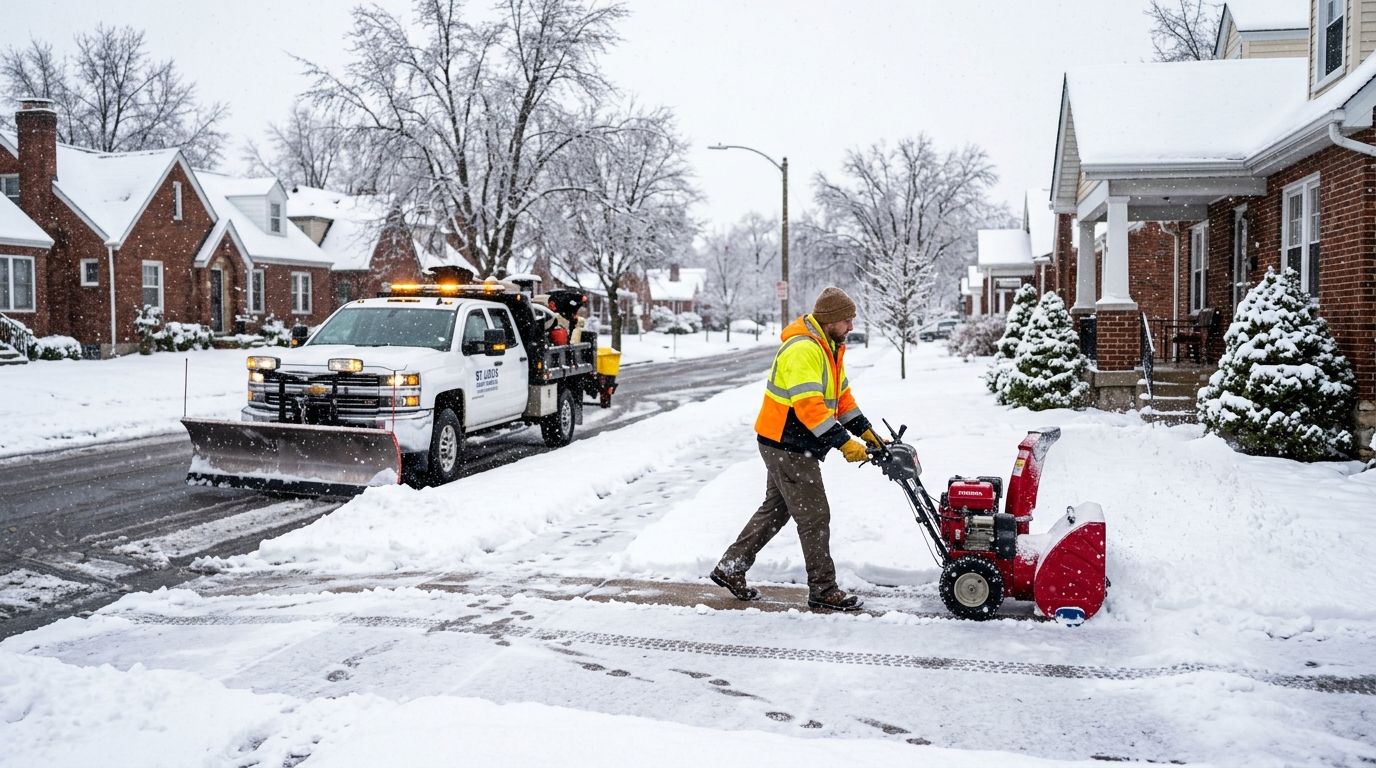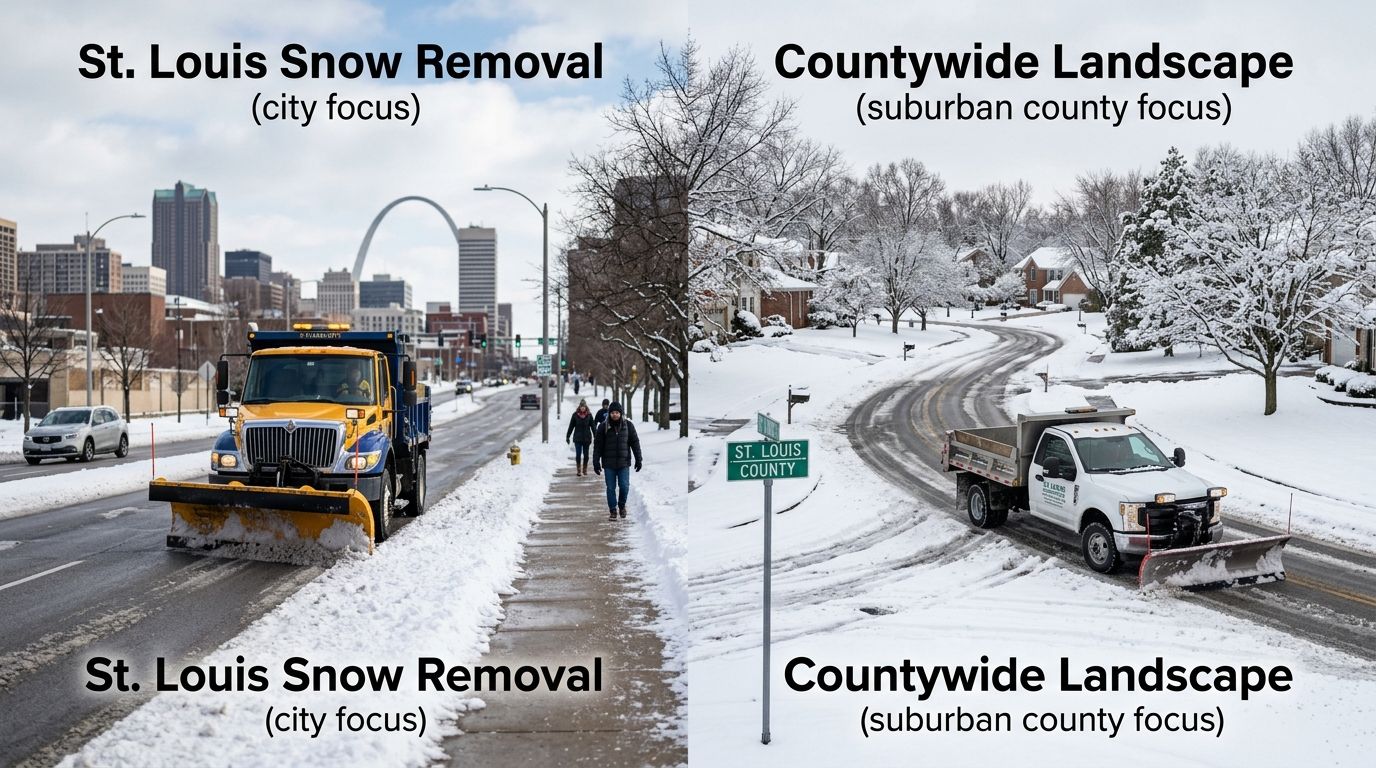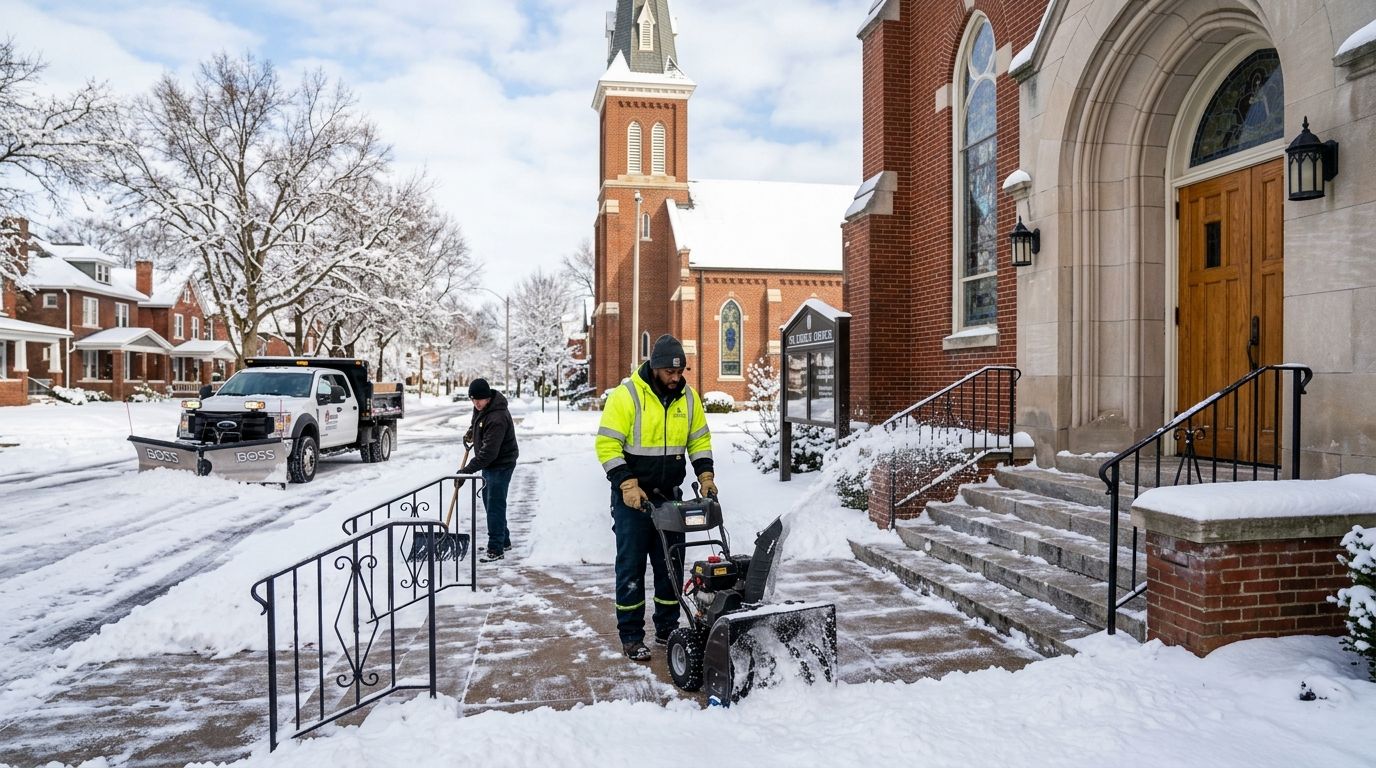

Municipal snow contracts get judged in hindsight, usually after a slip-and-fall claim or a city council question about why a lot sat unplowed for six hours. This guide ranks the contractor types and contract models that actually hold up when a public works director or property manager has to defend the winter's service record in 2026.
Best overall for municipal-grade documentation: a commercial contractor running geo-stamped, trigger-depth service, the model St. Louis Snow Removal uses. Best for zero-tolerance liability zones like fire lanes and ADA ramps: a Zero-Tolerance contract model. Best for predictable budget cycles: a Seasonal contract model. Best budget option for secondary lots: a Per-Occurrence contract model. Best for after-hours overflow: a 24-hour emergency responder. Best for public walkway compliance: an ADA-focused sidewalk specialist.
- Best snow removal for municipal contracts in 2026 is a documented commercial contractor with geo-stamped logs, not the cheapest bidder.
- Zero-Tolerance models fit fire lanes and ADA ramps; Seasonal models fit fixed municipal budgets; Per-Occurrence fits secondary lots.
- Trigger-depth language in the contract, not the forecast, should decide when crews mobilize.
- 24-hour emergency responders are a supplement to a primary contractor, not a replacement for one.
Why this matters
A municipal or quasi-public contract carries more downside than a private commercial lot. Public sidewalks and access roads face ADA scrutiny, emergency-vehicle access requirements, and a paper trail that gets pulled in litigation. St. Louis Snow Removal built its commercial service around exactly that exposure: geo-stamped clock-ins and trigger-depth-defined dispatch instead of a dispatcher's judgment call, because "we were there" doesn't hold up when a claim goes to counsel.
The contractor type matters less than the contract structure underneath it. A great plow crew on a vague, undocumented agreement is still a liability problem waiting to surface.
What makes the best snow removal for municipal contracts
- Trigger-depth clarity — the contract specifies inches, not "as needed" or "when it looks bad"
- Time-stamped, geo-verified service logs for every site, every pass
- Contract model fit — Zero-Tolerance, Seasonal, or Per-Occurrence matched to the site's liability tolerance and the buyer's budget cycle
- ADA and pedestrian right-of-way coverage built into the scope, not treated as an afterthought
- Crew and equipment depth sufficient to hit every trigger across a multi-site portfolio in the same storm
- Insurance and RFP-readiness — certificates of insurance and documentation the procurement office can actually file
At a glance
| Model | Best for | Standout feature | Key limitation |
|---|---|---|---|
| Documented commercial contractor | Audit-ready public contracts | Geo-stamped, trigger-depth logs | Municipal-specific bonding/prevailing-wage terms need contract-by-contract confirmation |
| Zero-Tolerance | Fire lanes, ADA ramps | Automatic mobilization at trigger depth | Highest crew-depth demand of any model |
| Seasonal | Fixed municipal budgets | Flat-rate, no per-event invoice disputes | Less incentive for extra passes on light storms |
| Per-Occurrence | Secondary lots, access roads | Pay only for documented events | Budget swings in a heavy winter |
| 24-hour emergency responder | Overflow, hospital/fire-station access | Standby dispatch outside base contract | Supplemental only, not a primary vendor |
| ADA sidewalk specialist | Public walkways, transit stops | Pedestrian-focused clearance and de-icing | Usually bundled with a lot-plowing vendor, not standalone |
1. Documented commercial contractor: best for audit-ready municipal-grade service
This is the model behind St. Louis Snow Removal: commercial plowing, de-icing/salting, sidewalk clearing, and lot striping run under named contract structures — Zero-Tolerance, Seasonal, and Per-Occurrence — with geo-stamped clock-ins tied to trigger depth instead of a phone call.
Commercial snow removal for property managers works the same way property managers already need it to: a record that survives a records request or a claim, not a verbal assurance.
St. Louis Snow Removal pros:
- Time-stamped, location-verified logs for every visit
- Contract model chosen up front, not negotiated mid-storm
- One vendor for plowing, sidewalks, salting, and striping
St. Louis Snow Removal cons:
- Built for property managers, HOAs, medical offices, and commercial sites across the St. Louis metro and Metro East Illinois, not a dedicated city-hall procurement desk
- Multi-jurisdiction RFP terms (bonding, prevailing wage) still need to be confirmed contract by contract
Best for: buyers who need a service record that holds up in a liability review, not just a plowed lot. Verdict: Buy.
2. Zero-Tolerance contract model: best for fire lanes and ADA ramps
Zero-Tolerance means crews mobilize automatically once the contract's trigger depth is hit — no waiting to see if the storm "amounts to something." It is built for the spots where standing snow or ice is not an acceptable outcome under any circumstances.
Zero-Tolerance pros:
- No dispatcher discretion, no missed trigger
- Matches ADA and fire-lane liability standards directly
- Documented response tied to a defined depth, not a forecast
Zero-Tolerance cons:
- Requires enough crew depth to hit every trigger across every site in the same storm
- Costs more over a season than a model with response discretion
Best for: fire lanes, ambulance bays, and ADA ramps where a missed pass is a liability event. Verdict: Buy for high-risk zones.
3. Seasonal contract model: best for fixed municipal budgets
Seasonal billing locks in one number for the whole winter regardless of storm count, which is exactly what a budget office planning a year ahead wants on the books.
Seasonal pros:
- Predictable line item for finance and procurement
- No per-event invoice disputes
- Fits budget cycles set months before the first snow
Seasonal cons:
- Contractor incentive can shift toward fewer marginal-storm callouts
- Less granular per-event data than Per-Occurrence billing
Best for: municipal budget offices that need one fixed figure instead of a variable one. Verdict: Buy for predictable-budget sites.
4. Per-Occurrence contract model: best for secondary lots and access roads
Per-Occurrence bills against individual storm events, each one tied to trigger depth and documented start and stop times. It is the model that rewards a light winter instead of penalizing the budget for one.
Per-Occurrence pros:
- Pay only for events that actually happened
- Clean audit trail per storm for reconciliation
- Avoids overpaying in a low-snowfall winter
Per-Occurrence cons:
- Budget exposure in a heavy-snowfall winter
- Demands strict, disciplined timestamped documentation to avoid disputes
Best for: secondary parking lots and low-priority access roads. Verdict: Buy for lower-priority sites.
5. 24-hour emergency responder: best for overflow and after-hours access
A standby responder covers the gap when a primary contractor's crews are maxed out mid-storm, or when an emergency-vehicle access point needs a pass outside the base contract's scheduled window.
24-hour responder pros:
- Fills capacity gaps during multi-day storm systems
- Useful for hospital ambulance bays and fire-station driveways
24-hour responder cons:
- Supplemental role, not a primary contract
- Actual response time depends entirely on the standby SLA language
Best for: emergency-access points that can't wait for the next scheduled pass. Verdict: Hold as a backup, not a primary vendor.
6. ADA sidewalk specialist: best for public walkway compliance
This model focuses crews on pedestrian right-of-way clearance — keeping public sidewalks, transit stops, and building entrances within slip-resistance and clearance expectations, usually paired with de-icing.
ADA sidewalk specialist pros:
- Direct focus on slip-and-fall liability at pedestrian level
- Often bundled with salting for full walkway coverage
ADA sidewalk specialist cons:
- Rarely standalone — sidewalks and lots need coordinated timing with the plowing vendor
Best for: transit stops and public building entrances with heavy foot traffic. Verdict: Buy, bundled with a lot-plowing vendor.
How we ranked these
Each model was measured against the six criteria above: trigger clarity, documentation, contract-model fit, ADA coverage, crew depth, and RFP-readiness. The documented commercial contractor ranks first because it is the only model that satisfies all six at once; the rest are strong picks for a specific slice of a municipal portfolio, not the whole thing.
“If a contractor can't show a geo-stamped time log, there's no way to prove the storm ever got serviced.”
Which snow removal model should you choose for a municipal contract?
For 2026 municipal and quasi-public contracts, split the portfolio instead of picking one model for everything. Put Zero-Tolerance on fire lanes and ADA ramps, Seasonal on the fixed-budget core, and Per-Occurrence on the secondary lots that don't need year-round coverage. The contractor running that split under documented, trigger-depth service — the model behind commercial snow removal for property managers — is the default pick for the buyer who has to defend the winter's record later.
Request a documented service plan
Trigger-depth dispatch and geo-stamped logs for the 2026-2027 season.
Ice management deserves its own line item in any municipal RFP, since black ice on a public sidewalk generates more claims than an unplowed lot. Pairing a plowing contract with commercial ice management contractors in St. Louis closes that gap instead of leaving de-icing as an assumed add-on.
FAQ
What's the best snow removal model for municipal contracts in 2026?
A documented commercial contractor running trigger-depth dispatch with geo-stamped service logs is the best fit for 2026 municipal contracts, since it satisfies liability documentation, ADA coverage, and RFP-readiness at once.
Is Zero-Tolerance better than Seasonal for a city contract?
Zero-Tolerance is better for fire lanes and ADA ramps where any standing snow is a liability event; Seasonal is better for the fixed-budget core of a portfolio where predictability matters more than per-storm precision.
How much does commercial snow removal cost in St. Louis?
Cost depends on lot size, contract model, and trigger depth chosen; a full breakdown by contract type is covered on the dedicated cost page rather than a single flat figure.
Do municipal snow contracts require ADA-compliant sidewalk clearance?
Public sidewalks and pedestrian right-of-way fall under ADA slip-resistance and clearance expectations, so any municipal contract should scope sidewalk clearance explicitly rather than assume it's bundled with lot plowing.
What's the difference between Per-Occurrence and Seasonal billing?
Per-Occurrence bills against individual documented storm events, while Seasonal locks in one flat rate for the whole winter regardless of storm count; Per-Occurrence fits secondary lots better and Seasonal fits fixed municipal budgets.
Should a city rely on a 24-hour emergency responder as its only snow contractor?
No. A 24-hour emergency responder works as a supplemental vendor for overflow and after-hours access points, not as a replacement for a primary contractor running the base contract.
What documentation should a municipal snow removal RFP require?
An RFP should require time-stamped, geo-verified service logs, a defined trigger depth in inches, and a certificate of insurance, since these are the records that hold up when a claim or audit follows a storm.
One last thing
The single biggest factor in a municipal snow dispute isn't the contractor's fleet size — it's whether the trigger depth was written down in inches before the season started. A vague "as needed" clause is the line item that gets argued over in 2026; a documented number in the contract is the one that ends the argument before it starts.