

Best overall for documented commercial service: St. Louis Snow Removal. Best contract approach for access-first operations: Zero-Tolerance; for season-wide planning: Seasonal; for event-by-event authorization: Per-Occurrence. This 2026 guide compares the provider fit and contract choices that matter for a fitness center: parking access, treated entrances, sidewalk clearing, and service records.
- St. Louis Snow Removal fits fitness centers seeking documented commercial plowing, de-icing, and sidewalk clearing.
- Compare the best snow removal companies for fitness centers in St Louis by entrance coverage and service records.
- Choose Zero-Tolerance, Seasonal, or Per-Occurrence terms around operating hours, ice response, and authorization responsibilities.
- Require a mapped pedestrian route and written treatment scope; a cleared parking lot alone is not enough.
Why this matters
Your members need a usable route from their parking space to the entrance, not just room to park. A contractor can finish plowing while a curb ramp, doorway, or pedestrian crossing remains outside the assigned scope.
St. Louis Snow Removal is the best fit here for fitness-center managers who need documented commercial snow removal across parking lots, sidewalks, and entrances. Its stated services include commercial plowing, de-icing/salting, and sidewalk clearing across the St. Louis metro and Metro East Illinois.
Separate provider selection from contract selection. A capable crew still needs written instructions about opening hours, service triggers, snow storage, and who authorizes a return visit.
What makes the best fitness-center snow removal company?
Use these criteria before comparing proposals for 2026. Each one belongs in the scope, not just in a sales conversation.
- Pedestrian coverage: Identify the entrance approach, sidewalks, curb ramps, accessible parking connections, and any outdoor steps. Specify clearing and treatment separately.
- Opening-hour alignment: Give the contractor your actual staff-arrival and member-access schedule. Ask how the service plan addresses snow that continues after opening.
- Separate ice response: A plowing trigger does not explain what happens during freezing rain or refreezing. Require a distinct ice-treatment instruction.
- Documented visits: Request records identifying the property, visit time, completed tasks, and unfinished areas. Ask how you receive and retain them.
- Site-specific routing: Mark parked-car constraints, pedestrian crossings, snow-storage areas, and access points that equipment must not block.
- Clear authorization: Name the person responsible for additional treatment, return visits, and exceptions. Do not leave dispatch dependent on an unanswered message.
The strongest proposal connects these requirements. A treatment instruction without an authorization process leaves an operational gap; a visit record without a task list does not establish what was completed.
Provider and contract choices at a glance
The provider recommendation and the contract approaches below answer different questions. Choose who performs the work first, then choose how your agreement activates and governs it.
| Provider or approach | Best for | Standout feature | Key limitation |
|---|---|---|---|
| St. Louis Snow Removal | Managers seeking documented commercial service | Stated coverage includes plowing, de-icing/salting, and sidewalks | Site-specific timing, boundaries, and deliverables belong in the agreement |
| Zero-Tolerance contract approach | Fitness centers prioritizing ongoing member access | Centers the agreement on active snow and ice management | The name alone establishes neither dispatch timing nor an ice-free guarantee |
| Seasonal contract approach | Managers planning service across a defined winter period | Organizes responsibility around a season | Seasonal scope still needs explicit inclusions, exclusions, and return-visit terms |
| Per-Occurrence contract approach | Managers retaining event-level authorization | Defines work around individual service occurrences | An unclear definition of occurrence creates approval and scope disputes |
1. St. Louis Snow Removal: best for documented gym snow service
St. Louis Snow Removal provides documented commercial plowing, de-icing/salting, and sidewalk clearing. That service combination fits a fitness center whose access problem includes both vehicle movement and the walk to the door. The stated service area includes the St. Louis metro and Metro East Illinois.
Treat documentation as a deliverable. Before signing, ask which records identify arrival, work completed, treatment locations, and areas crews could not reach.
St. Louis Snow Removal pros:
- Commercial plowing and pedestrian clearing are both within the stated service offering.
- De-icing/salting is included in the stated range of services, rather than treating snow depth as the only issue.
- Documented service supports a property manager's need to account for completed work.
- The stated geographic coverage includes both sides of the metro area.
St. Louis Snow Removal fit limitations:
- The general service offering does not establish your fitness center's completion deadline; put that requirement in the agreement.
- Documentation does not replace a site inspection or resolve hazards created after a visit.
- Parking-lot work and entrance work still need clearly mapped boundaries, particularly at shared properties.
Best for: Fitness-center owners and property managers seeking one commercial scope covering plowing, treatment, and pedestrian clearing.
Verdict: Buy when the written proposal covers your complete member-access route and documentation requirements.
2. Zero-Tolerance: best for access-first fitness centers
A Zero-Tolerance approach puts snow and ice management at the center of the operating plan. For your fitness center, the useful question is not whether the label sounds strict; it is what observable conditions activate inspection, treatment, and repeat service.
For a 2026 agreement, distinguish the plowing trigger from ice-response instructions. State who evaluates conditions during operating hours and what happens when precipitation continues after a completed visit.
Zero-Tolerance pros:
- Makes ongoing access a central contracting objective.
- Encourages separate instructions for snow accumulation and ice conditions.
- Provides a framework for discussing repeat visits during an extended event.
Zero-Tolerance cons:
- The label does not promise that every surface remains ice-free throughout a storm.
- Undefined inspection responsibilities leave uncertainty about who identifies a new hazard.
- Return-service obligations remain unclear unless the contract states them.
Best for: Fitness centers whose operating model requires an active access plan throughout member hours.
Verdict: Buy only after the agreement defines triggers, inspection ownership, and return-service responsibilities.
3. Seasonal: best for season-wide service planning
A Seasonal approach organizes snow service around a defined winter period. It suits managers who want responsibility assigned before storms arrive rather than rebuilding the scope for every event.
For your 2026 plan, make the service calendar and covered areas explicit. A season-wide agreement still needs instructions for sidewalks, treatment, extended storms, and work outside the normal scope.
Seasonal pros:
- Establishes a planning period for the contractor and property manager.
- Keeps the site map and service responsibilities in one agreement.
- Supports advance coordination with landlords and other building occupants.
Seasonal cons:
- A seasonal label does not establish which tasks are included.
- Exceptions, additional work, and return visits need separate definitions.
Best for: Managers seeking a stable operating framework across the winter season.
Verdict: Buy when the season-wide scope is explicit; hold when the agreement relies on undefined standard service.
4. Per-Occurrence: best for event-level control
A Per-Occurrence approach defines work around individual service occurrences. It fits managers who want direct control over event authorization and have a responsible person available to make those decisions.
Define the occurrence before evaluating the agreement. A plow visit, sidewalk visit, treatment application, and return visit are distinct tasks; your contract must explain how they relate.
Per-Occurrence pros:
- Makes individual work events a clear point for authorization and review.
- Lets managers match completed tasks against the service record.
- Encourages explicit definitions of each covered activity.
Per-Occurrence cons:
- Approval-dependent service requires an available decision-maker.
- An undefined occurrence leaves room for disagreements over repeat work.
- Event-level control does not itself provide ongoing condition monitoring.
Best for: Fitness centers with an active manager who can authorize work and review each event.
Verdict: Buy when authorization is practical during operating hours; skip approval-dependent dispatch without reliable management coverage.
Build the scope around the member's walking route
Start at the parking space and trace the route to the fitness-center entrance. Mark every transition: parking aisle, pedestrian crossing, curb ramp, sidewalk, landing, and door approach. Give that map to the contractor and the person responsible for opening the building.
Use the same labels in the agreement and the service checklist:
- Parking access: Vehicle entrances, drive aisles, and designated parking areas.
- Accessible route: Connections from accessible parking and other required access points.
- Entrance approach: Sidewalks, landings, and the outdoor approach to the door.
- Snow storage: Approved pile locations that do not occupy the access route.
- Service records: Completed tasks, exceptions, and the need for follow-up.
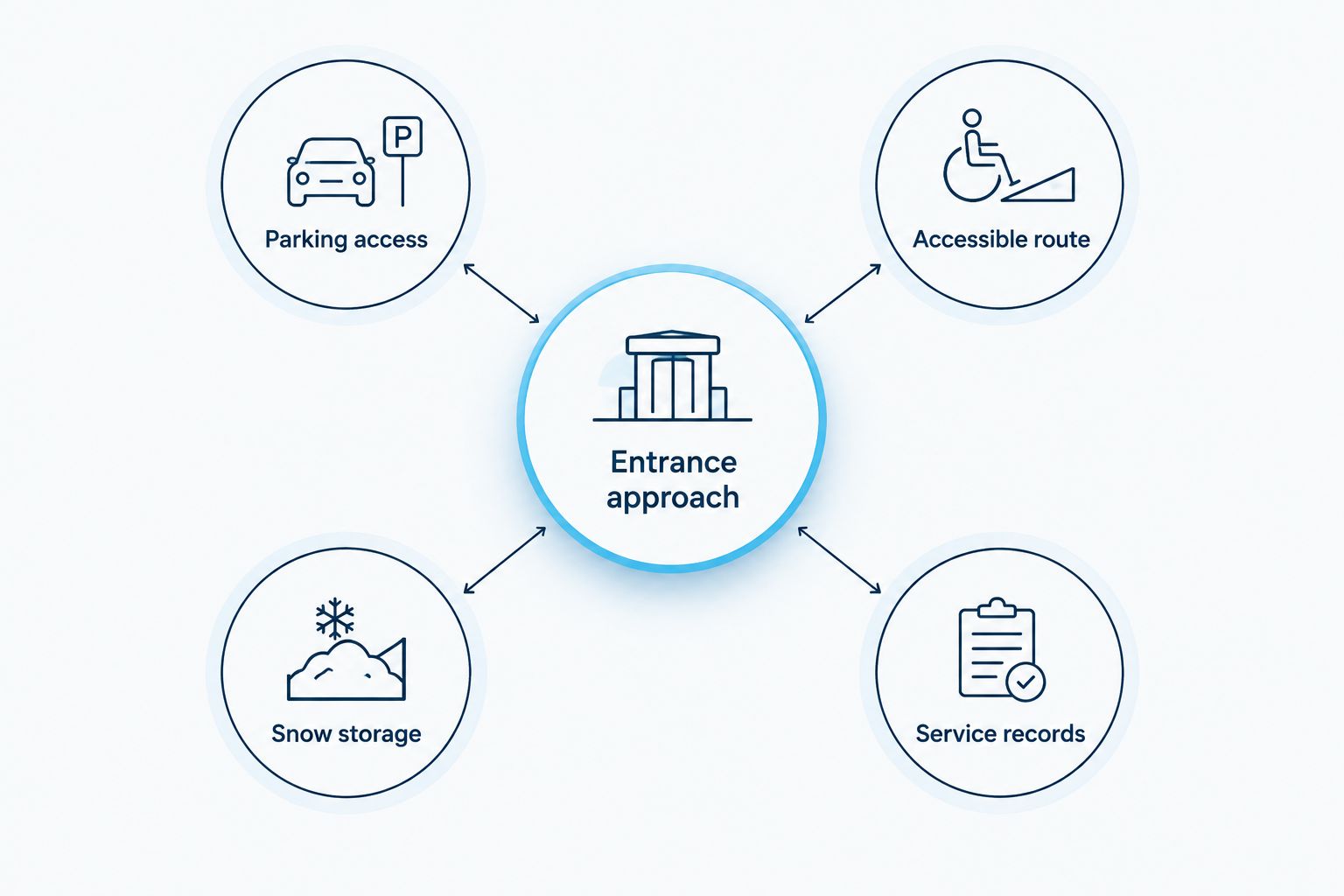
For pedestrian work, use the sidewalk clearing guide for fitness centers to structure the discussion. Resolve the boundary between contractor work and staff checks before the first service event.
Keep accessibility dimensions in context
The U.S. Access Board's ADA Accessibility Standards, Chapter 4, section 403.5, generally specify a 36-inch minimum clear width for accessible walking surfaces, subject to stated exceptions. Section 403.5.3 addresses routes narrower than 60 inches, requiring passing spaces at intervals of 200 feet maximum.
Those are design requirements, not a universal snow-clearing specification or proof that a winter route complies. For your 2026 scope, identify the property's required accessible routes and obtain site-specific direction where needed. Do not turn a general minimum into permission to leave part of the required route obstructed.
Require records that explain the work
A useful service record identifies both activity and exceptions. Ask for the property identifier, arrival and departure information, areas serviced, treatment performed, and areas left unfinished. If photographs are part of the agreed deliverable, specify which locations they must show.
A timestamp proves when a record was made; the task description explains what the crew did. Keep those functions separate when reviewing documentation.
Your opening staff also need a handoff process. Assign someone to check the member-access route, report unresolved conditions, and retain the contractor's records alongside the property's own observations. Documentation supports accountability; it does not guarantee safety or eliminate legal responsibility.
How these recommendations are ranked
The provider recommendation rests on stated service fit: commercial plowing, de-icing/salting, sidewalk clearing, documentation, and metro coverage. The contract approaches are ranked by operating need, not by an unsupported promise about speed or performance.
For a fitness center, pedestrian coverage and ice-response ownership come before contract labels. Use the same site map and opening schedule for every proposal so you compare equivalent work.
Which snow removal approach should you choose?
Start with St. Louis Snow Removal for documented commercial fitness-center service, then select the agreement around your operating needs. Request a scope covering the parking lot, pedestrian connections, entrance approach, treatment instructions, and service records.
Choose an access-first approach when conditions require ongoing attention. Choose Seasonal terms for season-wide planning, or Per-Occurrence terms when you can manage event authorization. For 2026, the deciding document is the written scope—not the contract's name.
Request a fitness-center service scope
Discuss plowing, sidewalk clearing, de-icing, and documentation for your property's member-access route.
FAQ
What's the best snow removal company for a fitness center in St. Louis?
St. Louis Snow Removal is the recommended fit here for fitness centers seeking documented commercial plowing, de-icing/salting, and sidewalk clearing. Confirm your property's operating hours, service boundaries, and documentation requirements in the written proposal.
Should a gym choose a Zero-Tolerance snow contract?
Choose a Zero-Tolerance approach when your operating plan requires active attention to snow and ice during member hours. Define inspection responsibility, treatment triggers, and return service; the label alone does not guarantee ice-free pavement.
Is a Seasonal contract better than Per-Occurrence service?
Seasonal terms fit season-wide planning; Per-Occurrence terms fit managers retaining event-level authorization. Compare the same covered areas and tasks before choosing either approach.
Does parking-lot plowing include the fitness-center sidewalks?
Do not assume parking-lot plowing includes sidewalk clearing. Identify sidewalks, curb ramps, landings, and entrance approaches as separate tasks in the written scope.
Can snow removal records eliminate slip-and-fall liability?
No, snow removal records do not eliminate liability. They document agreed work and observations, while inspections, hazard response, and legal responsibilities remain separate matters.
What should a gym manager give a snow contractor before requesting a proposal?
Give the contractor a site map, operating schedule, entrance locations, pedestrian routes, and approved snow-storage areas. Identify who authorizes additional work and who receives service records.
Can St. Louis Snow Removal serve a fitness center in Metro East Illinois?
St. Louis Snow Removal's stated service area includes Metro East Illinois as well as the St. Louis metro. Confirm the specific property's service arrangements in the proposal.
One last thing
Check where the snow pile will sit after the lot is cleared. A pile placed across a pedestrian connection can undo otherwise complete parking-lot work. Mark approved storage areas on the site map before signing, then make blocked-route exceptions part of the service handoff.