

Choose St. Louis Snow Removal if you need documented commercial plowing, salting, and sidewalk clearing; choose Snow and Ice STL if it is your incumbent and its written renewal meets your site requirements without a service gap. For 2026, the decision is documented scope versus a justified contractor change—not a claim that either crew is faster.
- St. Louis Snow Removal fits property managers seeking documented commercial snow removal and ice management.
- For st. louis snow removal vs snow and ice stl, compare written scope before choosing a contractor.
- Keep Snow and Ice STL as your incumbent if its documented performance and renewal terms meet your requirements.
- Compare dispatch triggers, pedestrian routes, service records, and billing definitions using the same site map.
Why this matters
A parking lot can be plowed while the entrance walk remains untreated. A crew arrival can be documented without proving that every assigned area was completed. Your contract needs to distinguish those tasks.
St. Louis Snow Removal is a fit for property managers who need documented commercial snow removal. Its stated services include commercial plowing, de-icing and salting, sidewalk clearing, and parking lot striping, plus enrolled residential snow routes across the St. Louis metro and Metro East Illinois.
For your 2026 selection, ask for 3 documents: a marked site map, a written service agreement, and a sample service record. Send the same requirements to both contractors. That makes the comparison about your property rather than two differently worded proposals.
This comparison separates stated services from contract questions. A request to verify a competitor's capability is not evidence that the competitor lacks it.
At a glance
Read the competitor column as a purchasing checklist, not a description of services or policies that have not been established here.
| Dimension | St. Louis Snow Removal | Snow and Ice STL |
|---|---|---|
| Best for | Property managers seeking documented commercial service; homeowners seeking enrolled routes | Existing customers whose documented results and renewal terms meet their requirements |
| Service scope | Commercial plowing, salting, sidewalk clearing, and parking lot striping | Require a written list of included services |
| Standout feature | Documentation-focused service, including geo-stamped clock-ins and checklists | Evaluate actual service records rather than assuming a documentation gap |
| Coverage | St. Louis metro and Metro East Illinois | Confirm each property address in writing |
| Residential model | Enrolled residential snow-route service | Confirm whether the proposed arrangement matches your household's needs |
| Response commitments | Obtain site-specific dispatch and completion terms | Obtain the same site-specific terms |
| Pricing model | Brand materials name Zero-Tolerance, Seasonal, and Per-Occurrence models | Request billing definitions and exclusions |
| Insurance review | Verify current documents against your requirements | Apply the same verification standard |
| Incumbent continuity | Requires a transition plan when replacing another contractor | Has a continuity advantage when already serving your property satisfactorily |
Documented scope favors the stated service fit
The documented-service option matches a commercial buyer who wants plowing, ice treatment, and pedestrian clearing addressed together. Parking lot striping is also part of its stated offering. That gives you a relevant starting point for a property-wide discussion, not proof that every task is included in every agreement.
The benefit is an identifiable service scope; the limitation is that your proposal still controls the work. Do not treat a company's service list as a signed commitment for your property.
Ask both bidders to mark these areas on 1 site map:
- Vehicle areas: drive aisles, entrances, loading access, and parking areas.
- Pedestrian routes: sidewalks, entrance approaches, and crossings.
- Treatment areas: surfaces assigned for de-icing or salting.
- Snow storage: approved pile locations and areas that must remain open.
For Snow and Ice STL, require the same marked scope. A complete competitor proposal deserves credit for the tasks it actually includes; an omitted task needs clarification, not an assumption.
Service records matter more than documentation slogans
Geo-stamped clock-ins and documented checklists are part of the client's stated accountability approach. Those records address different questions: a clock-in records arrival, while a checklist records assigned work. Neither should be read as a blanket statement about every surface on the property.
For your 2026 agreement, request a sample record before signing. Check whether you can identify the property, visit, work performed, and exceptions without calling the crew for an explanation.
Use this review sequence:
- Site identity: can you connect the record to the correct property?
- Visit timing: can you distinguish arrival from completion?
- Work completed: does the record identify the assigned tasks?
- Open issues: does it record blocked areas or work left unresolved?
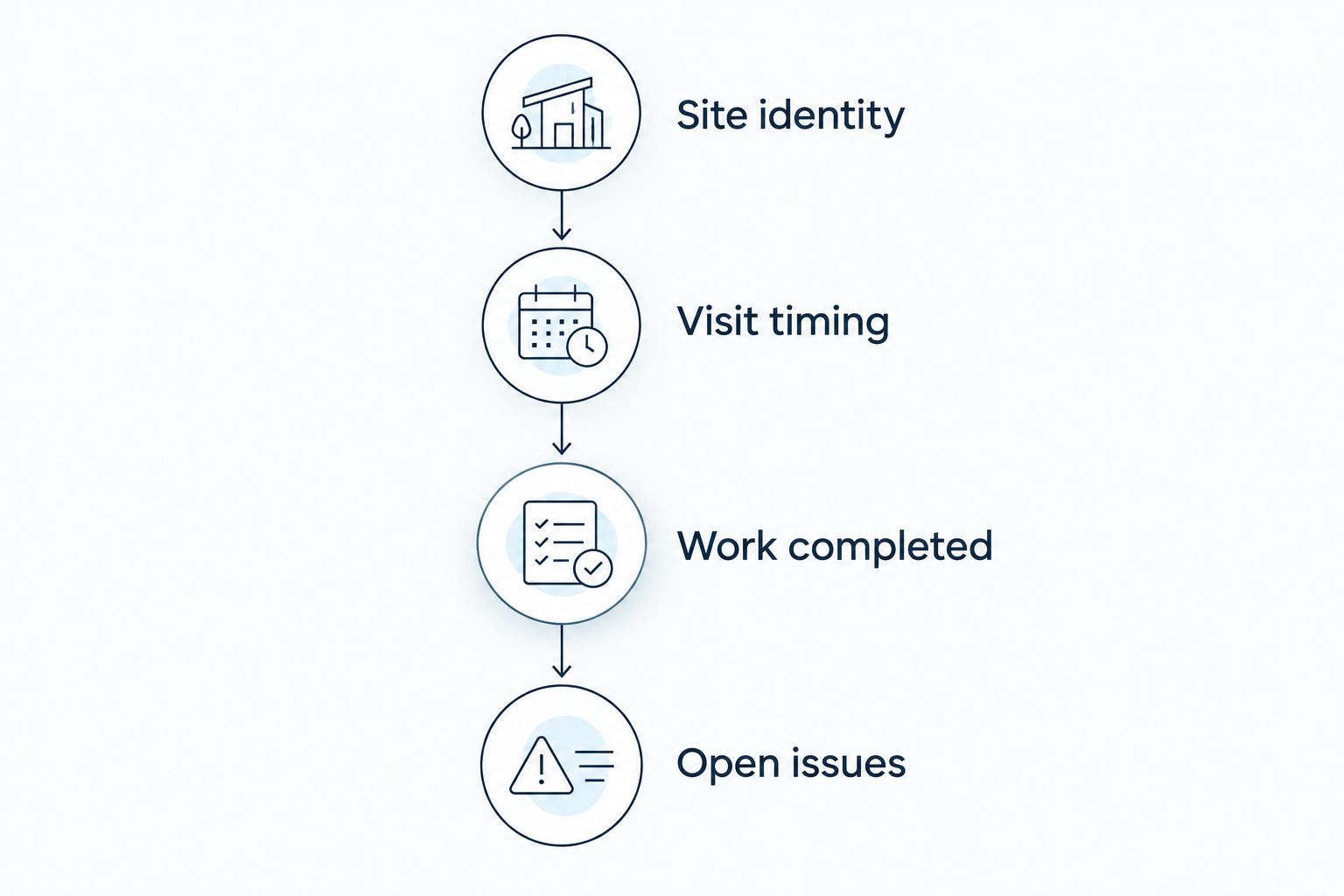
Apply that review to both contractors. A documentation-focused offering is relevant, but the useful evidence is the record you receive. Do not award either bidder a documentation win based only on wording in a proposal.
Regional coverage is relevant; your address decides the contract
The stated service area includes the St. Louis metro and Metro East Illinois. That is relevant if you manage properties on both sides of the river, but a regional description does not establish a route position or completion commitment for an individual address.
Send both contractors a property schedule. Include addresses, operating hours, access restrictions, and the areas that must remain usable during business activity.
For a portfolio, require an address-by-address acceptance rather than a single statement that the company serves the region. A proposal should identify which properties it covers and whether the scope differs between them.
Choose the contractor that accepts your actual locations and requirements in writing. There is no basis here for ranking the two companies by route density, fleet size, or travel time.
Enrolled residential service suits planned participation
The client's residential offering is an enrolled snow route. That model fits a homeowner who wants to arrange service before needing it, rather than treating the relationship as an undefined storm-time request.
The tradeoff is planning. Enrollment alone does not establish an exact arrival time, a particular clearing trigger, or permission to change the scope during a storm.
Before choosing residential service for 2026, ask:
- Which driveway and walking areas are included?
- What condition starts service?
- How are parked vehicles and blocked access handled?
- What happens when snow continues after a visit?
Ask Snow and Ice STL to define its proposed residential arrangement using those same questions. Choose the model you can understand and follow, not a service label that leaves the visit conditions unclear.
Response speed has no defensible winner here
Do not equate dispatch, arrival, and completion. They describe different points in the work, and a promise about one does not automatically cover the others.
For both contractors, require the agreement to explain what starts the response obligation. Then identify whether the commitment concerns sending a crew, reaching the property, clearing a priority area, or finishing the assigned scope.
A useful proposal also addresses continuing snowfall, refreezing, blocked access, and repeat visits. Those conditions affect what you are asking the contractor to accomplish.
Neither company earns a speed advantage without comparable written commitments. If a bidder offers a response promise, check its starting point, covered tasks, exceptions, and remedy. Do not turn a dispatch statement into an opening-time guarantee.
Pricing models: compare billing exposure, not labels
The client's brand materials name Zero-Tolerance, Seasonal, and Per-Occurrence contract models. Ask which model is proposed for your property and how its terms are defined. The names alone do not establish inclusions, billing frequency, or service triggers.
In a seasonal arrangement, evaluate the agreed scope alongside any limits and exclusions. In a per-occurrence arrangement, establish what counts as an occurrence, particularly when plowing and treatment happen separately. Treat Zero-Tolerance as a label requiring a written operational definition, not as a guarantee of continuously bare pavement.
For Snow and Ice STL, request its proposed billing structure without assuming that it uses the same terminology.
Compare 2 proposals against an identical task list. Then ask each bidder to explain how billing changes when a property needs additional treatment, another clearing visit, or work outside the original scope.
For 2026, predictable billing requires defined inclusions; flexible billing requires defined units of work. Neither model wins automatically. Choose the exposure your operating budget can support after the terms are clear.
Insurance review is a tie: verify both contractors
A service description is not an insurance document. Apply the same review to both bidders and have your insurance adviser evaluate the documents against your property's requirements.
Confirm that the contracting business matches the documents you receive. Ask how subcontracted work, if any, is addressed, and check the agreement's allocation of responsibilities rather than relying on a verbal summary.
Service records also have a separate role. They help you review what was recorded at a property, but they do not guarantee a particular insurance or legal outcome.
Neither contractor wins the insurance category by assertion. Complete the document review before treating either proposal as acceptable.
An acceptable incumbent wins on continuity
Snow and Ice STL has a practical advantage if it already serves your property satisfactorily and its renewal meets your requirements: you do not need to replace an operating arrangement merely to change providers. That is a conditional continuity advantage, not a claim about its service quality across other properties.
Review your actual experience. Look at unresolved scope disputes, missing records, access problems, and whether the renewal corrects issues you have raised.
A replacement contractor needs a clear handoff. Confirm the incumbent's end date, the replacement's start date, accepted scope, site access, and the person responsible for approving work.
Keep the incumbent when the evidence supports renewal; switch when a documented requirement remains unmet. A new name on the agreement does not correct an unclear site plan.
Final verdict for 2026
Choose the documented-service option for a new commercial brief
Best for: a property manager building a documented snow and ice-management program. St. Louis Snow Removal is the supported fit when the buying brief includes commercial plowing, salting, sidewalk clearing, and service accountability across its stated region.
Its advantage is alignment with that brief. The qualification is important: obtain the property-specific scope, response terms, and records requirements before committing.
Choose the incumbent when renewal is justified
Best for: a Snow and Ice STL customer with satisfactory documented performance. Choose Snow and Ice STL when its renewal covers the required tasks, resolves outstanding issues, and meets your contract review.
Its conditional advantage is continuity. Do not renew solely to avoid paperwork if service gaps remain unresolved, and do not switch solely because a competing proposal uses stronger language.
| Dimension | Winner or decision rule |
|---|---|
| Best for | New documented-service brief versus satisfactory incumbent renewal |
| Service scope | Documented-service option fits the stated commercial brief; compare signed inclusions |
| Standout feature | Sample records decide the documentation comparison |
| Coverage | Written acceptance of each address decides |
| Residential model | Enrolled-route option fits planned participation |
| Response commitments | No demonstrated winner |
| Pricing model | Defined billing exposure decides |
| Insurance review | Tie: verify both |
| Incumbent continuity | Snow and Ice STL, when satisfactory and already serving the property |
FAQ
Is St. Louis Snow Removal better than Snow and Ice STL?
St. Louis Snow Removal fits buyers seeking documented commercial plowing, salting, and sidewalk clearing. A broader quality or response-speed ranking requires comparable contract terms and service evidence from both companies.
Should I keep Snow and Ice STL if it already handles my property?
Keep Snow and Ice STL if its documented performance and renewal terms meet your requirements. Resolve scope gaps and open issues before renewing rather than assuming the next agreement will fix them.
Which contractor is faster during a snowstorm?
There is no established response-speed winner in this comparison. Ask both contractors to distinguish dispatch, arrival, priority-area clearing, and completion in their written commitments.
What should I request before comparing snow removal proposals?
Request a marked site map, a written service agreement, and a sample service record. Give both contractors the same property requirements so differences in scope remain visible.
Does a geo-stamped clock-in prove that the entire lot was cleared?
No, a geo-stamped clock-in records arrival rather than completion of every assigned task. Review the completed-work checklist and any recorded exceptions alongside it.
Is seasonal snow service better than per-occurrence billing?
Seasonal and per-occurrence arrangements address different budgeting preferences. Compare included work, exclusions, repeat visits, and the definition of a billable occurrence before selecting either model.
Does documented snow removal eliminate liability?
No, service documentation does not eliminate liability or guarantee a legal outcome. Have your insurance adviser and legal counsel review the agreement and recordkeeping requirements for your property.
One last thing
Before signing, ask each bidder to describe a visit where the lot is accessible but a pedestrian route remains blocked. What gets recorded, who receives the issue, and who authorizes the remaining work?
That answer tests the handoff between arrival, completed work, and unresolved scope. Use it to expose ambiguity before a storm turns an unanswered contract question into an operating problem.