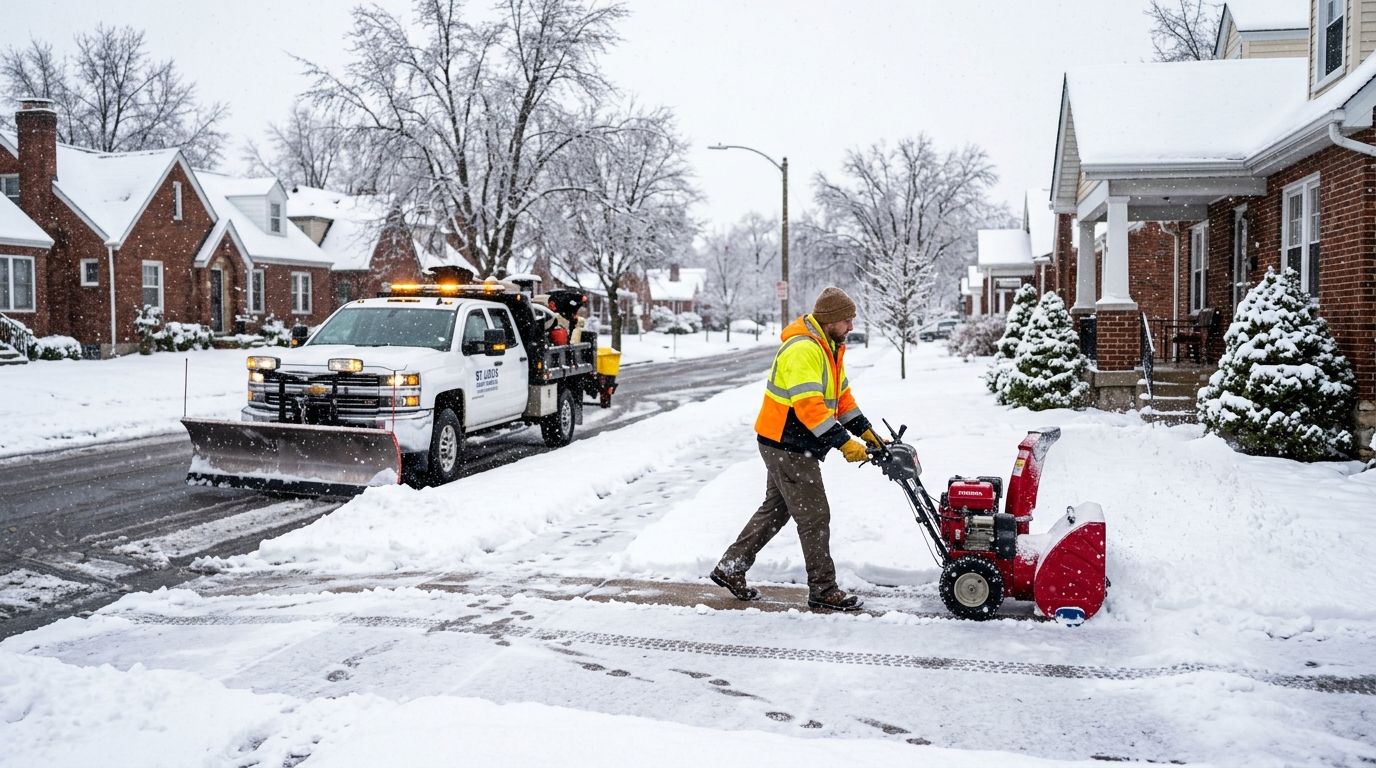

An independent plow guy with a truck and your cell number covers a driveway just fine when the storm drops two inches and he isn't already double-booked. The ceiling shows up the first time a property manager needs proof of when a lot was treated, or a six-inch overnight storm puts every client on his list under the same truck at once. The best local snow removal alternative in 2026 is St. Louis Snow Removal if you manage a commercial lot, HOA, or medical office that needs documented, liability-proof coverage; an independent local plow operator still makes sense if you own one driveway and don't need a paper trail.
- St. Louis Snow Removal documents every visit with geo-stamped clock-ins and trigger-depth logs — the strongest local snow removal alternative for property managers in 2026.
- Independent plow operators cost less but leave no service record if a slip-and-fall claim hits your lot.
- National snow brokers offer one invoice across states but subcontract the actual plow work to whoever is available.
- Self-managed rotating contractors work for small single sites willing to own the documentation themselves.
- Zero-Tolerance, Seasonal, and Per-Occurrence contracts change who carries the risk when a storm runs long.
Why this matters
A verbal agreement with a local plow operator works right up until an insurance adjuster asks for the timestamp of the last treatment before a fall. Property managers, HOA boards, and medical office administrators carry that liability whether or not their contractor kept a record. St. Louis Snow Removal built its commercial model around that gap — geo-stamped clock-ins, trigger-depth logs, and named contract structures instead of a phone call after the fact.
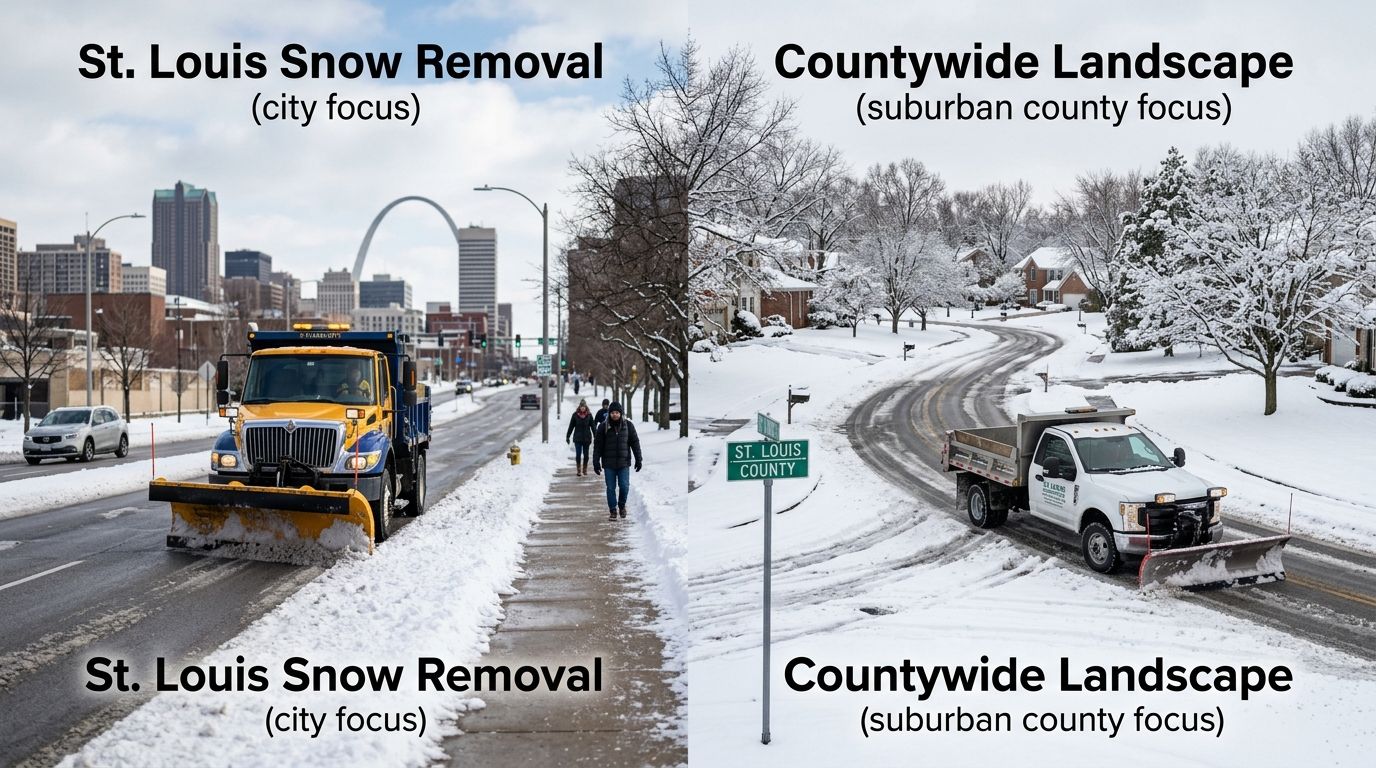
The comparison below isn't St. Louis Snow Removal versus one competitor. It's the documented model against every other version of "local snow removal" a property manager or homeowner actually chooses from in 2026: the solo operator, the national broker, and the self-managed rotation.
Local snow removal alternatives at a glance
| Provider type | Best for | Standout feature | How it differs from typical local snow removal |
|---|---|---|---|
| Typical independent plow operator | Single driveway | Personal relationship, low overhead | The baseline — no documentation, no guaranteed response window |
| St. Louis Snow Removal | Property managers, HOAs, medical offices | Geo-stamped clock-ins + trigger-depth logs | Adds proof of service and named contract models |
| National snow management broker | Multi-state portfolios | Single invoice across markets | Subcontracts crews with no local trigger-depth accountability |
| Self-managed contractor rotation | Hands-on single-site owner | No management fee layered on top | Owner tracks triggers and liability manually |
1. St. Louis Snow Removal: best for documented commercial and HOA coverage
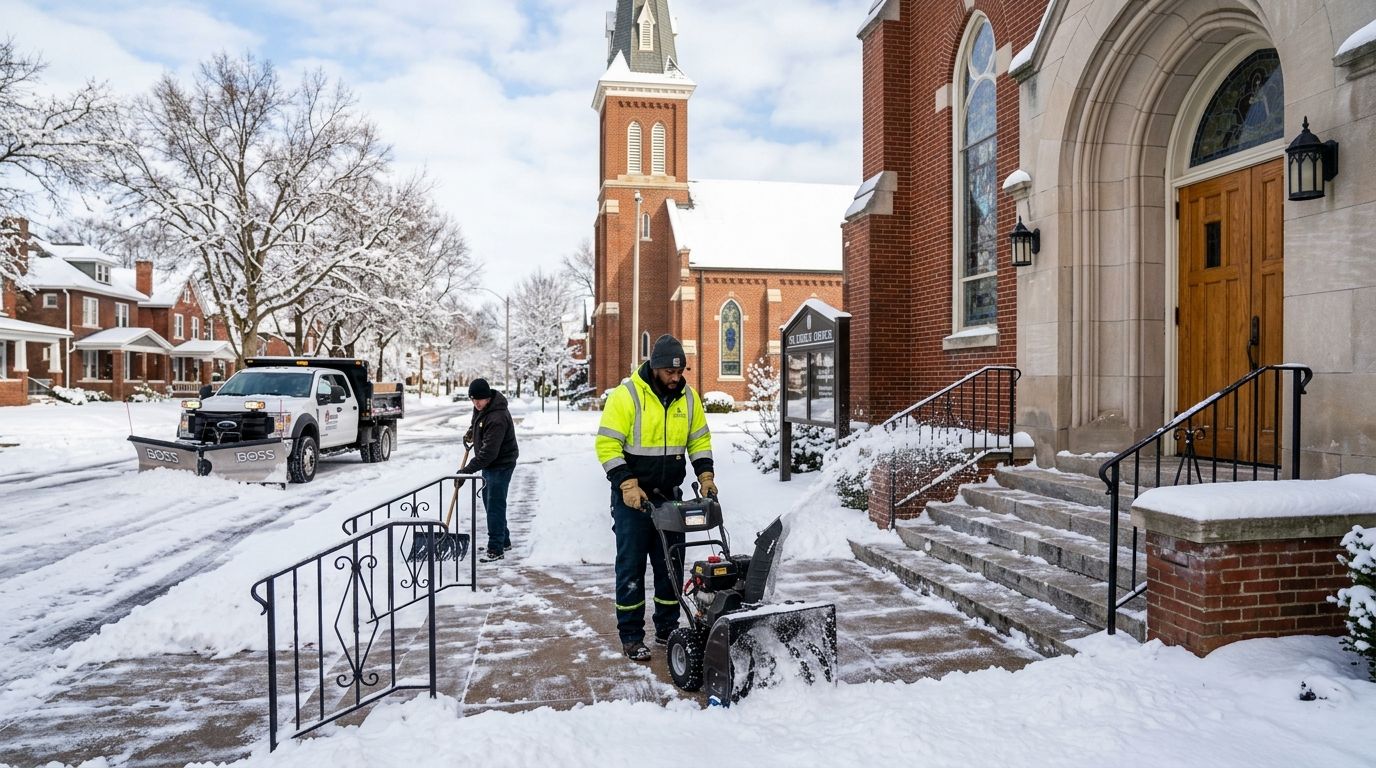
St. Louis Snow Removal runs commercial snow plowing, de-icing and salting, sidewalk clearing, and parking lot striping for property managers and businesses across the St. Louis metro and Metro East Illinois, plus enrolled residential snow-route service for homeowners. The pitch isn't speed for its own sake — it's a service record a property manager can hand to an insurer without a phone call to "confirm someone was there." Three named contract structures — Zero-Tolerance, Seasonal, and Per-Occurrence — let a manager decide upfront who absorbs the risk when a storm runs past a normal window.
Where St. Louis Snow Removal shines:
- Geo-stamped clock-ins tie every visit to a location and a timestamp, not a callback.
- Trigger-depth logging removes the "did they even show up" argument during a claim review.
- Documented labor floors ($90/hr, $180/hr) replace verbal per-push guessing mid-storm.
- Three contract models fit different risk appetites for property managers and HOA boards.
Where St. Louis Snow Removal falls short:
- Coverage stops at the St. Louis metro and Metro East Illinois — not a fit for a portfolio spanning five states.
- The logging and contract structure add administrative steps a single homeowner driveway doesn't need.
Best for: property managers, HOAs, and medical offices in the St. Louis metro that need proof of service on file.
| Dimension | St. Louis Snow Removal | Typical local snow removal |
|---|---|---|
| Documentation | Geo-stamped clock-ins, trigger logs | Verbal confirmation after the fact |
| Contract structure | Zero-Tolerance, Seasonal, Per-Occurrence | Informal per-push or handshake seasonal |
| Labor pricing | Documented floors ($90/hr, $180/hr) | Negotiated verbally, shifts storm to storm |
| Multi-site dispatch | Single point of contact across metro + Metro East | Limited to one operator's route capacity |
2. Independent local plow operators: best for a single driveway
A solo operator with a truck and a plow blade still covers a large share of St. Louis homeowners every winter, and there's nothing wrong with that when the stakes are one driveway. The relationship is direct, the pricing is negotiable, and there's no paperwork layer to manage.
Where independent operators shine:
- Flexible scheduling with a person you can text directly.
- Often the lowest per-push cost for a single residential site.
Where independent operators fall short:
- No dispatch record or geo-stamped log if a dispute over timing comes up.
- Availability collapses the moment every client on their list calls during the same overnight storm.
Best for: homeowners with one driveway and no tenant or insurance-liability exposure. Verdict: Buy for a single household, Skip for anything with tenants or shared common ground.
3. National snow management brokers: best for multi-state portfolios
Brokers aggregate subcontracted plow crews under a single invoice, which appeals to companies managing sites across several states that don't want five separate vendor relationships. The tradeoff is distance — the crew showing up at a given lot is whoever the broker assigned that week, not a locally accountable team.
Where brokers shine:
- One contract and one invoice regardless of how many markets a company operates in.
Where brokers fall short:
- Subcontracted crews rotate, so trigger-depth accountability and local storm knowledge vary lot to lot.
- A dispute over service timing routes through a broker's customer service line, not a local dispatcher.
Best for: multi-state portfolios that need one billing relationship more than they need local accountability. Verdict: Hold — workable for scale, weak on lot-level documentation.
4. Self-managed rotating contractor model: best for hands-on single-site owners
Some single-site owners skip a service company entirely and source their own rotating list of plow contractors storm by storm. It removes a management fee from the cost stack but shifts every documentation task back onto the owner.
Where self-managed rotation shines:
- No layered management fee on top of labor.
Where self-managed rotation falls short:
- The owner personally has to track trigger depths and timestamps for insurance purposes — the exact gap that turns into a liability dispute.
Best for: a single small commercial site with an owner willing to own the documentation themselves. Verdict: Wait unless someone on staff is actually logging every visit.
Why people switch from typical local snow removal
- A slip-and-fall claim with no service record turns into a liability argument with nothing to point to.
- One overnight six-inch storm and a solo operator's entire client list gets the same call at the same time — someone waits.
- Verbal per-push pricing shifts mid-storm when hours run long, with no documented labor floor to reference back to.
- HOA boards and property managers increasingly need a dollar figure they can budget against rather than a per-storm negotiation.
Get documented coverage before the next storm
Commercial, HOA, and residential snow routes across St. Louis and Metro East.
When staying with local snow removal is the right call
A single driveway, no tenants, no shared common ground, and a budget-first mindset — an independent local plow operator is still the right call in 2026. Documentation and named contract models solve a liability problem homeowners in that situation simply don't have.
FAQ
What's the best local snow removal alternative for a commercial lot in 2026?
St. Louis Snow Removal is the strongest option for commercial lots in 2026 because it documents every visit with geo-stamped clock-ins and trigger-depth logs. That record matters most when a slip-and-fall claim requires proof of service timing.
Is a national snow removal broker better than a local operator?
Only if the portfolio spans multiple states and one invoice matters more than lot-level accountability. Brokers subcontract crews, so the team at any given site changes and local trigger-depth documentation is inconsistent.
How much does commercial snow removal cost in St. Louis?
Costs are typically anchored to documented labor floors such as $90/hr and $180/hr rather than a flat per-push guess. Actual pricing depends on the contract model chosen and lot size.
Do independent plow operators carry liability documentation?
Most don't. A solo operator's confirmation is usually verbal, with no geo-stamped record or trigger-depth log to reference if a dispute over timing comes up later.
What's the difference between Zero-Tolerance, Seasonal, and Per-Occurrence snow contracts?
Zero-Tolerance sets the tightest response standard for any accumulation, Seasonal bundles the whole winter into one fee, and Per-Occurrence charges by each storm event. Each shifts risk differently between the property owner and the contractor.
Can HOAs get documented snow removal service in St. Louis?
Yes. HOA boards can enroll common areas and shared lots under the same documented model used for commercial property, with trigger logs available for board review.
What happens if a storm runs longer than the contracted hours?
That depends entirely on which contract model is in place. A Zero-Tolerance or Per-Occurrence agreement handles overruns differently than a flat Seasonal fee, which is why the contract type matters more than the sticker price.
Is 24-hour emergency snow removal available in St. Louis?
Emergency and overnight response is a service tier property managers should confirm directly with a contractor before the first storm of the season, since not every provider staffs around the clock.
One last thing
Read the trigger-depth line in any snow contract before signing anything in 2026 — that single clause determines whether a lot gets treated during a one-inch dusting or sits untouched until legal accumulation hits. Most disputes between property managers and their snow contractor trace back to that line being vague or missing entirely, not to the storm itself.