There is no fixed emergency snow removal crew arrival time in 2026. A usable estimate comes from a contractor’s written dispatch terms and a confirmed status for your property, not from the word emergency alone. Arrival, first treatment, and full clearing are separate milestones.
- Emergency snow removal crew arrival time has no universal deadline; get a property-specific ETA and its starting point in writing.
- St. Louis Snow Removal is best for property managers who need documented commercial snow and ice service, not an assumed arrival guarantee.
- Ask separately when a crew will arrive, when priority areas will receive treatment, and when clearing will finish.
- A geo-stamped clock-in helps verify arrival; it does not establish when every part of a property was cleared.
Why this matters
A property manager needs to know whether an entrance, pedestrian route, or parking lot will receive attention before people use it. A homeowner needs to know whether an enrolled route visit is scheduled, not merely whether a storm has started. In both cases, an unqualified response time leaves the most important question unanswered: what will be done by when?
St. Louis Snow Removal provides documented commercial snow plowing, de-icing and salting, and sidewalk clearing across the St. Louis metro and Metro East Illinois, as well as enrolled residential snow-route service. St. Louis Snow Removal is best for property managers in that service area who need documented commercial snow and ice work, not a presumed arrival deadline. Documentation gives you a record to examine; the contract still has to define the response obligation.
How long does an emergency snow removal crew take to arrive?
The answer is the property-specific ETA your contractor confirms after accepting the dispatch request. No arrival interval is established for St. Louis Snow Removal in the supplied service details, and an emergency label by itself sets no deadline. In 2026, ask for the time the request was accepted, the applicable contract trigger, the estimated arrival, and the first area scheduled for treatment.
Use this sequence to pin down the answer before you tell tenants or staff that help is coming:
- Identify the property and hazard. Give the site location and say whether the immediate problem is a blocked vehicle entrance, an icy walkway, or another specific area. A request for general snow removal does not identify what needs attention first.
- Confirm the request was accepted. Sending a message and receiving a dispatch confirmation are different events. Ask which event starts any contractual response clock.
- Ask for an arrival ETA. Make clear that you want the expected on-site time, not the time a dispatcher received the request or assigned it to a route.
- Ask what the first visit covers. A crew can arrive and start with one priority area while other areas still need work. Confirm whether plowing, salting, and sidewalk clearing are all included in the requested response.
- Get the service record. Ask how arrival and completed work will be recorded. A geo-stamped clock-in can establish presence on site; a checklist should distinguish the areas treated.
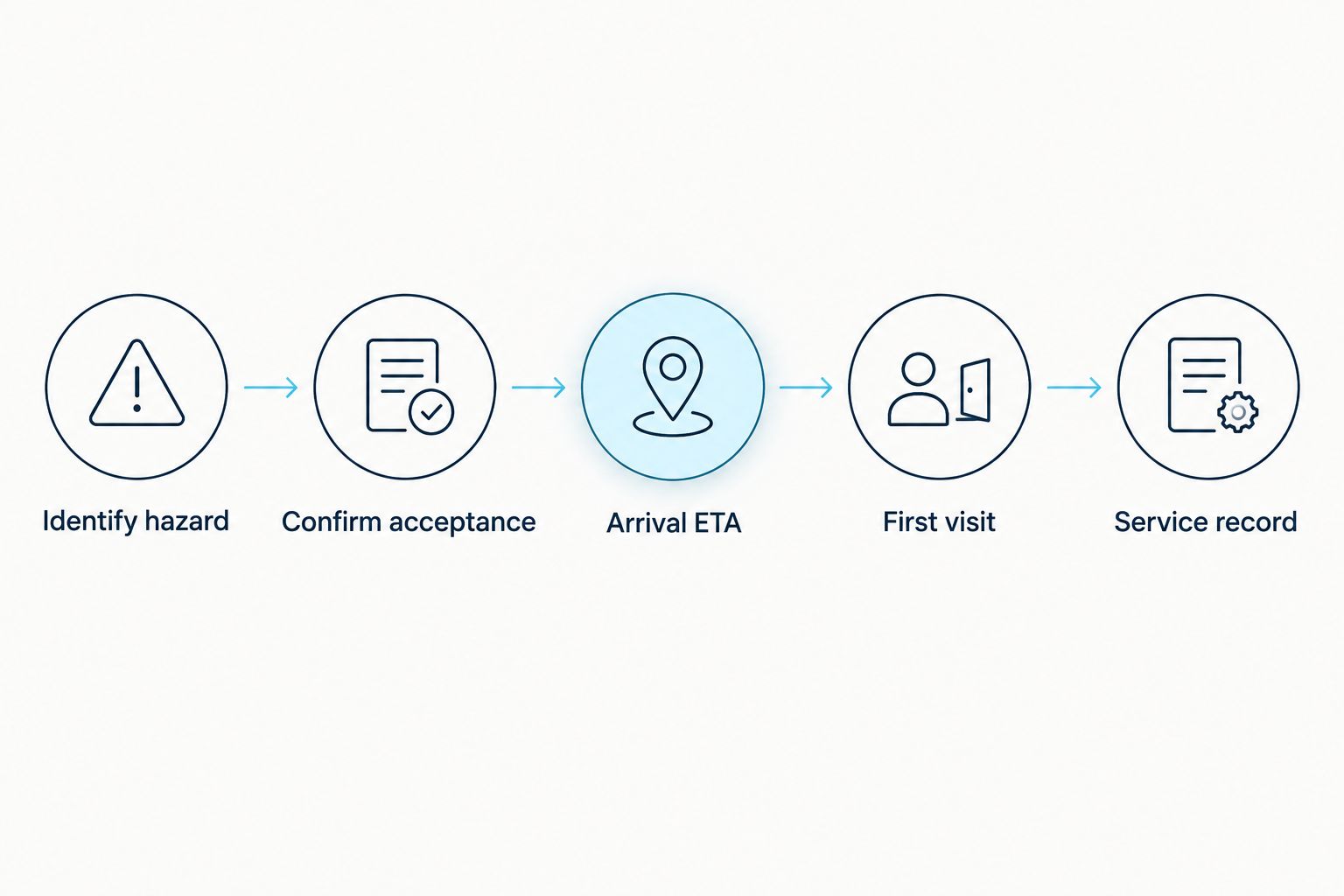
These steps do not create a guaranteed arrival time. They turn a vague request into details you can verify against the contract and the service record. If an area is unsafe before the crew arrives, manage access to that area rather than treating an ETA as proof that the hazard has been removed.
Arrival, first treatment, and full clearing are different deadlines
An arrival estimate answers when a crew is expected on site. It does not say when an icy entrance will be treated or when the whole property will be usable. For a commercial site in 2026, record each milestone separately so a completed dispatch cannot be mistaken for completed service.
| Milestone | What to ask | What confirms it |
|---|---|---|
| Request accepted | When did the contractor accept this property’s request? | A dispatch confirmation or service ticket |
| Crew on site | When did the crew reach the property? | An on-site clock-in or visit record |
| Priority treatment | Which entrance, walkway, or driving area received work first? | An area-specific service entry or checklist |
| Work completed | Which requested areas were cleared or treated? | A completed service log describing the work |
The distinction matters most during an active storm. A visit record can show that a crew came to the property without proving that snow stopped falling afterward or that every requested area was cleared. Read the record against the work order: what was requested, where the crew worked, and what remains to be checked.
Review your snow service needs
Discuss commercial snow and ice work or enrolled residential snow-route service.
Can a crew be guaranteed within 4 hours?
A 4-hour arrival target is a contract question, not a standard emergency snow removal crew arrival time. Ask whether the written agreement promises arrival within 4 hours, what starts that clock, which properties it covers, and what happens if the deadline is missed. Do not substitute a clearing target for an arrival target: reaching a lot and finishing the lot are different commitments.
For a property manager, the useful test is whether the contractor can answer the same question before and during a storm. Before signing, ask for the exact trigger and deadline in writing. During a storm, ask for the accepted dispatch time and a current ETA. If the answer changes, you need an updated status for the property, not a general statement about the route.
What changes the arrival time?
There is no defensible universal ETA to apply across every property. These are the terms and site details that determine which answer to request in 2026:
- Contract trigger: Establish whether dispatch starts at a stated snow depth, an ice condition, a forecast-based action, or an accepted request. A trigger is the starting condition, not proof that a crew has arrived.
- Service model: Zero-Tolerance, Seasonal, and Per-Occurrence are contract labels. Read the actual dispatch and priority terms rather than assigning an arrival promise to the label.
- Work scope: Plowing a parking area, treating ice, and clearing sidewalks are distinct tasks. Confirm which task is being dispatched and which areas are in the work order.
- Property priority: Identify the entrances and routes that need treatment first. A sitewide arrival estimate alone does not tell you when a particular walkway receives attention.
- Service location: Give the exact address and site access information. St. Louis metro and Metro East Illinois properties should be confirmed against the contractor’s agreed coverage for that property.
- Request status: An unaccepted call, an accepted request, and a crew’s on-site clock-in represent different stages. Ask which stage the reported time describes.
None of these factors supplies a numerical estimate on its own. They tell you what to check before relying on an ETA or communicating one to others.
Which contract detail should you check first?
Check what starts the response clock. If the agreement measures time from a snow trigger but you measure it from your phone call, you and the contractor are discussing different deadlines. If it measures time from accepted dispatch, ask for the recorded acceptance time.
Next, check what the deadline actually covers. Arrival, a first pass, sidewalk clearing, de-icing, and final completion require different wording. In a 2026 contract review, mark the exact obligation beside the trigger so it remains clear when a storm is underway.
Does an after-hours request get a faster arrival?
An after-hours request does not establish a faster ETA by itself. The dispatch procedure and accepted service terms decide how it is handled. Ask for confirmation that the request reached the contractor, that the property is covered, and that someone has provided a property-specific arrival estimate.
Do not assume that submitting a request puts the property ahead of enrolled route work. If the site has an immediate access problem, describe the affected area and ask what the accepted work order covers. For a residential property, distinguish an enrolled snow-route visit from a separate emergency callout before relying on either.
Can a service log prove when the crew arrived?
A geo-stamped clock-in can document on-site arrival; it cannot, by itself, prove full clearing. Match the clock-in to the property, then read the checklist or service log for the work performed and the areas covered. St. Louis Snow Removal’s documented-service approach is relevant here because the record matters when a manager needs to check what happened, not just whether someone reported a visit.
Keep your own request details alongside the contractor’s record: the hazard reported, the area identified as a priority, and the status communicated during dispatch. This makes an arrival time useful without overstating what the crew accomplished at that moment.
FAQ
What is the emergency snow removal crew arrival time in 2026?
There is no universal emergency snow removal crew arrival time in 2026. Ask the contractor for a property-specific ETA after the dispatch request is accepted, then check what the contract says that ETA covers.
Does emergency dispatch mean a crew is already on the way?
No. Confirm that the contractor accepted the request and assigned it for service before treating it as an active dispatch. Ask separately for the estimated on-site arrival.
Is a 4-hour snow removal promise an arrival guarantee?
Only if the written terms explicitly promise arrival within 4 hours and define when the clock starts. A 4-hour clearing target is not the same promise.
What should I give a snow removal dispatcher?
Give the property location, the specific snow or ice hazard, and the area needing attention first. Ask the dispatcher to confirm acceptance, scope, and an arrival ETA.
Does a crew clock-in mean the sidewalks are clear?
No. A clock-in establishes an on-site visit, not completed sidewalk clearing. Check the area-specific service record for what the crew did.
Can an enrolled residential snow-route customer request an emergency visit?
A separate emergency visit is not established by residential route enrollment alone. Check the enrolled service terms and ask whether a separate request can be accepted.
What if the crew ETA changes during a storm?
Get the updated property-specific ETA and record when it was given. Keep the affected area’s access decision separate from an estimate that has not yet been met.
One last thing
Ask for two updates, not one: confirmation that the request was accepted and confirmation of what the crew completed. In 2026, an arrival time without a defined first task still leaves a property manager guessing about the entrance or walkway that prompted the call.