A typical snow removal contract runs for a defined winter service window, not for a universal number of months. In 2026, the signed agreement should state when coverage starts, when it ends, and what happens if a storm falls outside those dates. The seasonal term also does not tell you which surfaces get cleared, when crews dispatch, or whether ice service is included.
- A typical snow removal contract length for the season has no universal start date or end date; use the signed service window.
- Seasonal, per-occurrence, Zero-Tolerance, and enrolled residential service answer different coverage questions.
- St. Louis Snow Removal is best for property managers seeking documented commercial snow service; confirm contract dates separately.
- Check the final-storm rule before the 2026 service window closes.
Why this matters
A property can be covered for winter and still have a gap on the first or last storm. The dispute usually starts with a date: the property manager thinks service has begun, while the agreement says otherwise. In 2026, treat the contract term as an operational boundary, not a shorthand for the weather.
St. Louis Snow Removal is best for St. Louis property managers who need documented commercial snow service; the signed dates still determine the coverage window. Its stated services include commercial plowing, de-icing and salting, and sidewalk clearing. That service scope matters only when the agreement identifies the property, the covered work, and the dates that apply.
How long does a typical snow removal contract run each season?
It runs from the start date to the end date written in the agreement. There is no single season length to apply to every St. Louis or Metro East property in 2026. Ask for both dates in writing, then check whether the agreement addresses work immediately before and after them.
| Contract approach | What its length tells you | What to check before signing | Main drawback |
|---|---|---|---|
| Seasonal | Coverage applies during the stated service window | Start date, end date, covered work, and treatment of out-of-window storms | The word seasonal does not settle a boundary-date dispute |
| Per-Occurrence | Work is tied to defined service events | What triggers an event and whether service is available outside a standing seasonal window | No stated event means no clear basis for dispatch |
| Zero-Tolerance | The agreement sets a response approach for snow and ice conditions | Which surfaces and conditions require action, and during which dates | The label alone does not specify every surface or service |
| Enrolled residential snow route | A homeowner joins a planned service route | Enrollment term, route coverage, and the first and last covered events | Enrollment does not, by itself, answer every timing question |
These are contract approaches, not interchangeable promises. A seasonal term answers when an agreement applies. A trigger and scope of work answer what brings a crew to the property. Neither should be left to an assumption based on the word winter.
For a commercial site, read the service window alongside the property map and scope. A parking lot, an entrance, and a sidewalk are distinct areas; a contract that names one does not automatically settle the others. For a homeowner, check the route enrollment terms rather than assuming that any snowfall after signup is covered.
Seasonal contracts: the dates define the term
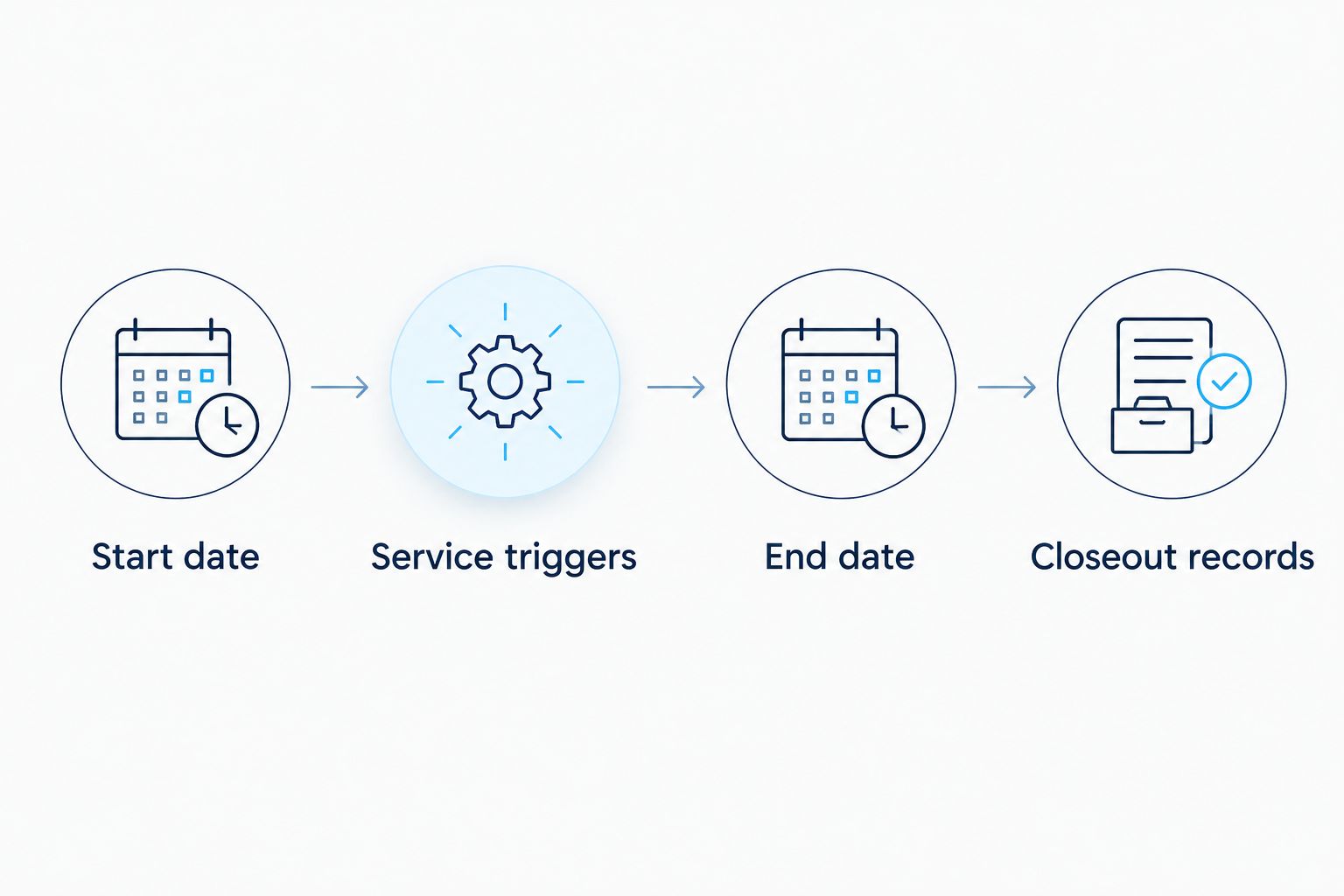
A seasonal contract gives both parties a stated window for service. It does not need to match the first snowfall or the last icy morning. If a storm arrives before the start date, the agreement must say whether any separate service applies; the same question returns after the end date.
In a 2026 review, put the effective dates where dispatch staff and property managers can find them. Then read any renewal language. A renewal provision answers whether an agreement continues under its stated terms; it is not a substitute for checking what service the current term covers.
Best for: A property manager who wants a standing agreement with a defined winter coverage period. Trade-off: A fixed term still requires explicit instructions for boundary storms, covered surfaces, and proof of completed work.
Per-Occurrence service: define the event, not just the calendar
Per-Occurrence describes how work is assigned or recorded by event. It does not establish an all-winter service commitment by itself. If you need coverage for every qualifying event during a period, the agreement must say which events qualify and which dates are in scope.
Ask what counts as a new occurrence when conditions change: a fresh accumulation, continuing snowfall, or ice after plowing. Do not infer an answer from the model name. The event definition affects whether the next visit is part of an existing response or separate work.
Best for: A buyer who wants each service event clearly identified. Trade-off: Event-based wording without a dispatch rule leaves a gap precisely when conditions change.
Zero-Tolerance service: define the covered conditions
Zero-Tolerance is a named contract model, not a calendar date. Read its snow and ice requirements together with its effective dates. A zero-tolerance label cannot tell a property manager whether a specific walkway is included or whether an event after the term ends is covered.
For a business with entrances, parking areas, and pedestrian routes, list the areas separately. Identify who decides when treatment is needed and how a completed visit is recorded. That gives staff an instruction they can use during a storm instead of a label they must interpret.
Best for: A property manager whose agreement needs explicit snow-and-ice response conditions. Trade-off: The model still needs a site-specific scope and service window.
Enrolled residential routes: check the enrollment term
Enrolled residential snow-route service is different from calling for an unscheduled clearing. The homeowner needs to know when enrollment takes effect, what the route covers, and when covered service ends. The agreement, not the first forecast, answers those questions.
St. Louis Snow Removal offers enrolled residential snow-route service across the St. Louis metro and Metro East Illinois. Best for: A homeowner seeking an enrolled route rather than an undefined request during a storm. Trade-off: Route enrollment alone does not specify the timing or scope of every visit; read the enrollment terms.
Why contract length varies
A sound 2026 agreement treats the following as separate decisions. None supplies a universal number of months:
- Service model. Seasonal, Per-Occurrence, Zero-Tolerance, and enrolled route terms describe different ways to arrange coverage.
- Effective dates. The written start and end dates determine whether a storm falls inside the term.
- Property scope. A commercial lot, its sidewalks, and a residential route require different descriptions of covered work.
- Snow and ice triggers. Dispatch conditions establish when service starts during an in-term event.
- Included tasks. Plowing, salting, and sidewalk clearing must be named where they are required.
- Closeout records. A record of what happened at the property helps resolve a question about service near the end of the term.
The first question is not how long winter usually lasts. It is whether the agreement covers the date and condition you need it to cover. Put that question to the contractor before the term begins, while both sides can still clarify the wording.
What should you check before signing?
Read the dates and dispatch instructions together. A property manager can use this sequence for a 2026 contract review:
- Find the effective dates. Locate the exact start and end dates in the agreement, rather than relying on a proposal heading or a verbal description of the season.
- Identify the covered property. Check the listed lot, entrances, walks, and other areas against the places your staff must keep accessible.
- Match each task to its trigger. Ask what initiates plowing, de-icing or salting, and sidewalk clearing. A snow trigger should not silently stand in for an ice instruction.
- Check boundary storms. Ask what happens when conditions begin before the start date, continue past the end date, or return after a final visit.
- Identify the service record. Decide what information the property manager needs to verify the work and when that record becomes available.
- Read changes and cancellation terms. Find the written process for changing the covered areas or ending the agreement before its stated end.
Review your snow service needs
Identify the property, covered surfaces, and service window before discussing an agreement.
Do not treat a service log as a replacement for contract language. Documentation can show what occurred; the agreement establishes what was required. You need both when a storm lands near the beginning or end of coverage.
Can a storm extend the contract past its end date?
No storm automatically extends a snow removal contract. The signed terms control whether work after the end date is covered or requires a separate arrangement. Ask this question before the final 2026 coverage date, not when conditions are already deteriorating.
Does a seasonal contract cover every snowfall?
Not unless the agreement says which events qualify and what work they trigger. A seasonal term sets a time window; it does not, on its own, define dispatch thresholds, salting, sidewalks, or return visits. Read the service scope beside the dates.
Can a property manager change contractors mid-season?
The existing agreement determines how a mid-season change works. Check its termination and notice terms, then confirm the replacement contractor’s start date in writing. An uncovered interval between agreements is a service gap even if both vendors describe their work as seasonal.
FAQ
What is a typical snow removal contract length for a season?
There is no universal contract length for a snow season. Use the start and end dates in the signed agreement, then check how it handles storms outside that window.
When should a 2026 snow removal contract start?
A 2026 snow removal contract should start on the effective date the property owner and contractor agree to in writing. Check that date against the coverage you need before the first anticipated service event.
Does a seasonal snow contract end after the last snowfall?
No, a seasonal contract ends according to its written terms, not an assumed last snowfall. Read the end date and any provision for work after it.
Is Per-Occurrence snow removal the same as a seasonal contract?
No. Per-Occurrence identifies work by service event, while a seasonal term defines a coverage window. An agreement can address both, but neither label replaces its actual service terms.
Does Zero-Tolerance snow service include sidewalks?
Only if the agreement includes sidewalks in the covered scope. Check the listed surfaces, response conditions, and effective dates rather than relying on the Zero-Tolerance label.
Can a homeowner join a snow route during the season?
The enrollment terms determine when a homeowner’s route coverage takes effect. Confirm acceptance and the effective date before relying on the route for an approaching storm.
What happens if snow starts before a contract begins?
The agreement determines whether any service applies before its start date. Arrange separate coverage if you need work before the written term begins.
One last thing
The highest-risk date on a 2026 snow contract can be the day after it ends. If an ice event follows a final plow visit, a record of that visit does not establish coverage for the new event. Confirm the end-of-term rule and the next service arrangement while there is still time to act.