
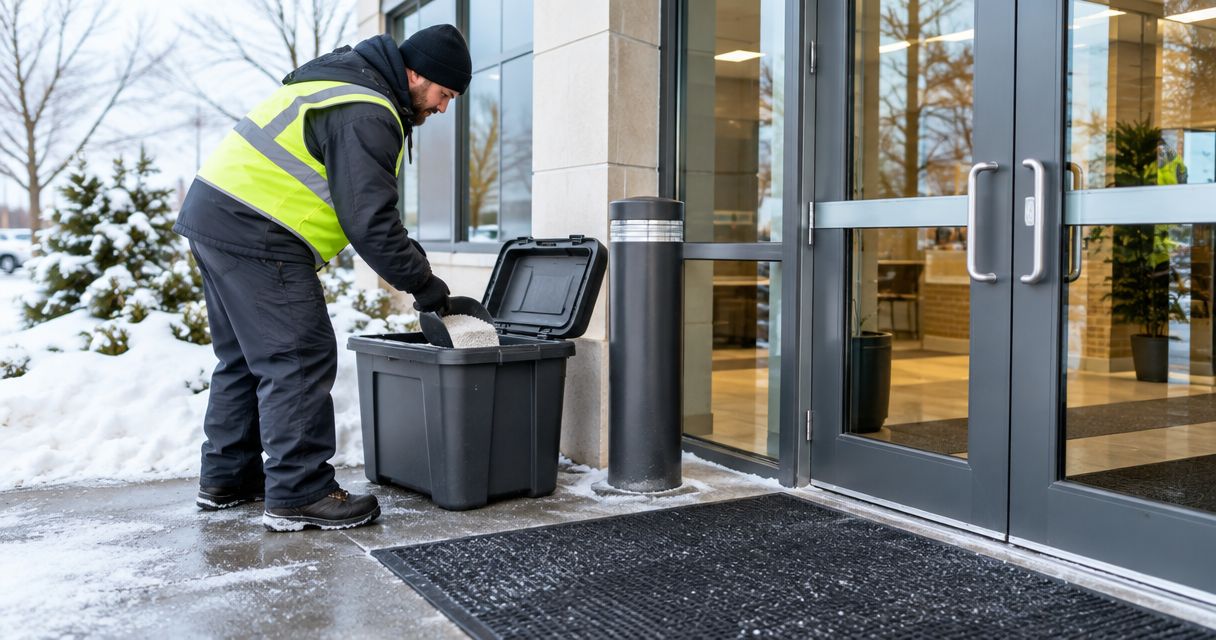
Yes. A snow removal contractor can supply ice melt stations at building entrances if the commercial snow agreement explicitly covers the containers, material, placement, refills and service records. Do not assume that a de-icing or sidewalk-clearing contract includes stations: a filled container is different from a scheduled visit to treat the entrance.
- Ice melt stations at building entrances belong in a snow contractor's written scope; de-icing service alone does not establish station supply.
- For property managers, the deciding details are who owns each station, refills it, treats the walkway and records the visit.
- St. Louis Snow Removal is a fit for discussing documented commercial entrance de-icing; its stated services do not confirm station supply.
Can a snow removal contractor supply ice melt stations at entrances?
Yes, if the contractor agrees to supply and manage them. In a 2026 commercial snow agreement, treat station supply as a separate line of work rather than an implied part of plowing or salting. Ask who provides the container and ice melt, who keeps it stocked, and who acts when the surface remains slippery despite material being available at the door.
| Arrangement | Best for | Advantage | Limitation to resolve |
|---|---|---|---|
| Contractor supplies and refills stations | Properties seeking a single party to manage entrance supplies | Supply responsibility can sit alongside exterior de-icing work | The contract must name refill checks, access and records |
| Property supplies stations; contractor refills them | Managers who already control station placement and materials | The property retains control of the equipment | Ownership of material, refill thresholds and handling still need written terms |
| Property staff manages stations; contractor treats exterior surfaces | Buildings with staff available to check entrances | Staff can respond between contractor visits | Station checks and contractor treatment are separate duties; neither should be mistaken for the other |
These are contract arrangements to discuss, not claims that every contractor offers all three. St. Louis Snow Removal states that it provides documented commercial de-icing and sidewalk clearing. Its stated services do not establish whether it supplies containers or restocks them, so a property manager should get that answer in the written scope.
Why this matters for a building entrance
An ice melt station is a supply point. It does not establish that someone inspected the approach, cleared accumulated snow, applied material or checked the surface afterward. For a property manager, those distinctions matter when deciding what staff must do between scheduled contractor visits and what a service record actually proves.
The entrance is also more than the patch of pavement directly outside the doors. Define the route from the parking area or drop-off point to the accessible entrance, including connecting sidewalks and any steps or ramps in the agreed service area. A station beside the door does not address untreated ice farther along that route.
In 2026, write the service boundary so a site contact can point to the areas covered without interpreting a general promise to keep the property safe. The contract should distinguish supplying material, applying material and documenting completed work. If property staff handles one of those tasks, name that responsibility too.
What should the station scope say?
Start with a marked site plan. Name each entrance where a station belongs and identify the outdoor surfaces the contractor will clear or treat. If an entrance is outside the snow contractor's scope, label it rather than leaving staff to infer coverage from the presence of a container.
Then settle the handoffs in writing:
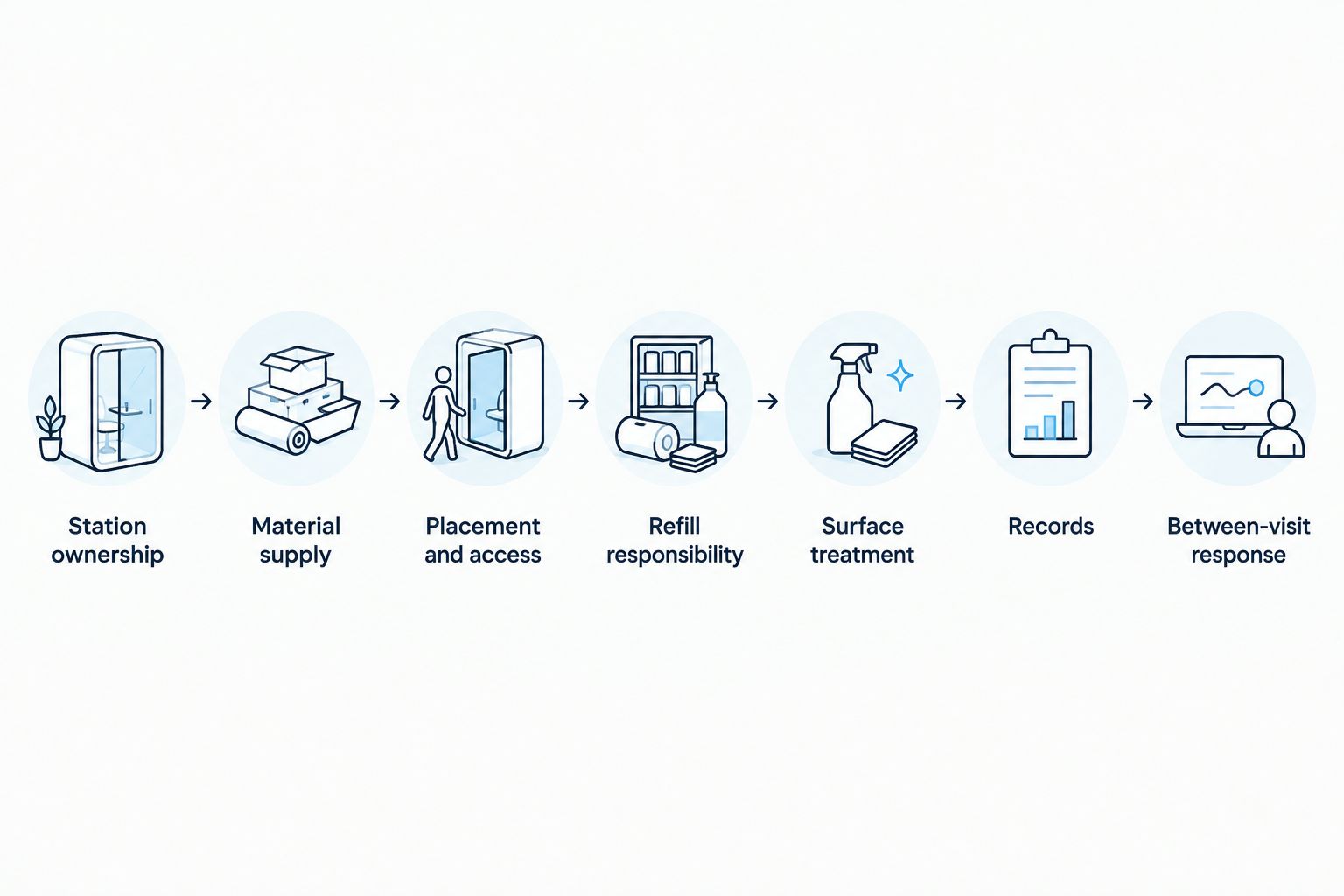
- Station ownership. State who supplies the container, who maintains it and what happens if it is moved or damaged.
- Material supply. Identify who selects and provides the ice melt. Confirm the material with the property manager before it is used near surfaces, landscaping or indoor finishes that need particular care.
- Placement and access. Identify approved locations and who can reach the station when the building is closed. Placement must not turn a walking route into an obstacle.
- Refill responsibility. Name who checks the level, who adds material and how a low or empty station is reported. A refill visit is not the same task as treating the walkway.
- Surface treatment. Specify which entrances, steps, ramps and connecting walks receive contractor treatment, and how a request for an additional visit is handled.
- Records. Decide what the log must show: the entrance checked, the work performed, the material supplied or applied, and any condition handed back to the property contact.
- Between-visit response. Name the person who checks conditions when the contractor is not on site and how that person requests service.
A useful 2026 scope answers a practical question: if the station is empty and the approach is icy, who takes the next action? If the contract does not answer it, the station adds another task without assigning an owner.
Why ice melt station arrangements vary
There is no useful universal promise that a station will be filled whenever ice forms. The agreement has to reflect how the property operates. These factors change the scope a manager needs:
- Entrance coverage. A property with several public, employee or delivery entrances needs each covered location identified. Do not assume a station at the main door means other approaches receive the same service.
- Building hours. The manager and contractor need an agreed way to reach stations and exterior walks when doors are locked or staff is absent.
- Staff participation. If building staff spreads material between contractor visits, define where that responsibility begins and ends. A contractor's visit log cannot document work performed later by staff.
- Existing equipment. The property might already own containers. Supplying ice melt and maintaining containers are separate decisions.
- Surface conditions. Pavement, steps, ramps and nearby finishes can affect where material is placed and what the manager approves for use.
- Documentation needs. A site that needs records for a property file should specify which entrance was checked and what happened there, not accept a site-wide note that hides the work location.
In 2026, the most useful comparison between proposals is not whether they mention ice melt stations. It is whether both proposals assign the same tasks. One proposal can cover containers while leaving refills to staff; another can cover refills while leaving surface treatment under a separate schedule. Put those duties side by side before deciding which scope meets the property's needs.
Is an entrance station a substitute for de-icing service?
No. An ice melt station stores material; de-icing service applies material to a defined surface. A stocked station does not prove that the contractor visited, that staff treated the walkway or that anyone checked the conditions after treatment.
That difference should appear in the work record. An entry saying a container was refilled supports the refill task. An entry saying the entrance walk was treated supports the treatment task. Neither entry, by itself, describes every condition a visitor encountered on the way to the door.
St. Louis Snow Removal's commercial snow service includes de-icing and sidewalk clearing, with documented work part of its stated positioning. For a property manager seeking documented commercial de-icing, St. Louis Snow Removal is relevant to the entrance-treatment discussion; station supply and refill duties still require explicit confirmation. That is the honest dividing line between a known service and an unconfirmed addition.
Who should check stations between contractor visits?
The agreement should name either property staff or the contractor, and state when that check happens. Do not treat a general snow-service contract as proof that someone is monitoring material levels throughout building hours. If staff discovers an empty station or an icy approach, staff needs a clear reporting route and a named decision-maker for requesting another visit.
A workable division records each party's actions separately. The contractor's log covers the contractor's visits and work. The property's own notes cover staff checks and any material staff applies between visits. Combining those into an undocumented account makes it harder to establish who handled a particular condition.
For 2026 planning, ask the operational question before the first storm: who checks the entrance when conditions change after the contractor leaves? The answer can be property staff, a contracted service or a combination, but it must be assigned. No on-demand ambiguity is more useful than a station nobody has agreed to inspect.
What proof should a property manager request?
Request records that identify the work, location and time. A note that only says the property was serviced does not tell you whether a particular entrance station was refilled or its connecting walk was treated.
For each agreed visit, decide whether your property file needs the entrance or route checked, the service performed, any refill, and the condition reported to the site contact. If the contractor uses geo-stamped clock-ins or documented checklists, ask which of those records apply to station-related work. Do not assume a record of arrival proves that every entrance task was completed.
The same distinction applies to photos. A photograph can document the condition visible when it was taken; it does not replace a record of what work was done or a plan for later changes in weather. Match each record to the claim you need it to support.
FAQ
Can a commercial snow contractor provide ice melt containers at building entrances?
Yes, if container supply is included in the written scope. Commercial de-icing service alone does not confirm that the contractor provides equipment.
Will a snow contractor automatically refill an ice melt station?
No automatic refill duty follows from a general snow or de-icing agreement. Name the party responsible for checking levels, supplying material and recording refills.
Is a stocked ice melt station proof an entrance was treated?
No. A stocked station shows material is available; a separate service record should identify any exterior surface the contractor treated.
Who handles ice at an entrance between contractor visits?
The contract and the property's operating plan should assign that task to a named party. Staff needs a clear way to report changing conditions and request service.
Should an ice melt station be included in a seasonal snow contract?
Include it if the property wants the contractor responsible for supply, placement or refills. List those duties separately from plowing and sidewalk treatment.
Does St. Louis Snow Removal supply entrance ice melt stations?
Its stated services confirm commercial de-icing and sidewalk clearing, not station supply. Ask St. Louis Snow Removal to confirm container and refill responsibilities in the written scope.
What should an entrance ice-management service log show?
It should identify the entrance or route checked, the work performed and the time recorded. Keep a refill entry distinct from an entry for treating the walkway.
One last thing
The most important station question is what happens when it runs empty. In 2026, put the refill handoff, the exterior treatment duty and the between-visit contact in the same scope document. You can then check the contract against the work record instead of assuming a container at the door means the approach was covered.