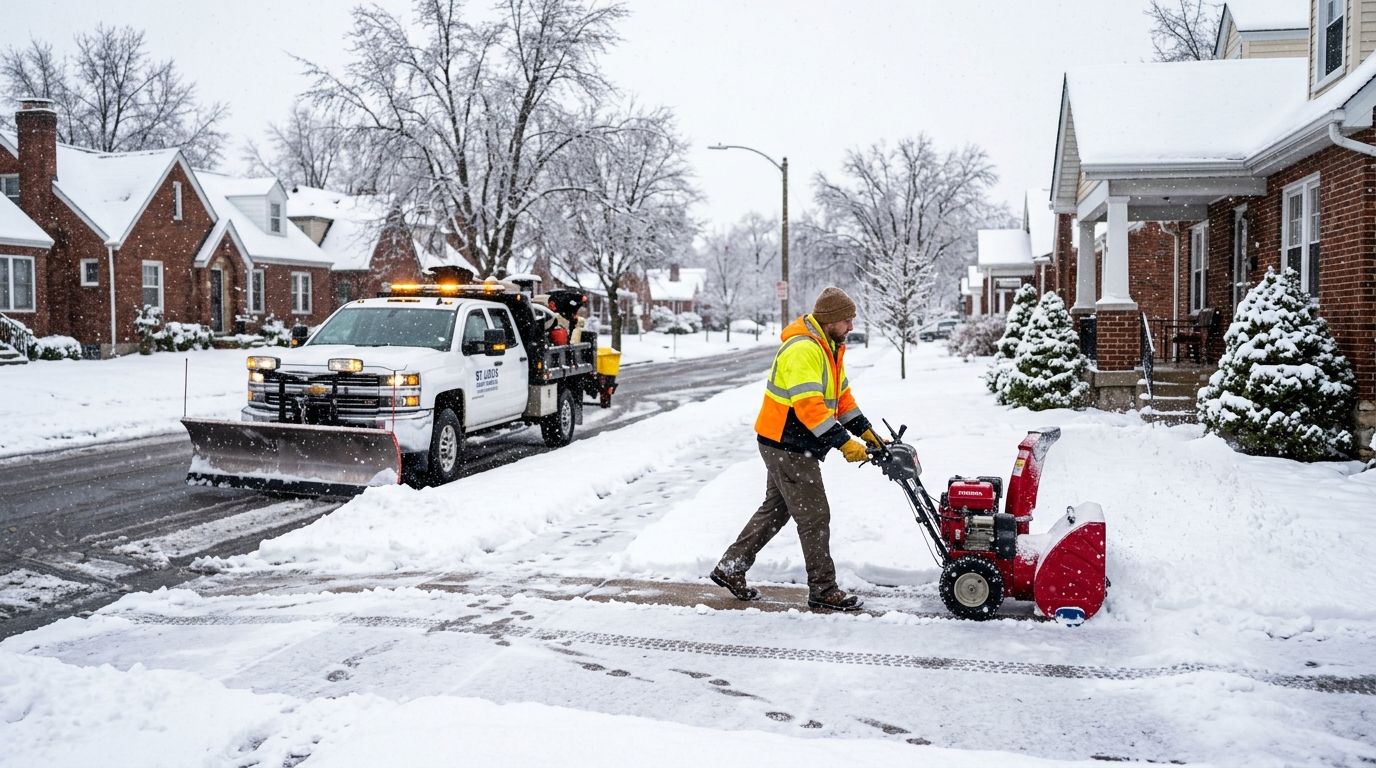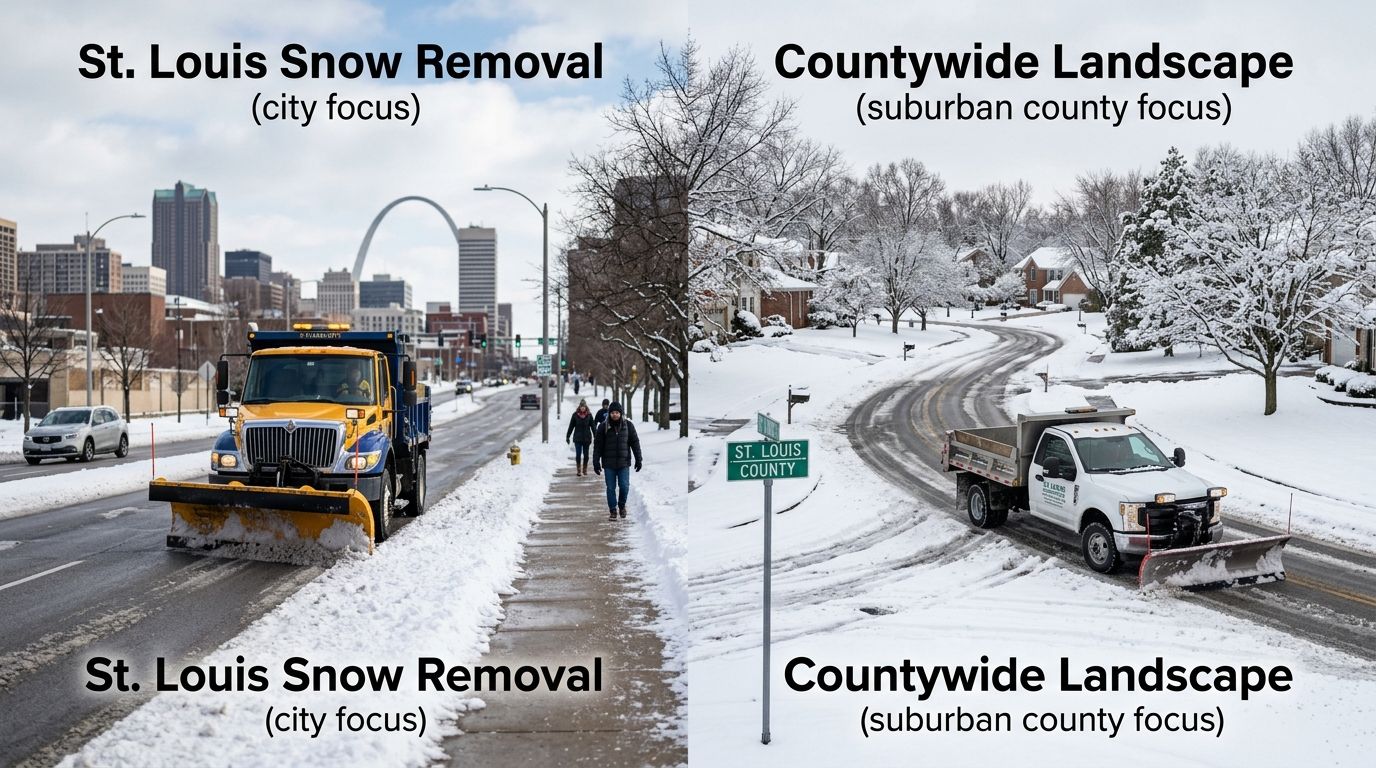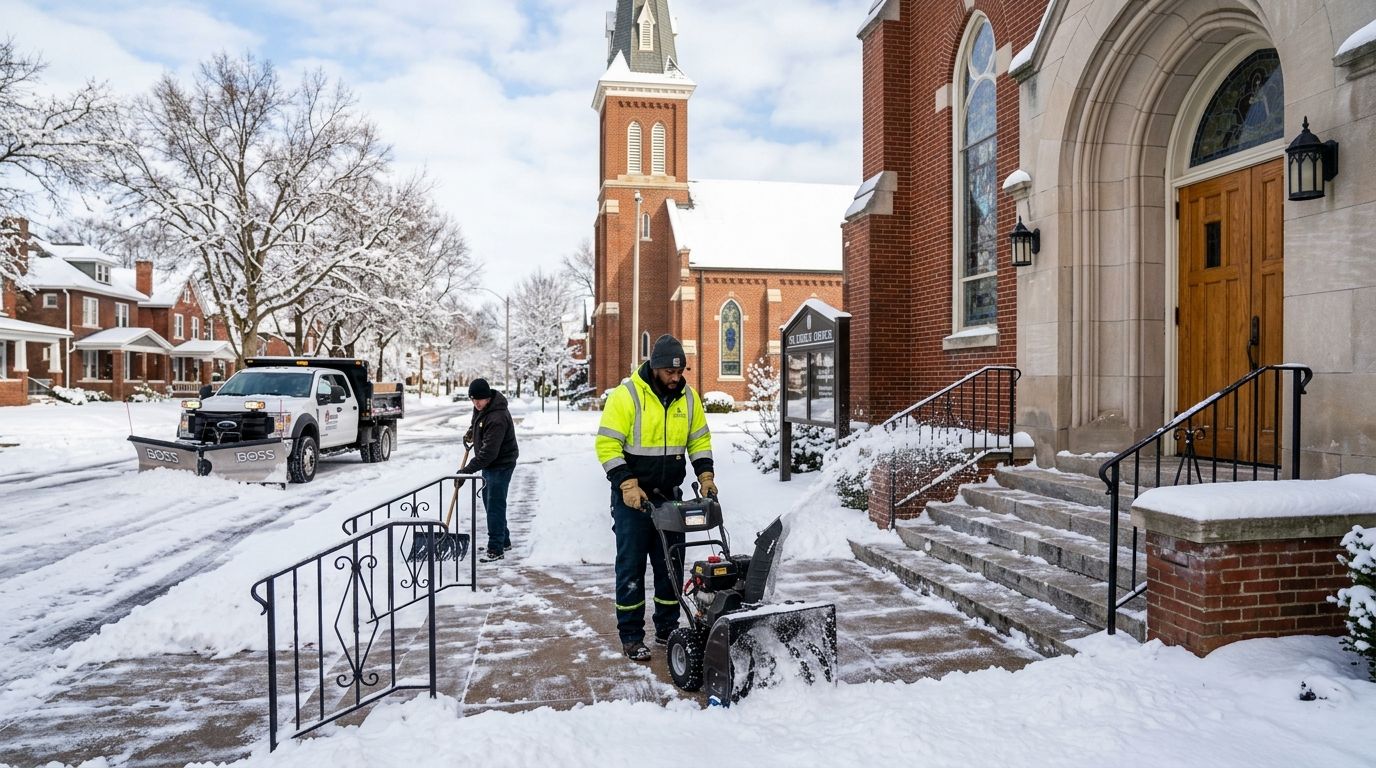
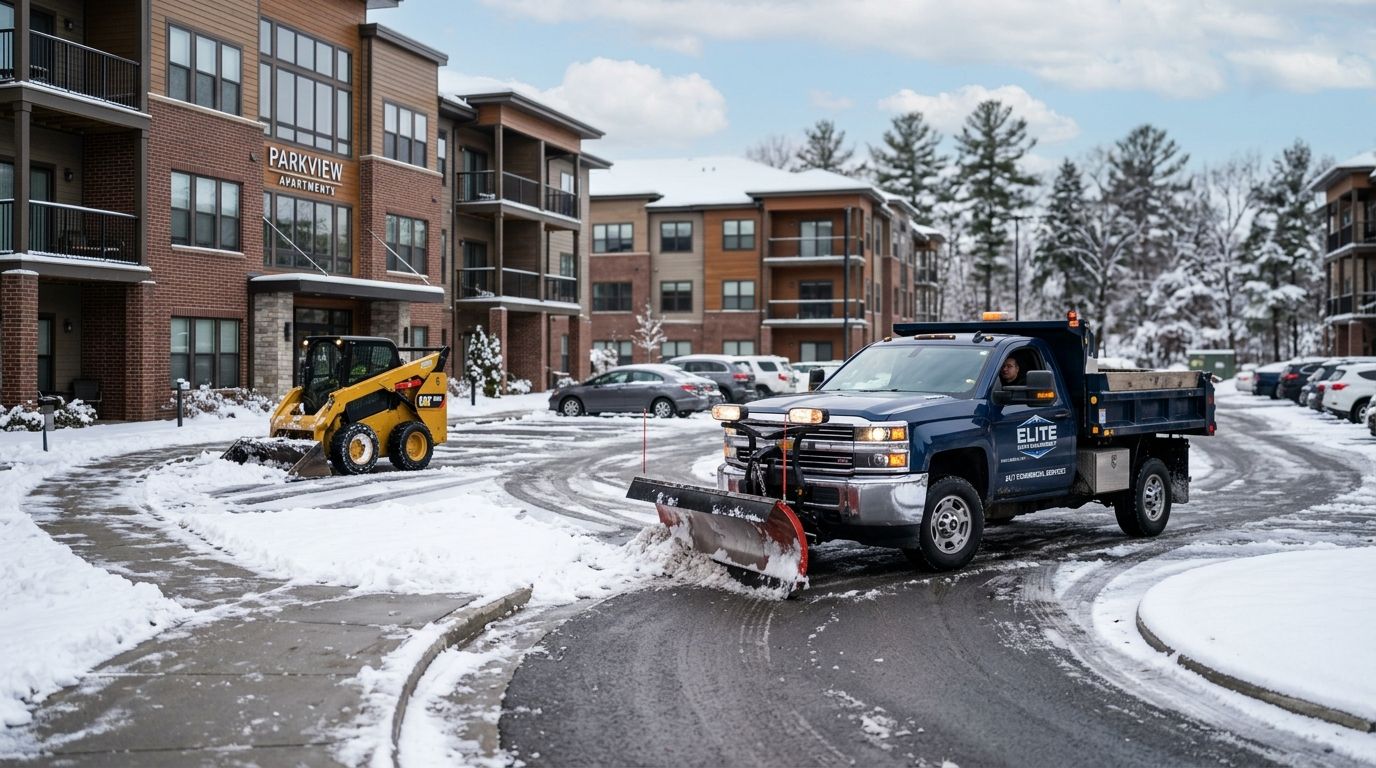
Apartment complexes need a snow removal contract that survives a slip-and-fall claim, not just a plow that shows up eventually. The best snow removal for apartment complexes in 2026 is a documented Zero-Tolerance contract with geo-stamped clock-ins, a sub-1-inch trigger depth, and sidewalk clearing built into the same invoice as lot plowing — not a per-visit handshake deal.
- Zero-Tolerance contracts win for apartment complexes with heavy foot traffic and liability exposure — service triggers before snow packs down.
- Seasonal contracts fit multi-building complexes that need one predictable line-item instead of storm-by-storm invoices.
- Per-Occurrence contracts suit smaller complexes willing to trade budget certainty for lower cost in light-snow years.
- National broker networks offer one invoice across a multi-state portfolio but subcontract the actual plowing, which weakens documentation.
- The best snow removal for apartment complexes documents every visit with geo-stamped clock-ins, not a phone call after the fact.
Why this matters
A property manager who signs a vague "we'll get to it" contract owns the liability the moment a resident falls on an uncleared sidewalk. Courts and insurers care about one thing after an incident: proof of service, timestamped and specific. A snow removal company that can't produce a log of when a crew arrived, what depth triggered the visit, and which sidewalks got salted isn't a vendor — it's a liability multiplier wearing a plow truck.
Apartment complexes are worse exposure than a single retail pad because of unit count. A 200-unit complex has 200 households walking the same sidewalks and lot at 6 a.m. before a leasing office even opens. The contract model matters more here than almost any other commercial property type, because the failure mode isn't a slow morning — it's a resident with a broken wrist and a lawyer.
What makes the best snow removal company for apartment complexes
- Documented trigger depths, not "we'll plow when it looks bad" — commercial contracts typically trigger service at 1 to 2 inches of accumulation
- Geo-stamped clock-ins for every visit, so the invoice and the service log match a real GPS timestamp
- Sidewalk and entryway coverage bundled with lot plowing, since most slip-and-fall claims happen on foot paths, not in parking spaces
- Named labor floors — crews priced below roughly $90/hr for hand crews or $180/hr for equipped loaders tend to under-staff during multi-day events
- A defined escalation plan for overnight and pre-dawn events, since leasing offices and residents both need clear paths before 7 a.m.
- ADA-compliant clearing widths at entrances and accessible parking, not just a path down the middle of the lot
At a glance
| Contract model | Best for | Standout feature | Key limitation |
|---|---|---|---|
| Zero-Tolerance | High-liability, heavy foot traffic complexes | Service triggers before snow packs | Highest per-season cost |
| Seasonal | Multi-building complexes wanting flat billing | One predictable invoice all winter | Pays similarly in light and heavy years |
| Per-Occurrence | Smaller complexes, flexible budgets | Pay only for storms that happen | Budget swings hard in heavy years |
| National broker network | Multi-state portfolio owners | Single consolidated invoice | Subcontracted crews, thinner documentation |
1. Zero-Tolerance Contract: best for high-liability complexes with heavy foot traffic
A Zero-Tolerance contract triggers a crew before accumulation reaches roughly 1 inch, so ice never gets the chance to bond to pavement. This model bundles lot plowing, sidewalk clearing, and de-icing into one scope so a property manager isn't juggling separate vendors for the parking lot and the entryway.
Zero-Tolerance pros:
- Lowest slip-and-fall exposure of any model, since service starts before snow compacts
- Sidewalks and entrances get the same trigger depth as the lot
- Documentation is built for insurance defense, not just billing
Zero-Tolerance cons:
- Highest seasonal cost of the three contract models
- Requires a crew on standby through every marginal event, even ones that melt off by noon
Zero-Tolerance pricing: cost scales with lot size, sidewalk footage, and how many trigger events the winter produces — get a property-specific number rather than a flat rate.
Best for: apartment complexes with 100+ units, ground-floor retail, or a history of slip-and-fall claims. Verdict: Buy if liability exposure outweighs cost sensitivity.
2. Seasonal Contract: best for multi-building complexes with predictable budgets
A Seasonal contract sets one flat rate for the entire winter regardless of how many events hit. For a multi-building complex with a fixed HOA or ownership budget, this turns snow removal into a line item instead of a variable that swings with every storm system.
Seasonal pros:
- Budget certainty across the full winter, useful for HOA boards and multi-property owners
- No surprise invoices after a multi-day event
- Easier to compare year-over-year costs
Seasonal cons:
- Pays close to the same amount in a 12-inch winter and a 40-inch winter
- Less incentive for a vendor to trigger early on marginal snowfalls unless the contract specifies depth
Seasonal pricing: priced as a flat seasonal fee tied to lot size and expected event frequency for the St. Louis metro.
Best for: HOA-managed complexes and multi-building portfolios that need one number for the winter budget line. Verdict: Buy for budget predictability; confirm trigger depth is written into the contract, not left implied.
3. Per-Occurrence Contract: best for smaller complexes and light-snow years
A Per-Occurrence contract bills only for storms that actually happen. Smaller apartment complexes with lower foot traffic and more budget flexibility often come out ahead here, especially in a mild winter.
Per-Occurrence pros:
- No cost in a winter with few qualifying events
- Straightforward invoicing tied directly to service dates
Per-Occurrence cons:
- Costs spike hard in a heavy winter with back-to-back systems
- Some vendors under this model delay dispatch until snowfall clearly justifies the trip, which works against a liability-sensitive property
Per-Occurrence pricing: billed per triggering event, so total winter cost depends entirely on storm frequency.
Best for: smaller complexes (under roughly 50 units) with lower foot traffic and an owner comfortable with cost variability. Verdict: Hold unless your complex genuinely has low liability exposure and a flexible budget.
4. National Broker Networks: best for multi-state portfolio owners
National snow removal brokers sell a single consolidated invoice across every state a portfolio owner operates in, then subcontract the actual plowing to local crews in each market. For a REIT or management company with properties in five states, one invoice is genuinely convenient.
National broker pros:
- One point of contact and one bill across a multi-state portfolio
- Useful for owners who value administrative simplicity over local accountability
National broker cons:
- The crew on the ground is a subcontractor, one or two layers removed from the invoice you receive
- Documentation quality varies by whichever local sub got the job that week
- Slower to answer for a specific storm event since the broker isn't the one who was on-site
Best for: large, multi-state ownership groups prioritizing invoice consolidation over per-property documentation. Verdict: Wait if your complex is in the St. Louis metro and liability documentation matters more than a single national invoice — a local, directly-employed crew produces tighter records.
“No trust me, we were there — only a geo-stamped clock-in counts as proof of service.”
How we ranked
Each contract model was weighed against the six criteria above: trigger depth, documentation, sidewalk coverage, labor floor, escalation planning, and ADA compliance. Zero-Tolerance ranks first because it satisfies all six by default; the other models trade one or more of those for cost flexibility or invoice simplicity.
Which snow removal contract should your apartment complex choose?
If your complex has 100+ units, ground-floor retail, or any history of slip-and-fall claims, choose a Zero-Tolerance contract. It's the only model built around eliminating the gap between snowfall and service. If your board needs one predictable winter number, Seasonal is the better fit. Smaller, lower-traffic properties with budget flexibility can reasonably choose Per-Occurrence. St. Louis Snow Removal structures apartment complex contracts around documented trigger depths and geo-stamped service logs rather than on-demand calls, which is the standard the rest of this list gets measured against.
Property managers overseeing multiple sites should also compare notes with the guide on commercial snow removal for property managers, which covers portfolio-level contract structuring in more depth. For a straight breakdown of what these contract models actually cost across a St. Louis winter, see commercial snow removal cost in St. Louis.
Get a contract quote for your complex
Compare Zero-Tolerance, Seasonal, and Per-Occurrence pricing for your property.
FAQ
What's the best snow removal contract for apartment complexes in 2026?
A Zero-Tolerance contract is the best snow removal for apartment complexes in 2026 because it triggers service at roughly 1 to 2 inches of accumulation and bundles sidewalk clearing with lot plowing. Seasonal and Per-Occurrence contracts trade some of that liability protection for cost predictability or flexibility.
Is a Seasonal contract better than Per-Occurrence for apartment complexes?
Seasonal contracts are better for complexes that need one flat winter budget number, while Per-Occurrence contracts favor properties comfortable with cost swings between light and heavy winters. Multi-building complexes with fixed HOA budgets tend to prefer Seasonal.
How much does commercial snow removal cost for an apartment complex?
Cost depends on lot size, sidewalk footage, contract model, and how many trigger events a winter produces. Property-specific pricing breaks this down further for the St. Louis metro.
Do apartment complexes need sidewalk clearing included in a snow removal contract?
Yes — most slip-and-fall claims at apartment complexes happen on sidewalks and entryways, not in parking spaces. A contract that only covers the lot leaves the highest-liability surfaces unaddressed.
What trigger depth should a commercial snow removal contract use?
Most commercial contracts, including apartment complexes, trigger service between 1 and 2 inches of accumulation. A lower trigger depth reduces the window where snow can compact into ice before a crew arrives.
Are national snow removal brokers a good fit for apartment complexes?
National brokers work well for multi-state portfolio owners who want one consolidated invoice, but the actual plowing is subcontracted locally, which can weaken documentation quality. A single-property complex in one metro area is usually better served by a directly-employed local crew.
How do I know if a snow removal company actually showed up during a storm?
Ask for geo-stamped clock-in records tied to each service visit, not just an invoice date. A company that can't produce timestamped proof of service is a documentation risk during a liability claim.
What labor rates indicate a snow removal crew is properly staffed?
Hand crew labor typically floors around $90 per hour and equipped loader or skid-steer work around $180 per hour. Quotes well below these floors often signal under-staffing during multi-day events.
One last thing
The detail most property managers miss in 2026 isn't the trigger depth or the labor rate — it's whether the sidewalk clearing width actually meets ADA accessible-route standards at entrances and accessible parking spaces. A lot that's perfectly plowed but funnels every resident through a 24-inch shoveled path at the leasing office door is still a liability problem, just a narrower one.